Sign In
By signing in or creating an account, you agree with Associated Broadcasting Company's Terms & Conditions and Privacy Policy.
By signing in or creating an account, you agree with Associated Broadcasting Company's Terms & Conditions and Privacy Policy.


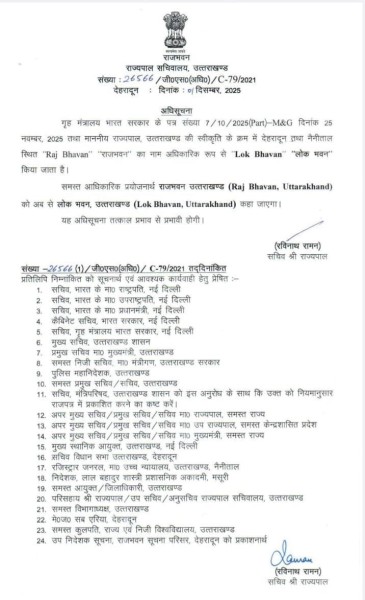
Dehradun: The Raj Bhavans of Uttarakhand have been given a new identity. From now on, the Raj Bhavans in Dehradun and Nainital will be known as Lok Bhavans.
The notification was issued on November 25, 2025, by the Ministry of Home Affairs, Government of India, with the approval of Governor Lieutenant General (Retd.) Gurmit Singh. The order was formally released by Ravinath Raman, Secretary to the Governor.
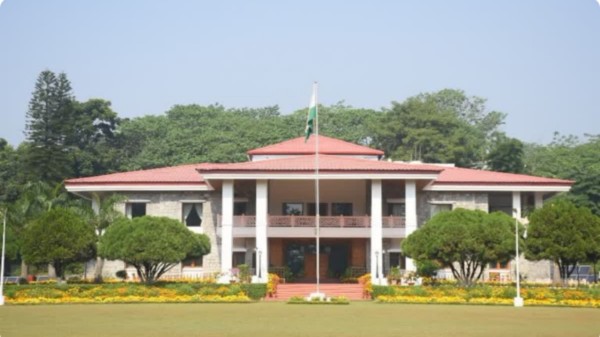
Significant change in the state’s administrative and cultural history
This renaming marks a significant change in the state’s administrative and cultural history. The Raj Bhavan in Dehradun, which came into existence after Uttarakhand (then Uttaranchal) was formed as India’s 27th state on November 9, 2000, will now be called Lok Bhavan Dehradun. Initially, the Raj Bhavan was set up at Bijapur House on New Cantt Road, but later the Circuit House was converted into the Raj Bhavan. The first Governor, Surjit Singh Barnala, occupied it on December 25, 2000.
Nainital Raj Bhavan, now Lok Bhavan Nainital, carries deeper historical significance
The Nainital Raj Bhavan, now Lok Bhavan Nainital, carries even deeper historical significance. Built during the British era, it recently completed 125 years. President Droupadi Murmu visited the site to mark its anniversary and appreciated its heritage. The foundation stone was laid on April 27, 1897, and the building was completed in March 1900 under the guidance of British Governor Sir Anthony Patrick MacDonald. The structure, designed in Western Gothic style, is shaped like the letter “E” and stands as a symbol of colonial architecture.

Nainital’s Raj Bhavan played a central role in governance during the British period
Nainital was once the summer capital of Uttar Pradesh, and the Raj Bhavan played a central role in governance during the British period. Earlier, temporary Raj Bhavans were set up at Ramsay Hospital campus (1862), Malden House (1865), and Snow View area (1875) before the permanent relocation to Sherwood House in 1897. Spread across 160 acres of dense forest, the Nainital Raj Bhavan also houses Asia’s highest golf course, built in 1925 over 75 acres.
For decades, the building remained restricted to officials, but in 1994, it was opened to locals and tourists, becoming a popular heritage site. With the new name Lok Bhavan, the government aims to give these historic structures a more people-centric identity, while preserving their cultural and architectural importance.