Sign In
By signing in or creating an account, you agree with Associated Broadcasting Company's Terms & Conditions and Privacy Policy.
By signing in or creating an account, you agree with Associated Broadcasting Company's Terms & Conditions and Privacy Policy.
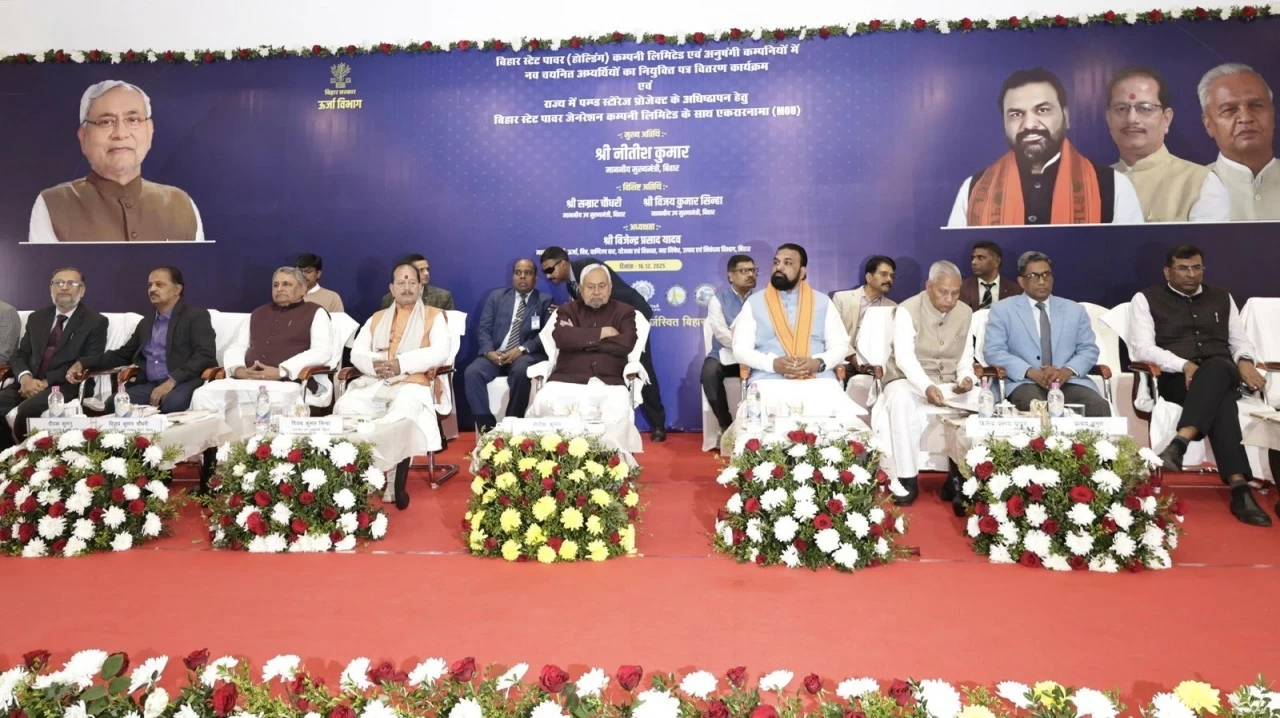

Patna: Bihar has launched a new project to bolster its energy security and accelerate its transition to clean power with a monumental investment in renewable energy. The Bihar State Power Generation Company Limited (BSPGCL) recently inked Memoranda of Understanding (MoUs) with two private developers, Greenko Energies Private Limited and Sun Petrochemicals Private Limited, to establish pumped storage power projects in Nawada district.
This landmark initiative, totalling a proposed investment of Rs 13,000 crore, marks the single largest renewable energy commitment in the state's history.
The Bedrock: Bihar's pump storage project promotion policy, 2025
At the heart of this transformative investment lies the Bihar's Pump Storage Project Promotion Policy, 2025. This policy framework has been specifically designed to attract and facilitate significant renewable energy projects in the state.
Key tenets of the policy include:
Objective of energy security: The primary goal of the policy is to strengthen Bihar's energy security by diversifying its power sources and reducing reliance on conventional, often polluting, alternatives.
Promotion of renewable energy: It actively promotes the development of renewable energy infrastructure, aligning with both state and national sustainability targets, including India's commitment to Net Zero emissions by 2070.
Structured developer selection: The policy dictates a transparent process for awarding projects. In this instance, BSPGCL, following the formal notification of the policy, selected Greenko Energies and Sun Petrochemicals to undertake these large-scale ventures.
Project details and technological approach: Under this policy, two substantial pumped storage projects will be developed. 1,200 MW will be developed at Ekamba (by Greenko Energies) and 920 MW at Gosaitari (by Sun Petrochemicals), collectively adding 2,120 MW of dispatchable renewable capacity to the grid.
A crucial aspect enshrined in the policy, as explained by Energy Department officials, is the emphasis on off-stream and closed-loop pumped storage systems. This sophisticated technology involves:
Water storage during monsoon: Water is strategically stored during the monsoon season, minimising dependence on continuous river flow.
Renewable power generation: This stored water is then utilised to generate electricity, ensuring a clean and sustainable power source.
Environmental preservation: Importantly, this closed-loop system is designed to have no adverse impact on the natural flow of rivers, mitigating ecological concerns.
Grid stability: The flexible nature of pumped storage, which can quickly respond to demand fluctuations, is vital for enhancing the overall stability and reliability of the state's electricity grid.
Financial model and commitment:
The policy framework clearly outlines a developer-driven financial model for these projects. The entire Rs 13,000 crore investment will be made by the private developers themselves. Greenko Energies is committing Rs 7,800 crore for the Ekamba project, while Sun Petrochemicals will invest Rs 5,200 crore in Gosaitari.
BSPGCL, as the state's nodal agency, is mandated by the policy to provide all necessary administrative and logistical support, ensuring a conducive environment for project execution. Both projects are targeted for completion within six years.
Broader economic vision:
Energy Minister Bijendra Prasad Yadav hailed this as the state's largest-ever renewable energy project, crediting Chief Minister Nitish Kumar's "visionary thinking." He affirmed the Energy Department's dedication to providing uninterrupted, clean electricity to Bihar's residents and industries, noting the state's consistent power supply over the past five years.
This private investment is not just about energy; it's presented as the "first tranche" towards Bihar's objective of attracting Rs 50 lakh crore in investments over the next five years, aiming for significant economic development and job creation.
The Minister reiterated an open invitation to investors, encouraging them to explore Bihar's "developing environment" and highlighting the government's commitment to both energy conservation and employment generation.
The signing event was graced by Chief Minister Nitish Kumar, Deputy Chief Ministers Samrat Chaudhary and Vijay Kumar Sinha, and Water Resources Minister Vijay Kumar Chaudhary.