
Sign In
By signing in or creating an account, you agree with Associated Broadcasting Company's Terms & Conditions and Privacy Policy.
By signing in or creating an account, you agree with Associated Broadcasting Company's Terms & Conditions and Privacy Policy.

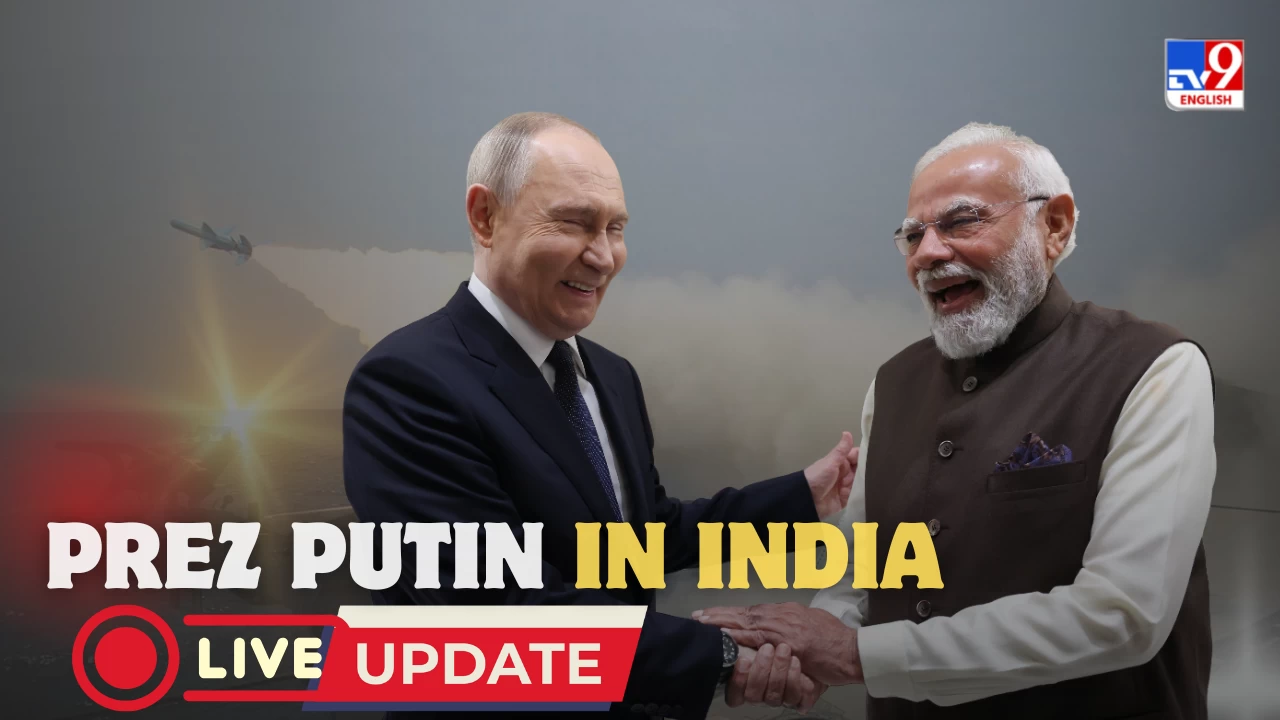
New Delhi: Russian President Vladimir Putin is all set to hold a summit meeting with PM Narendra Modi on Friday. The meeting is expected to yield a series of substantive agreements across trade, defence and wider strategic cooperation, reinforcing a partnership that both countries consider vital.
The visit comes at a delicate moment in India’s foreign policy landscape. New Delhi and Washington are experiencing one of their most difficult periods in nearly twenty years, following the United States’ decision to impose steep tariffs on a range of Indian exports. The American measures include a 50 per cent duty on several categories of Indian goods and a separate 25 per cent levy linked to India’s continued purchase of Russian crude oil.
Against this backdrop, Putin’s presence in India is seen as particularly significant. Both countries are likely to use the summit to signal the resilience of their long-standing ties and to explore ways of deepening cooperation at a time of shifting global alignments.
Stay with TV9 English for latest updates about the Russian President's India visit.
Coverage of Russian President Vladimir Putin’s two-day visit to India has ended. Stay tuned for detailed reports, analysis and key highlights.
Russian President Vladimir Putin departed from New Delhi on Friday evening, wrapping up his two-day visit to India that culminated with a state banquet at Rashtrapati Bhavan.
External Affairs Minister S Jaishankar was present at the Palam Technical Airport to see him off, marking the formal conclusion of the high-level engagement.
The main course offered Zafrani Paneer Roll, Palak Methi Mattar Saag, Achaari Baingan, Tandoori Bharwan Aloo and Yellow Dal Tadka, served with saffron–dry fruit pulao and Indian breads, followed by Badam Halwa, Kesar-Pista Kulfi and fresh fruits for dessert.
The meal began with Murungelai Chaaru broth before moving to gourmet starters, including Kashmiri Gucchi Doon Chetin, Kaale Chane ke Shikampuri kebabs and pelmeni-inspired vegetable jhol momos prepared in honour of the visiting Russian leader.
The state banquet at Rashtrapati Bhavan featured an all-vegetarian Indian thali for President Putin, showcasing regional depth and culinary sophistication. The carefully curated spread highlighted India’s hospitality and cultural tradition.
Russian President Vladimir Putin received a ceremonial welcome at Rashtrapati Bhavan on his arrival for the state banquet hosted in his honour by President Droupadi Murmu. The formal reception marked the culmination of his engagements on the second day of the visit.
President Droupadi Murmu received Russian President Vladimir Putin on his arrival at Rashtrapati Bhavan for the state banquet held in his honour. The ceremonial welcome marks one of the key concluding engagements of Putin’s two-day visit to India.
Economic cooperation emerged as the central theme of President Putin’s visit, with both sides describing the talks as highly productive. Officials said the outcomes and roadmap agreed today will further boost the India–Russia strategic partnership.
India and Russia have agreed to open new avenues for Indian workers in Russia’s IT and construction sectors. The announcement is expected to widen labour mobility and support workforce demand in key Russian industries.
Both sides have agreed to accelerate negotiations on the India–Eurasian Economic Union Free Trade Agreement. The move aims to strengthen trade ties and help address the current imbalance by boosting India’s exports to Russia.
A day after Rahul Gandhi accused the Narendra Modi government of abandoning the long-standing practice of including Opposition leaders in meetings with visiting foreign dignitaries, it has emerged that neither the Leader of the Opposition in the Lok Sabha nor Congress president Mallikarjun Kharge has been invited to the dinner being hosted for Russian President Vladimir Putin at Rashtrapati Bhavan tonight.
However, some media reports suggest that, party MP Shashi Tharoor has received an invitation to the event.
The development follows strong remarks from Rahul Gandhi, who alleged that the government was deliberately excluding the Opposition from key diplomatic engagements.
At a joint press briefing in Delhi, President Vladimir Putin thanked President Droupadi Murmu, Prime Minister Narendra Modi and the people of India for what he described as a warm and gracious welcome to the Russian delegation.
He said his dinner discussions with Modi were “very helpful” for advancing the countries’ Special and Privileged Strategic Partnership. Putin added that he and Modi have built a close working relationship, noting their recent interaction at the SCO Summit and their joint oversight of the Russia–India dialogue.
The Ukraine war featured prominently in this year’s India–Russia annual summit, which centres on reinforcing a partnership that has endured despite global tensions and shifting geopolitical dynamics.
In his opening remarks, Prime Minister Narendra Modi stressed that India is not “neutral” on the matter, saying the country stands firmly for peace and wants the fighting to end. He said the two leaders have discussed the conflict repeatedly since it began and that President Putin’s regular updates reflect the depth of trust between them. Modi added that the international community must work collectively towards peace and expressed confidence that ongoing diplomatic efforts could help steer the situation in that direction.
President Putin said he and PM Modi resolved to prioritise our cooperation in areas of security, economy, trade and cultural spheres. "We discussed all issues relating to India-Russia relations," he added. “The Prime Minister gave us a list of challenges that deserve the attention of both governments, and we will act on them. The creation of a Free Trade Agreement between India and the Eurasian Economic Union will help. Our countries are gradually moving to mutual settlements in national currencies, which already account for 96% of commercial transactions. We are also witnessing successful partnerships in energy - stable supplies of oil, gas, coal, and everything required for India’s energy needs," Putin said.
At a joint press conference with PM Modi, President Vladimir Putin said Russia is ready for uninterrupted shipments of fuel to India. He also said that India and Russia are looking at expanding cooperation in energy sector and increasing annual bilateral trade volume to USD 100 billion. He also stressed that India and Russia are gradually moving towards the use of national currencies for bilateral payment settlements:
Last year, our bilateral trade turnover grew by 12 per cent, setting a new record. We are currently forecasting that this year’s trade agreement will remain at the same impressive level."
On Ukraine conflict, PM Modi said that India welcomes all efforts being made for a peaceful and lasting resolution of the Ukraine conflict. "India has advocated for peace on Ukraine issue from the very beginning: PM Modi after talks with President Putin. Prime Minister Modi further said that India and Russia's cooperation in critical minerals is crucial for ensuring secure and diversified supply chains across entire world.
Prime Minister Narendra Modi said that energy security has been a strong pillar of India and Russia's partnership, and that the two countries will continue this win-win cooperation. "Our collaboration in civil nuclear energy has spanned decades and contributed to clean energy. Our cooperation in critical minerals is essential for maintaining a diverse and reliable global supply chain," the Prime Minister said at a joint press meet with Russian President Vladimir Putin. PM Modi further said that building connectivity between both countries is our priority. "We will start working on the International North–South Transport Corridor, the Northern Sea Route, and the Chennai–Vladivostok Maritime Corridor with new zest," he added.
At a joint press meet with Russian President Vladimir Putin, Prime Minister Narendra Modi said that Putin's visit to India comes at a time when bilateral relations between India and Russia are passing through several historic milestones. "My friend President Putin, delegates from both countries - I am happy to welcome President Putin for the 23rd India–Russia Bilateral Summit. Twenty-five years ago, President Putin laid the foundation of our strategic partnership…” he said.
"The world has witnessed many ups and downs in the last eight decades. However, the friendship between India and Russia has remained steadfast like a pole star. This relationship is built on mutual respect and trust... Today, we have held discussions on all factors that will help strengthen this relationship."
PM Narendra Modi and Russian President Vladimir Putin witness exchange of agreements between India and Russia
On Lok Sabha LoP Rahul Gandhi's allegations that LoP is not allowed to meet visiting dignitaries, Shiv Sena (UBT) MP Priyanka Chaturvedi says, "Not just within the country but even outside, there have been some principles - when the public sends you to Treasury Benches, it also sends the Opposition here with a great responsibility. Only then is there a balance and structure of power. Honouring it has been a tradition. When a foreign dignitary arrives on a State Visit, they meet people of the ruling side, the State Head and ministers, but also hear the voice of the Opposition through the LoP...After 2014, a new trend began in our country where the LoP was not given his place. Now, people who do not believe in democracy are talking about ending this tradition. It is unfortunate."
In his meeting with PM Narendra Modi, Russian President Vladimir Putin says, "First of all, thank you very much for inviting me. I could share a great deal of details about the events taking place in Ukraine. We are taking together with some partners, including the US, on a possible peaceful statement. Thank you for the attention in finding solutions for this situation. Our ways are deeply rooted in history, but it is not the words that matter; it is the substance of the matter, which is very profound. We really appreciate that and the fact that you, as PM, take special personal attention to that."
In his meeting with Russian President Vladimir Putin, PM Narendra Modi says, "From COVID till date, the world has gone through several crises. We hope that very soon, the world will be freed of worries and a new hope will rise for the global community in the right direction."
On Russian President Vladimir Putin's visit to India, Congress MP Shashi Tharoor says, "It is a very important gesture, and you must understand that diplomacy is both symbol and substance. The symbolism is an essential part of our foreign policy outreach. When the Prime Minister goes to the airport, when he makes him sit in his own car, when he takes him for a private dinner, when he gifts him the Gita translated into Russian, all these are very significant symbolic gestures. But they are not a substitute for substance. The substance is going on right now behind closed doors. We dont know what's being discussed, but I have no doubt that it's a very important signal of continuity and a very important relationship we've had with Russia for a very long time. This continuity will certainly be apparent when the decisions come out at the conclusion of the visit... We have the right to decide for ourselves who we meet, without it necessarily being seen as in any way connected to any other country's relationship. I hope we will maintain good independent relationships with the US, Europe, and China. Why should we have to worry about how people are going to react?"
On LoP Rahul Gandhi's allegations that the LoP is not allowed to meet visiting dignitaries, he says, "... I know that the LoP has met other leaders and other foreign Prime Ministers and Presidents who have come. Why this time it wasn't possible, you will have to ask the government."
In his meeting with Russian President Vladimir Putin, PM Narendra Modi says, "Our Summit is ongoing with numerous outcomes. Your visit is very historic. It has been 25 years since you took office in 2001 and first visited India. In that first visit itself, a strong foundation for a strategic partnership was laid. I am overjoyed personally too that my relations with you on a personal level have also completed 25 years. I believe that the role you played in 2001 is a fabulous example of how a visionary leader, where he begins from and where can he take the relations to."
During bilateral meeting with Russian President Putin, PM Narendra Modi says, "Since the Ukraine crisis began, we have been in constant discussion. From time to time, you too, as a true friend, have kept us informed about everything. I believe that trust is a great strength, and I have discussed this matter with you many times and also presented it before the world. The welfare of nations lies in the path of peace. Together, we will lead the world towards that path. I am fully confident that with the efforts being made in recent days, the world will once again return to the direction of peace."
PM Narendra Modi and Russian President Vladimir Putin reach Hyderabad House for their Summit meeting
Russian President Vladimir Putin signed the visitors' book at the Rajghat, where he paid tribute to Mahatma Gandhi
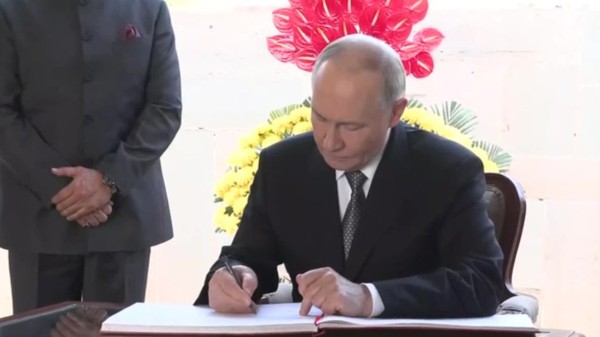
President Vladimir Putin visited Rajghat to pay respect to Mahatma Gandhi.
Russian President Vladimir Putin leaves from the forecourt of Rashtrapati Bhavan, where he was given a Guard of Honour.
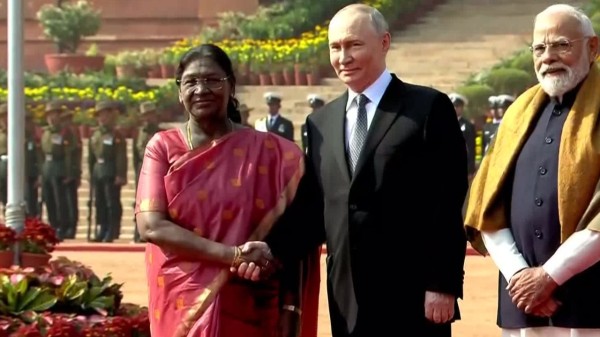
Russian President Vladimir Putin receives a Guard of Honour at the Rashtrapati Bhawan
Russian President Vladimir Putin and President Droupadi Murmu shake hands at the forecourt of Rashtrapati Bhavan. The Russian President and PM Narendra Modi also shake hands.
Russian President Vladimir Putin reached Rashtrapati Bhawan. He was welcomed by President Droupadi Murmu and PM Modi. He was accorded a ceremonial welcome to the country.
PM Narendra Modi welcomes President Droupadi Murmu to the Rashtrapati Bhawan forecourt ahead of the ceremonial welcome that is to be accorded to Russian President Vladimir Putin.
PM Narendra Modi arrives at the Rashtrapati Bhawan ahead of the ceremonial welcome that is to be accorded to Russian President Vladimir Putin. EAM Dr S Jaishankar welcomes him.
In 2012 there were calls to ban this book written by AC Bhaktivedanta Swami Prabhupada, the founder of ISKCON in Russia. The same book was now gifted by PM Modi to Russian President Putin. However at the time, Russian court had ruled in favour of the Gota and did not allow the ban.
PM Modi tweets in Russian about presenting the Holy Book to President Putin
Boards and flexes welcoming Russian President Vladimir Putin, along with Indian and Russian national flags, adorn the national capital as the city prepares for the 23rd India–Russia Annual Summit.
Yaroslav Lissovolik, Founder, BRICS+ Analytics, member of the Russian International Affairs Council (RIAC), says, "This (President Putin's visit) is a crucial jump during the development of economic ties between the two countries. We've seen a very significant rise in mutual trade and trade turnover over the past several years. The trade by the end of last year amounted to almost $70 billion. That's a very significant rise compared to the preceding years. But there's clearly a substantial scope for further growth. Policy makers in both countries are looking to set more ambitious goals for mutual trade, and some of the goals that have been thrown around in recent months have been close to $100 billion as the mutual trade target for the two countries. There's tremendous potential and unexplored opportunities. Both countries are starting to cooperate more actively in various international forums, whether the G20 or BRICS. This cooperation is very productive in terms of trade, investment and overall spirit of economic cooperation. Even though relations between India and Russia and the then Soviet Union have always been friendly, there's always a possibility to improve the past track record further... This relationship between the two countries is developing very productively."
Russian President Vladimir Putin, who arrived in India on Thursday, is all set to hold a Summit meeting with PM Narendra Modi on Friday. The day schedule of Putin includes, a cereminial welcome at the Rashtrapati Bhavan, visit to Rajghat, delegation level talks with PM Modi, followed by a joint press conference.
Prime Minister Narendra Modi shared on X (formerly Twitter) that he has presented a Russian-language edition of the Bhagavad Gita to President Vladimir Putin. Posting a photograph of the exchange, Modi wrote: “The teachings of the Gita give inspiration to millions across the world.”
The symbolic gesture came during their bilateral meeting in Delhi, underscoring cultural ties alongside strategic discussions. Further updates on the leaders’ engagements are expected as the visit progresses.
After spending more than two and a half hours at the Prime Minister’s residence in 7 Lok Kalyan Marg, President Vladimir Putin’s motorcade has finally departed.
Delhi is preparing for Russian President Vladimir Putin’s December 5 visit with extensive traffic restrictions across central and old city corridors. Key stretches around ITO, Delhi Gate, Rajghat, Shanti Van, Hanuman Setu, Netaji Subhash Marg, Vikas Marg and IP Marg will see regulated movement.
Commuters have been urged to take alternative routes and allow extra travel time. Police have deployed additional personnel to manage flow and prevent congestion during the high-security movement.
Kremlin spokesperson Dmitry Peskov and several members of the Russian delegation left earlier in a separate vehicle.
President Vladimir Putin, however, remains at the Prime Minister’s residence. He has been with Prime Minister Narendra Modi for nearly two hours after arriving for a private dinner.
The extended meeting underscores the significance both sides are attaching to the engagement during the Russian President’s two-day State visit.
India and Russia held the 22nd Inter Governmental Commission on Military and Military Technical Cooperation meeting in New Delhi, co chaired by Defence Minister Rajnath Singh and his Russian counterpart Andrei Belousov. Both sides reaffirmed their trusted strategic partnership ahead of the Modi Putin summit.
Singh stressed boosting India’s defence self reliance and expanding advanced technology cooperation. Belousov said Russia is ready to support India’s defence manufacturing capabilities. The ministers signed the session protocol outlining ongoing and future projects. Earlier, they paid tribute at the National War Memorial, where Belousov received a tri service guard of honour.
Prime Minister Narendra Modi and Russian President Vladimir Putin arrived at 7 Lok Kalyan Marg, the official residence of the Prime Minister, as the Russian leader’s two-day State visit to India got underway.
President Putin will hold the 23rd India Russia Annual Summit with Prime Minister Modi on December 5 in Delhi, where the two leaders will review defence, energy and strategic cooperation and outline the next steps in the bilateral partnership.
Prime Minister Narendra Modi said he was “delighted to welcome my friend, President Putin to India,” as the Russian leader arrived for his two-day State visit.
Posting from his official X handle, he added, “Looking forward to our interactions later this evening and tomorrow. India-Russia friendship is a time tested one that has greatly benefitted our people.”
Prime Minister Narendra Modi is currently hosting a private dinner for Russian President Vladimir Putin this evening, a gesture that reflects the political importance both sides are attaching to the visit and to their bilateral relationship.
The meeting is expected to set the tone for the 23rd India Russia Summit on Friday, where the two leaders will review key areas of cooperation and chart the path for the next stage of the partnership.
Kremlin spokesperson Dmitry Peskov has said that Prime Minister Narendra Modi’s decision to break protocol and personally receive President Vladimir Putin at the airport came as an unexpected gesture for the Russian side.
Peskov noted that the warm welcome underscored the importance India places on its relationship with Russia, adding that such personal hospitality from the Indian Prime Minister was both notable and appreciated by Moscow.
Prime Minister Narendra Modi and Russian President Vladimir Putin travelled together in the same car as they left Palam Technical Airport in Delhi, marking a warm and symbolic start to the Russian leader’s two-day State visit.
President Putin, who arrived earlier today, will hold the 23rd India Russia Annual Summit with Prime Minister Modi on December 5. The meeting is expected to review ongoing cooperation in defence, energy and strategic sectors while charting the course for the next phase of the partnership.
Russian President Vladimir Putin arrived in New Delhi on Thursday for a two-day State visit aimed at reinforcing the long-standing partnership between India and Russia.
During the visit, he is scheduled to hold the 23rd India Russia Annual Summit with Prime Minister Narendra Modi on 5 December. The two leaders are expected to review progress across key areas including defence cooperation, strategic partnership and energy collaboration, with a focus on strengthening bilateral ties and setting new directions for future engagement.
Russian President Valdimir Putin's aircraft lands in Delhi's Palam Technical Airport as he is set to step out of his special plane anytime soon. Notably, PM Narendra Modi is also present at the airport to receive his counterpart and close friend.
Russian President Vladimir Putin has landed in Delhi a short while back. PM Modi is also present at the airport to receive his counterpart.
Russia has been a longstanding and time-tested partner for India. Development of India-Russia relations has been a key pillar of India's foreign policy. Since the signing of the “Declaration on the India-Russia Strategic Partnership” in October 2000, India-Russia ties have acquired a qualitatively new character with enhanced levels of cooperation in almost all areas, including political, security, defense, trade and economy, science & technology, culture, and people-to-people ties. During the visit of the Russian President to India in December 2010, the Strategic Partnership was elevated to the level of “Special and Privileged Strategic Partnership.”
India is preparing to deepen its defence partnership with Russia, with discussions expected to cover both the S-400 air defence system and the Su-57 fifth-generation fighter aircraft.
According to sources, India may consider procuring an additional two to three S-400 regiments. The proposed agreement could include up to 50 per cent technology transfer, enabling Bharat Dynamics Limited to undertake local missile production. The total value of the deal is estimated to fall between 18,000 crore and 24,000 crore rupees.
Alongside this, India and Russia will hold detailed talks on the Su-57 stealth fighter. Discussions are likely to focus on joint manufacturing, technology sharing and a possible induction for the Indian Air Force. The government may look at acquiring two to three squadrons, which are expected to cost between 35,000 crore and 40,000 crore rupees. Hindustan Aeronautics Limited is also expected to play a key role in any potential arrangement.
These negotiations are seen as a significant step in strengthening long-term defence cooperation between the two countries.
President Vladimir Putin’s visit is expected to give a significant push to India Russia economic ties, with New Delhi keen to narrow the trade imbalance and expand its export footprint.
Putin is travelling with a large delegation of business leaders, signalling Moscow’s interest in widening commercial engagement. India is working on multiple avenues to boost its exports to Russia, with particular focus on pharmaceuticals, automobiles and agricultural goods, including marine products. Officials say a stronger presence in the Russian market would benefit Indian businesses and support job creation and rural livelihoods.
A series of agreements and memorandums of understanding are likely to be signed, covering shipping, healthcare, fertilisers and connectivity. Both sides are also expected to enhance cooperation in people to people exchanges, mobility initiatives, cultural ties and scientific collaboration.
The visit is being viewed as an opportunity to deepen long term economic and strategic partnerships.