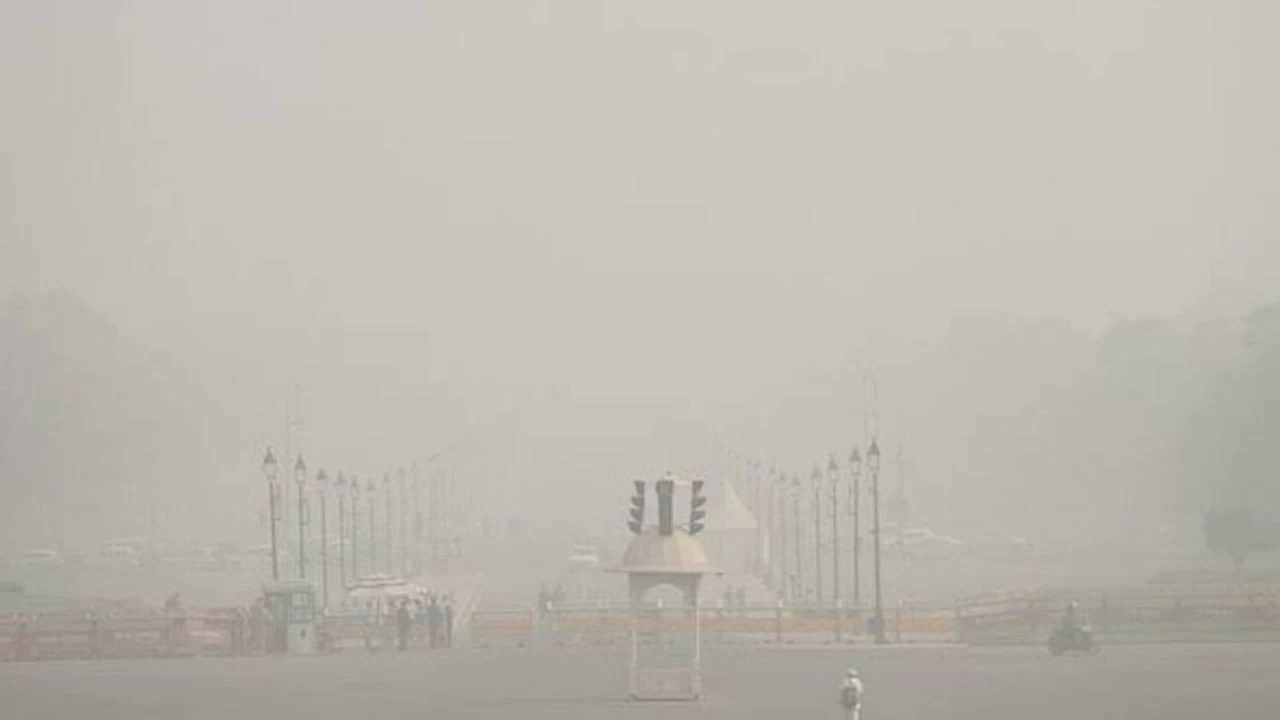
New Delhi: A thick layer of smog blankets Delhi as mornings become increasingly unbearable with each passing day. On Monday morning, Akshardham recorded an AQI of 493, while Dwarka plunged to 469 and Barapullah registered 433 — all categorised as “severe.” Visibility is deteriorating at a rapid pace, making it difficult for people to travel or even step out of their homes. The situation is further aggravated by the cold, as the national capital recorded a shivering temperature of 9 degrees Celsius.
The weather department has predicted that the maximum temperature across
Delhi-NCR today is expected to be around 23 degrees Celsius, while the minimum temperature is likely to range between 8 and 10 degrees Celsius.
Moderate winds likely to prevail in Delhi and surrounding areas
Meanwhile, the India Meteorological Department (IMD) has issued a fresh weather forecast, stating that a new Western Disturbance has reached the mountainous regions. Due to its influence, rain and light snowfall have begun in the hills. Another Western Disturbance is expected to arrive on December 18. During this period, moderate winds are likely to prevail from Punjab to Haryana, Delhi, Rajasthan, and north-western Uttar Pradesh, though there is no possibility of rainfall in these states at present.
Winds are expected to blow at a speed of around 10 kilometres per hour during this period. However, by December 19, wind speeds are likely to increase to approximately 20 kilometres per hour. While the maximum temperature is expected to remain at 23 degrees Celsius, the minimum temperature may hover between 8 and 9 degrees Celsius. The stronger winds may help bring some relief from pollution levels.
In view of the prevailing
weather conditions, the Commission for Air Quality Management (CAQM) has directed the suspension of outdoor sports activities.
SC to operate in hybrid mode
Additionally, the Hon’ble Chief Justice of India has advised members of the Bar and parties-in-person, if convenient, to avail the hybrid mode of appearance through video conferencing for matters listed before the courts.
The Supreme Court has also decided to conduct court proceedings in hybrid mode (virtual) due to poor air quality in Delhi.
As per the Central Pollution Control Board (CPCB), an Air Quality Index between 0–50 is categorised as “Good,” 51–100 as “Satisfactory,” 101–200 as “Moderately Polluted,” 201–300 as “Poor,” 301–400 as “Very Poor,” and 401–500 as “Severe.”