
Sign In
By signing in or creating an account, you agree with Associated Broadcasting Company's Terms & Conditions and Privacy Policy.
By signing in or creating an account, you agree with Associated Broadcasting Company's Terms & Conditions and Privacy Policy.
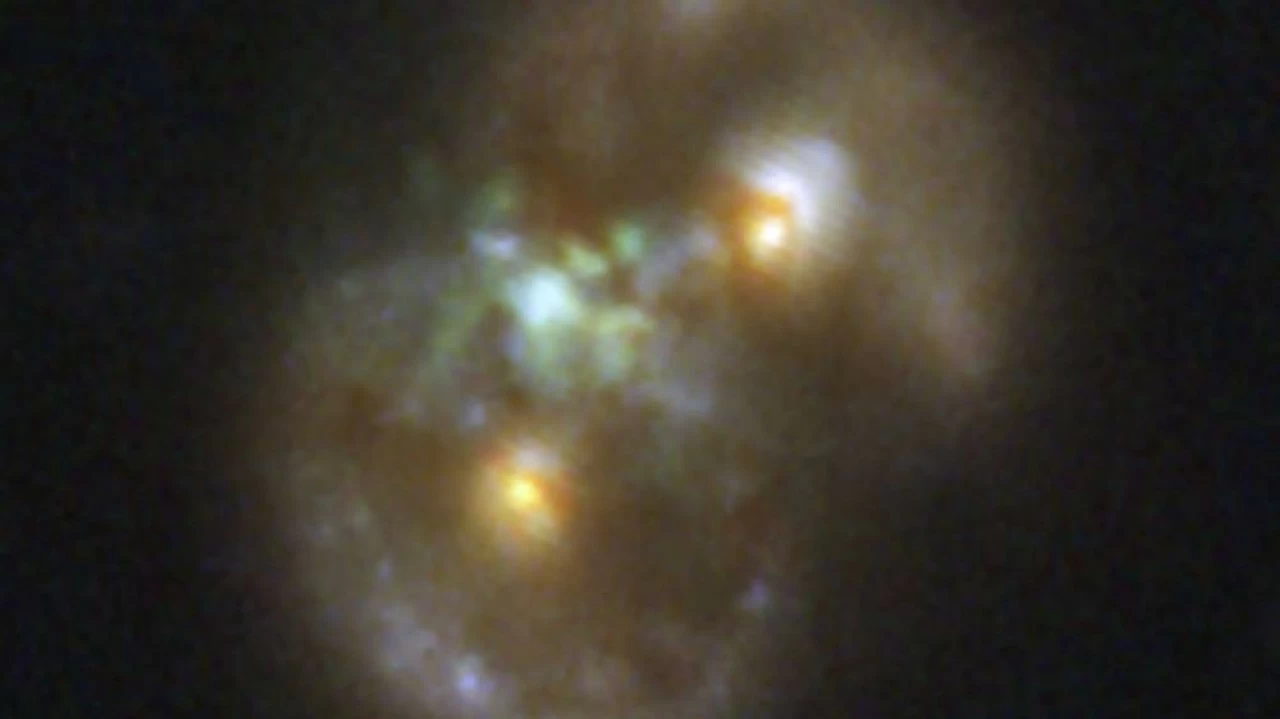


Dense clumps of material in molecular clouds collapse into stars, with the most massive ones living fast and dying young, leaving behind stellar mass black holes. This is the conventional mechanism for the formation of a black hole. Scientists had worked out that in theory, entire molecular clouds which can spawn millions of stars can directly collapse into a black hole, without first producing stars. Black holes being formed in this way can explain the unusually large number of black holes detected in the early universe. Astronomers may have spotted a black hole that was formed by the direct collapse of a molecular cloud.
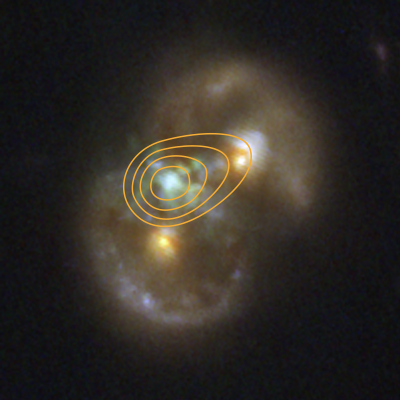
Contour maps from radio emissions align perfectly with the suspected black hole within the gas glowing in infrared light. (Image Credit: NASA, ESA, CSA, STScI, VLA, P. van Dokkum (Yale University)).
The black hole is nested between two colliding disc galaxies, which is an unusual location as black holes tend to occupy the cores of galaxies. The black hole is not at the nucleus of either of the interacting galaxies, and is instead embedded within the ionised gas between them. The black hole has a large mass, and is actively feeding on the surrounding material. Such black holes typically occupy the cores of galaxies. A long-standing problem in astrophysics is the process by which supermassive black holes are formed. The conventional theory is that these supermassive black holes are formed by a series of mergers of stellar-mass black holes. If black holes directly collapse from molecular clouds, then the process can occur much more rapidly.
Alternative Explanations ruled out
The researchers explored alternative theories that could explain the same observations, including a runaway galaxy ejected from a black hole, or it may be occupying the core of a third galaxy. Observations by Webb confirmed that the supermassive black hole matches the velocity of the surrounding gas, indicating that it was formed where it was located, compelling evidence for the direct-collapse process. Webb also revealed supermassive black holes in the cores of both the colliding galaxies. The scientists have clarified that they have managed to eliminate only some of the competing explanations, and more observations or processing of data is necessary to confirm the discovery. A paper describing the findings has been published in The Astrophysical Journal Letters.