Sign In
By signing in or creating an account, you agree with Associated Broadcasting Company's Terms & Conditions and Privacy Policy.
By signing in or creating an account, you agree with Associated Broadcasting Company's Terms & Conditions and Privacy Policy.
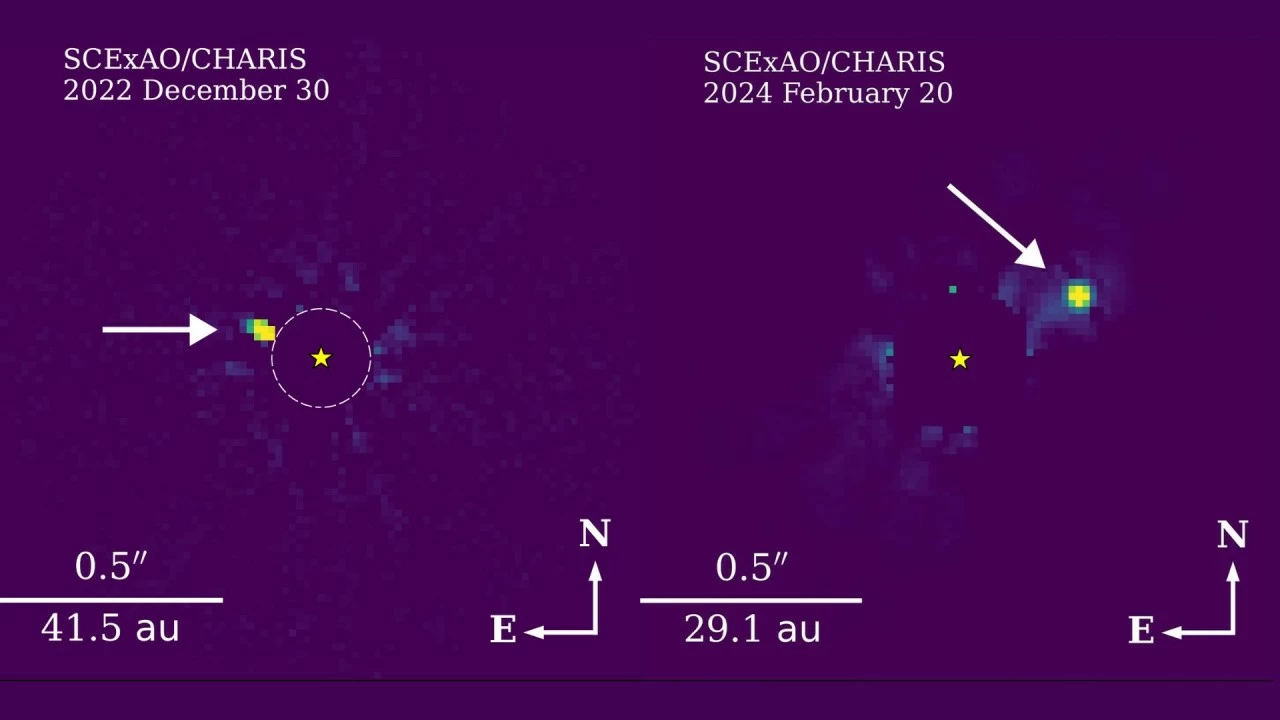


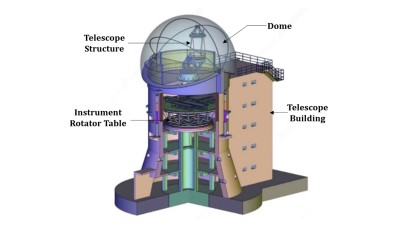
An international team of astronomers have discovered two substellar companions in orbit around distant stars using the ground-based Subaru telescope located in the Mauna Kea Observatory in Hawaii and operated by the National Astronomical Observatory of Japan. This are the first results from the OASIS programme to discover and characterise massive planets and brown dwarfs, exotic objects that straddle the line between stars and planets.
HIP 54515 b is a gas giant containing just under 18 times the mass of Jupiter. The host star contains twice the mass of the Sun. The gas giant orbits the host star at a distance of 25 astronomical units. A greater separation allows for the gas giant to be more easily imaged, away from the light of the host star. The system is at a distance of 275 light years from the Earth, which is why the gas giant appears extremely close to the host star, with the detection being at the limit of current capabilities. The world adds to a growing trend of Super Jupiters in less circular orbits than gas giants at around the same mass of Jupiter, indicate novel formation processes at work.
The second discovery is of a brown dwarf, designated as HIP 71618 B. This is a type of object that forms like a star, collapsing from a dense knot of gas and dust, but does not grow sufficiently massive to sustain the fusion of hydrogen into helium. At times, brown dwarfs are also described as failed stars. HIP 71618 B contains 60 times the mass of Jupiter, with the host star being twice as massive as the Sun. The brown dwarf orbits the host star at a distance slightly greater than Saturn's orbit around the Sun. While not a planet itself, the observations bolsters the scientific capability of detecting exoplanets in orbits around distant stars.