Sign In
By signing in or creating an account, you agree with Associated Broadcasting Company's Terms & Conditions and Privacy Policy.
By signing in or creating an account, you agree with Associated Broadcasting Company's Terms & Conditions and Privacy Policy.
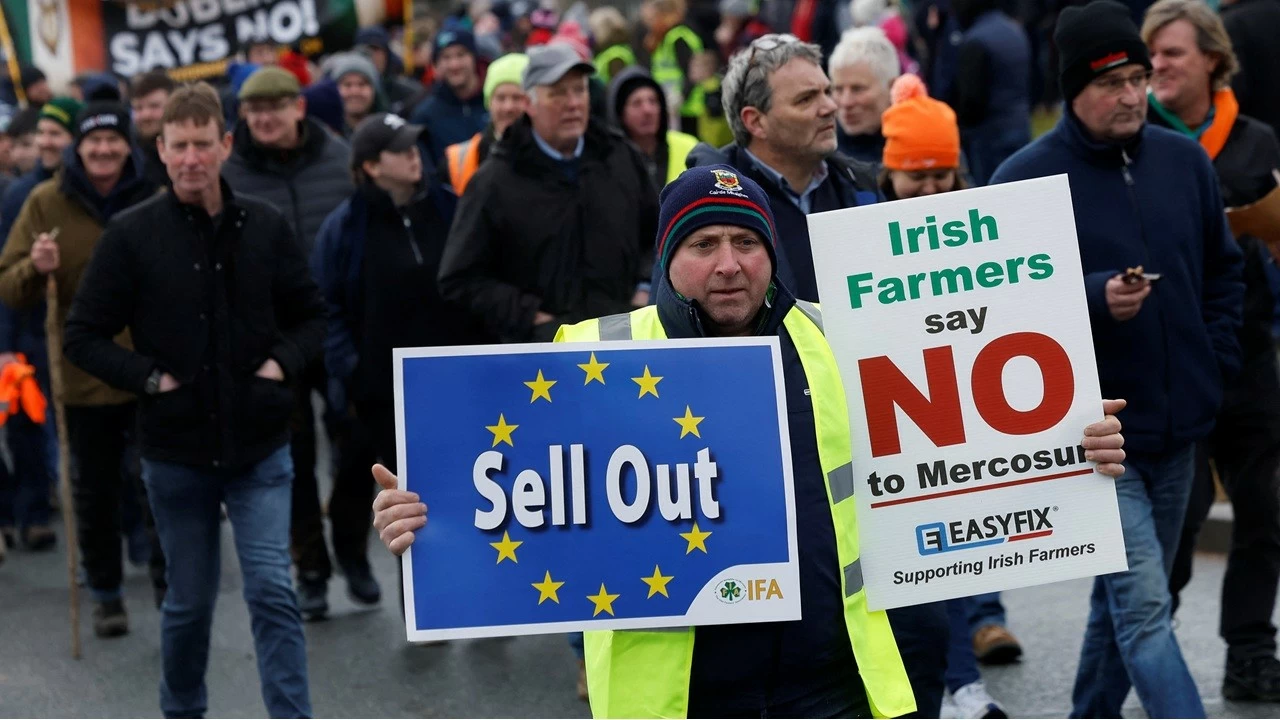


New Delhi: Ireland becomes the latest country seeing protests against the EU-Mercosur trade deal. Thousands of farmers were seen staging demonstrations against the deal as tractor convoys came out in larger numbers to voice their anger against the deal.
Irish farmers argue that the agreement would allow cheaper beef and other agricultural imports from South America to flood the European market, undercutting locally produced goods. Local goods, they argue, have to meet stricter EU rules on food safety, environmental protection, and animal welfare compared to the ones that would come from South America and thus be cheaper.
The protesters believe that such a deal would place Irish family farms at a severe disadvantage, threatening livelihoods, weakening rural economies and undermining consumer trust in food standards. Political leaders in Ireland have also echoed these concerns warning that the deal risks sacrificing agriculture in favour of broader trade ambitions.
The EU-Mercosur deal is a long-negotiated free-trade agreement between the European Union and the Mercosur bloc, comprising Brazil, Argentina, Uruguay, and Paraguay. It aims to create one of the world’s largest free-trade areas by significantly reducing tariffs on goods exchanged between both regions.
Under the agreement, European industrial products such as machinery, pharmaceuticals and cars would gain greater access to South American markets on one hand and Mercosur countries would benefit from increased access to Europe for agricultural exports on the other. The deal has had many differing opinions, with many European countries coming out in protests of the deal.
Those in favour of the deal have argued that it would strengthen Europe’s global trade position, diversify supply chains and deepen political and economic ties with Latin America. Detractors meanwhile say that the deal prioritises economic gains over environmental integrity and the stability of European farming sectors, and in the long term would be highly detrimental to European farmers.
Protests against the deal have thus erupted all across Europe, Ireland only being the latest place they have come about. This has made it more of a continental phenomenon than a local one.
Some of the biggest protests were seen in France where farmer unions organized widespread demonstrations against the deal saying that imports from Mercosur nations are produced under laxer environmental and health regulations, making fair competition impossible. The French government subsequently took a strong stance, signalling opposition to the deal in its current form. Another major point of resistance came from Poland, with farmers warning that their agricultural sector could be severely damaged by cheap imports. Belgium and several other EU states have also joined in expressing reservations against the deal.
This growing wave of protests have come to show the shared anxieties about economic pressure on farmers, risks to food sovereignty, and the long-term sustainability of European agricultural policy. The multiplicity and intensity of the protests have put the EU-Mercosur deal under immense pressure. As more countries join in in protest, growing public and political opposition means that ratification of the deal is far from guaranteed and the European Parliament, national governments and Mercosur partners would soon have to act before public opinion becomes too much of a hurdle against the deal.