Sign In
By signing in or creating an account, you agree with Associated Broadcasting Company's Terms & Conditions and Privacy Policy.
By signing in or creating an account, you agree with Associated Broadcasting Company's Terms & Conditions and Privacy Policy.
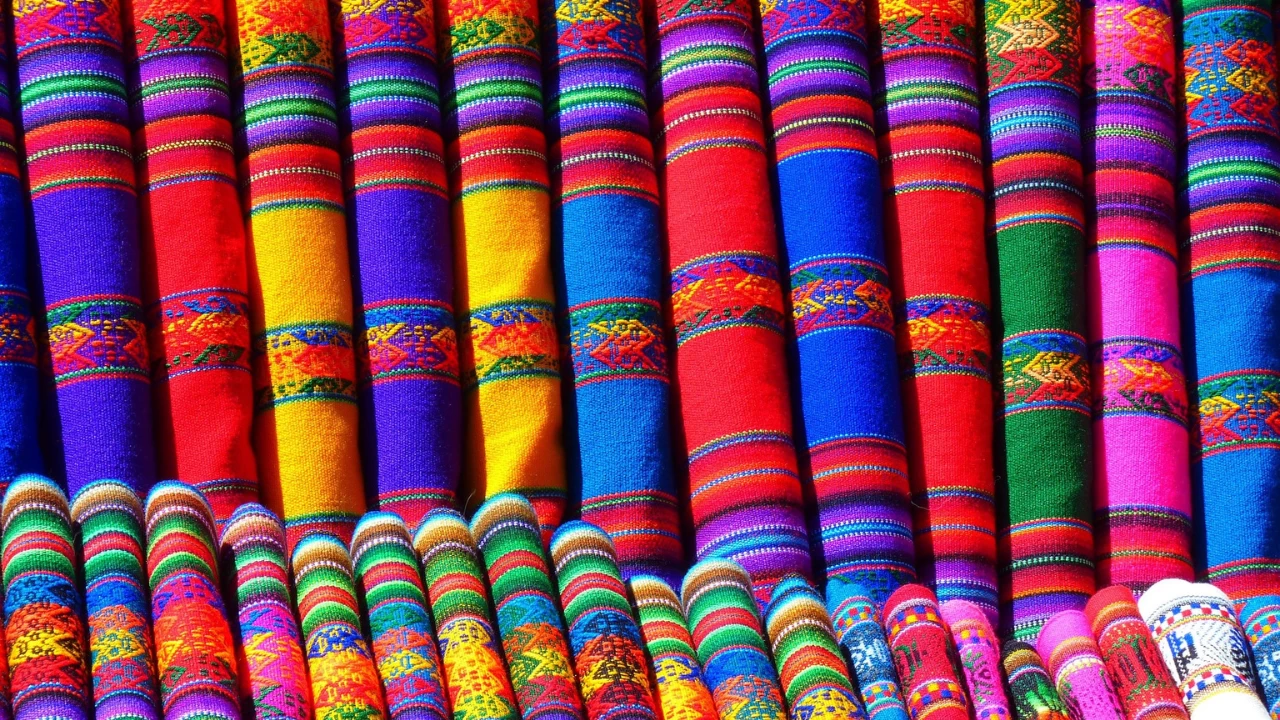


New Delhi: The Indian textile industry contributed 2 per cent to GDP, 10 per cent to industrial output and 8.63 per cent to exports. The sector provides employment to more than 45 million people, including women and rural communities. The sector drives economic growth, boosts exports, and showcases India’s rich heritage globally. In this article, we inform you about the performance of the textile industry in 2026 and the reforms introduced by the government to help the sector.
The Government has given the green signal to set up 7 PM Mega Integrated Textile Region and Apparel (PM MITRA) Parks in Greenfield/Brownfield sites with an outlay of Rs 4445 cr for a period of seven years up to 2027-28. The PM MITRA Parks will be set up in Virudhnagar in Tamil Nadu, Warangal in Telangana, Gujarat (Navsari), Kalaburagi in Karnataka, Dhar in Madhya Pradesh, Uttar Pradesh’s capital Lucknow and Maharashtra’s Amravati.
The National Technical Textiles Mission (NTTM) has been launched with a fund allocation of Rs 1,480 crore. The scheme is aimed at research, market development, education, and export promotion for the textile sector.
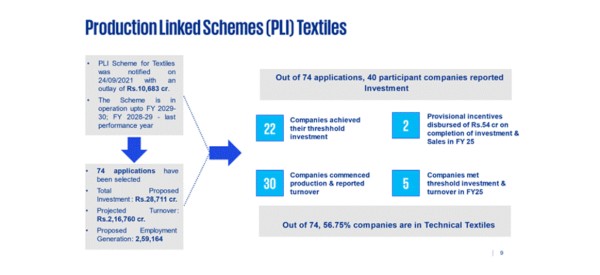
PLI Scheme for Textiles was started in 2021 with the objective to promote production of MMF Apparel & Fabrics and products of Technical Textiles to make the textile industry scale new heights, become advanced to compete at global level, and create employment opportunities. IT was approved with an outlay of Rs 10,683 crore. The scheme had two years of gestation period from FY: 2022-23 and FY: 2023-24.
Out of the 74 applications selected under the scheme, the total proposed investment would be Rs 28,711 crore. 40 participant companies reported investment and 22 companies achieved their threshold investment. 30 Participant companies commenced production and reported turnover, while five companies reported to have met threshold investment & turnover in 2024-25.
In 2024-25, exports of textiles and apparel, including handicrafts, reached USD 37.8 billion. India exported 55 per cent of its total exports to the USA, EU, and UK together. “With over 500 districts across 33 States/UTs actively engaged, the Ministry has set a bold Vision 2030 target of USD 100 billion exports,” the release mentioned.
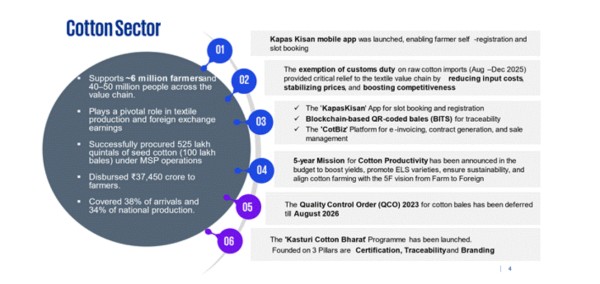
The cotton sector is very important for India’s agricultural economy as it supports nearly 6 million farmers and 40–50 million people across the value chain. In the cotton season of 2024–25, 525 lakh quintals of seed cotton was procured by the government and Rs 37,450 crore was disbursed to farmers.
GST rates reduced for Readymade Garments & Made ups, Man-Made Fibres & Yarns, Carpets & Floor Coverings, Handicrafts & Handlooms, and Sewing Machines (domestic and industrial covered under HS 8452)