Sign In
By signing in or creating an account, you agree with Associated Broadcasting Company's Terms & Conditions and Privacy Policy.
By signing in or creating an account, you agree with Associated Broadcasting Company's Terms & Conditions and Privacy Policy.


New Delhi: World Heritage Sites are locations which are acknowledged for their cultural, historical, or scientific significance, and given legal shield through an international treaty managed by UNESCO. That's why they are known as UNESCO World Heritage Sites. The sites are recognised for holding "cultural and natural heritage around the world considered to be of outstanding value to humanity".
India has a number of World Heritage Sites, which range from iconic monuments to landmark places. These sites are both cultural and natural.

The nomination for a World Heritage Site is made by the country where it is situated. These countries should be signatories to the UNESCO World Heritage Convention, set up in 1972 -- which has been ratified by 196 states till now. India adopted the convention on November 14, 1977, which made its sites eligible for inclusion on the World Heritage Sites list.
A particular site is selected by UNESCO's World Heritage Committee. This panel consists 21 'states parties' elected by the United Nations General Assembly and is supported by reviews from international expert committees in fields such as natural or cultural history and education.
To be chosen in the list, the site must qualify as a distinct landmark which is geographically and historically recognisable, possessing significant cultural or natural importance, and be sufficiently safeguarded by legal measures. Ancient ruins, historical structures, cities, deserts, forests, islands, lakes, monuments, mountains, wilderness areas, and more can be selected as World Heritage Sites.
The World Heritage Sites list is managed by the international World Heritage Program, which is monitored by the UNESCO World Heritage Committee.
According to reports, till July 2024, there were 1,223 World Heritage Sites worldwide, including 952 cultural sites, 231 natural sites, and 40 mixed cultural and natural sites, spread across 168 countries. Italy has 60 of these sites, China has 59, Germany 54, France 53 and Spain 50. As of March 2025, India had 43 UNESCO World Heritage Sites, comprising 35 cultural sites, 7 natural sites, and 1 mixed site that meets both cultural and natural criteria. India is placed sixth globally in terms of the number of UNESCO World Heritage Sites. These sites are diverse and historically rich.
India boasts of several sites of cultural and natural importance which have been listed in the UNESCO's World Heritage Sites club. Most notable among them are:
Ajanta Caves, Maharashtra: These historically significant caves were listed in the UNESCO World Heritage Sites in 1983. These caves showcase a collection of Buddhist art from two different periods. The earliest monuments date back to the 2nd and 1st centuries BCE. These were created by followers of Theravada Buddhism. In the 5th and 6th centuries CE, more monuments were constructed during the Vakataka dynasty by followers of Mahayana Buddhism.
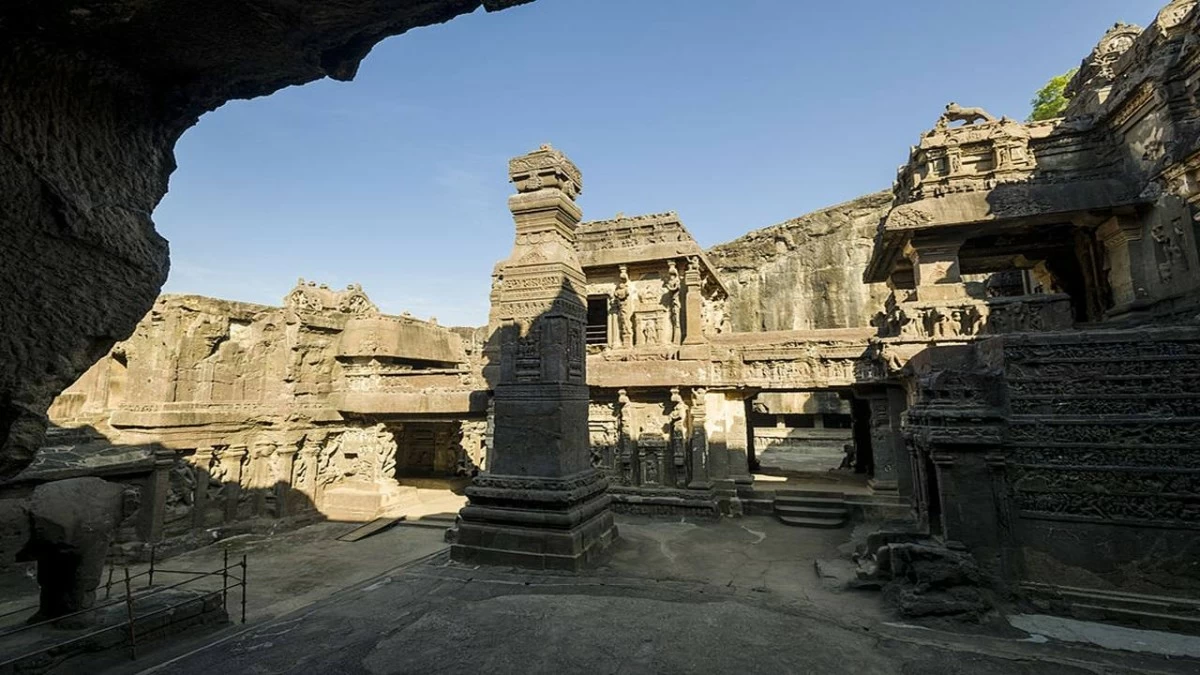
Ellora Caves, Maharashtra: The Ellora Caves have 34 temples and monasteries carved into a 2-km long basalt cliff between the 7th and 11th centuries. Constructed by followers of Buddhism, Hinduism, and Jainism, they showcase the religious tolerance of the era. The Kailasa Temple, the largest of these temples, is well-known for its intricate sculptures and paintings.
Agra Fort: It is a 16th-century Mughal imperial fortress, with its current layout established during the reign of Mughal Emperor Akbar. The complex has a number of palaces, including the Jahangiri Mahal, audience halls, and two mosques.
Taj Mahal, Agra: It reflects Indo-Islamic architecture. Constructed in Agra on the banks of the Yamuna River, it serves as the mausoleum for Mumtaz Mahal, the wife of the Emperor Shah Jahan. It was built between 1631 and 1648, and was designed by Ustad Ahmad Lahori. Built from white marble, it has intricate inlays of precious and semi-precious stones. The tomb is surrounded by four freestanding minarets. The complex also has beautiful gardens.
Sun Temple, Konark, Odisha: It made to the coveted list in 1984. This Hindu temple was constructed in the 13th century, and is an ideal example of Kalinga architecture. It is crafted to symbolise the chariot of the solar deity Surya, with 24 intricately carved stone wheels on its outer sides, each richly decorated, and pulled by six horses.
Kaziranga National Park, Assam: The Park was inscribed on the World Heritage List in 1985. Kaziranga is situated in the floodplains of the Brahmaputra River. The park is home to the largest population of Indian rhinoceroses, along with tigers, Asian elephants, wild water buffalo, the Ganga river dolphin. It also attracts migratory birds.
Churches and Convents of Goa: Old Goa was the capital of Portuguese India for around 450 years, until the colony ended in 1961. The place features seven churches and convents built during the 16th and 17th centuries, combining Gothic, Manueline, Mannerist, and Baroque styles, while also reflecting local building methods and resources.
Mountain Railways of India (West Bengal, Tamil Nadu, Himachal Pradesh): This site includes three mountain railways built in the late 19th and early 20th centuries to link towns in the highlands. The Darjeeling Himalayan Railway was initially listed on its own in 1999, followed by the Nilgiri Mountain Railway in 2005 and the Kalka–Shimla Railway (pictured) in 2008.
The list also includes Khajuraho Group of Monuments, Group of Monuments at Hampi, Keoladeo National Park (Rajasthan), Manas Wildlife Sanctuary (Assam), Elephanta Caves (Maharashtra), Great Living Chola Temples (Tamil Nadu), Sundarbans National Park (West Bengal), Nanda Devi and Valley of Flowers National Parks (Uttarakhand), Buddhist Monuments at Sanchi (Madhya Pradesh), Humayun's Tomb, Delhi, Qutb Minar and its Monuments, Delhi, Mahabodhi Temple Complex at Bodh Gaya, Rock Shelters of Bhimbetka, Chhatrapati Shivaji Terminus, Champaner-Pavagadh Archaeological Park, The Jantar Mantar, Jaipur, Western Ghats, Great Himalayan National Park Conservation Area (Himachal Pradesh), Archaeological Site of Nalanda Mahavihara at Nalanda, Bihar, Santiniketan (West Bengal) and Moidams – the Mound-Burial system of the Ahom Dynasty.