Sign In
By signing in or creating an account, you agree with Associated Broadcasting Company's Terms & Conditions and Privacy Policy.
By signing in or creating an account, you agree with Associated Broadcasting Company's Terms & Conditions and Privacy Policy.
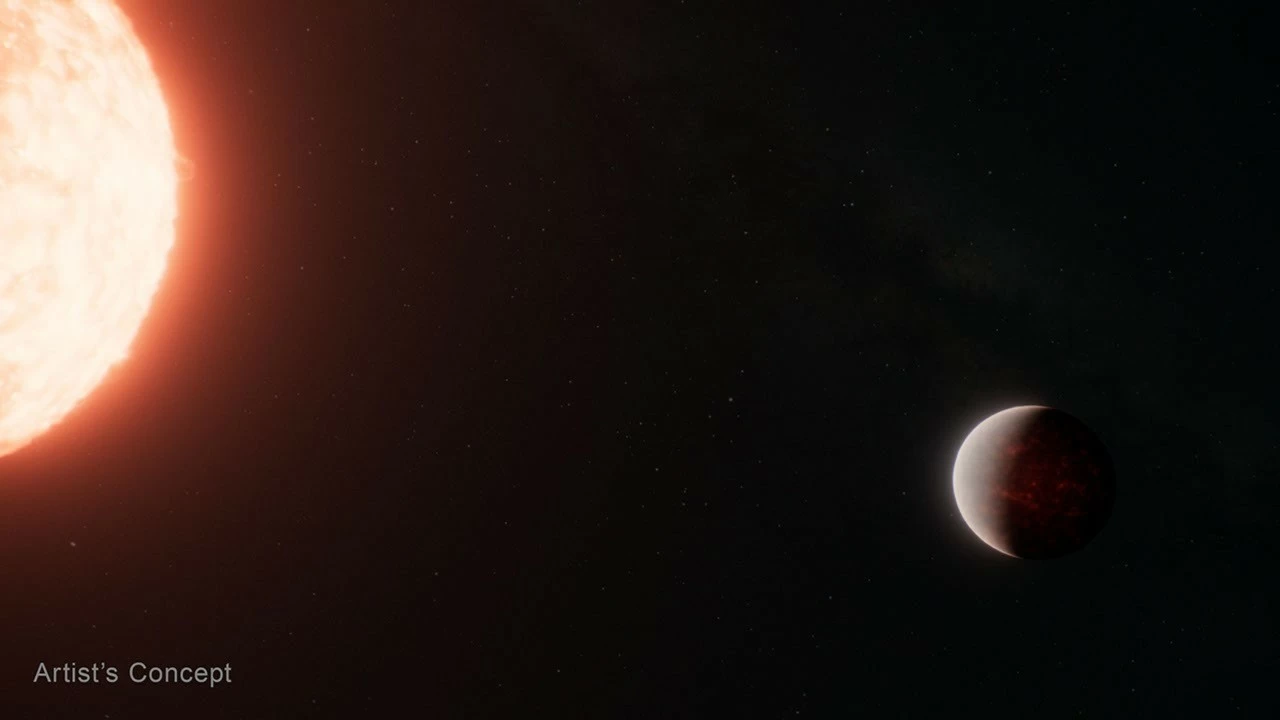


The James Webb Space Telescope has investigated a rocky exoplanet larger than the Earth in a tight orbit around its host star designated as TOI-561 b. The system is at a distance of about 280 lightyears from the Earth in the constellation of Sextans. Webb has detected the strongest evidence yet of an atmosphere surrounding a rocky exoplanet. The observations indicate that the exoplanet has a thick atmosphere above a global magma ocean, or molten rock. The observations help explain the unusually low density of the exoplanet.
The observations challenge conventional theories on exoplanets, as scientists did not believe that worlds could sustain thick atmospheres so close to their host stars. The exoplaet orbits the host star at a distance of 1.6 million kilometres, which is less than a fortieth of the distance between the Sun and Mercury. The exoplanet is tidally locked to the host star just like the Moon is tidally locked to the Earth. The temperatures on the dayside are permanently high enough to melt rock. The density is not as low as puffball gas giants where the atmosphere is inflated by the injection of heat much like a hot air balloon, but the density is lower than rocky exoplanets.
Scientists have some theories to explain the unusually low density of the exoplanet. It might have a small iron core with a mantle of rock that is not as dense as the Earth. The system is very old, and the host star is metal-poor. The exoplanet may have formed in a chemical environment much different than the Solar System. The scientists also believe that the thick atmosphere makes the planet look larger than it actually is. Without a thick atmosphere, the night side of the exoplanet would have cooled down. A thick atmosphere explains all the observations.