Sign In
By signing in or creating an account, you agree with Associated Broadcasting Company's Terms & Conditions and Privacy Policy.
By signing in or creating an account, you agree with Associated Broadcasting Company's Terms & Conditions and Privacy Policy.
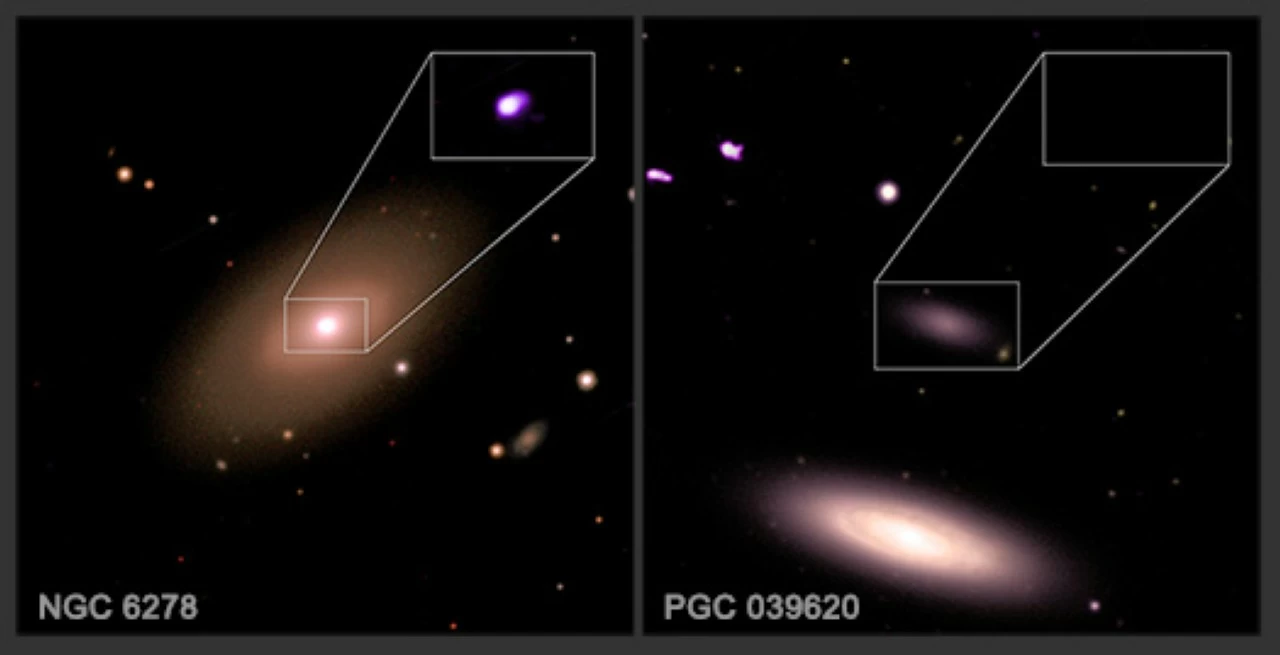


Astronomers have used NASA's Chandra X-ray Observatory to determine that only 30 per cent of dwarf galaxies contain supermassive black holes in their cores. The study challenges the notion that a supermassive black hole lurks in the cores of all galaxies. For the study, the researchers used data from over 1,600 galaxies captured by Chandra over a period of two decades. These galaxies ranged in size from ten times the size of the Milky Way to small dwarf galaxies. A paper describing the research has been accepted for publication in The Astrophysical Journal.
The extreme friction in the gas and dust falling into a supermassive black hole causes the tortured material to radiate light across the electromagnetic spectrum, including intense X-ray light. A bright spot in X-ray frequencies in the cores of galaxies is the telltale signature of a supermassive black hole. The researchers were able to determine that over 90 per cent of the large galaxies contain the signature of a supermassive black hole, but only 30 per cent of small galaxies contain this signature. Galaxies with masses less than three billion solar masses, about the size of the Large Magellanic Cloud, a satellite galaxy of the Milky Way, do not contain supermassive black holes in their cores.
Scientists have proposed two main theories on how supermassive black holes can be formed. The first is through a series of mergers between stellar mass black holes, produced by the violent deaths of the most massive stars. This process takes time, and cannot explain the supermassive black holes seen in the early universe by the James Webb Space Telescope. Another theory is that black holes can directly collapse from stellar nurseries, that can produce entire clusters of stars. Such direct-collapse black holes do not need to go through a stellar phase. The research favours the second hypothesis, as if the first were true, then the number of small galaxies with supermassive black holes should have been the same as large ones.