Sign In
By signing in or creating an account, you agree with Associated Broadcasting Company's Terms & Conditions and Privacy Policy.
By signing in or creating an account, you agree with Associated Broadcasting Company's Terms & Conditions and Privacy Policy.

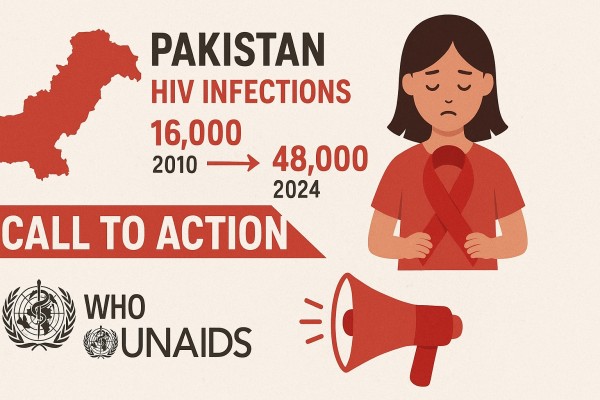
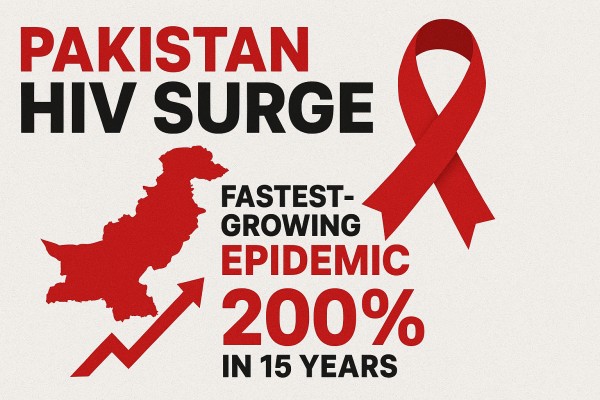
New Delhi: Pakistan is facing one of the most troubling HIV surges in its history, prompting the World Health Organization and UNAIDS to issue an urgent call for action. On World AIDS Day, both agencies warned that the country is now home to one of the fastest-growing HIV epidemics in the WHO Eastern Mediterranean Region, with new infections soaring by 200 per cent in just 15 years.
According to figures shared during a joint awareness walk held in Islamabad, annual infections have risen from 16,000 in 2010 to 48,000 in 2024. The escalation, once largely confined to high-risk groups, is now cutting across families and communities, exposing children, spouses and the wider population.
Health officials say the drivers of this rapid spread are well known: unsafe blood transfusions, unhygienic injection practices, gaps in infection control, inadequate testing during pregnancy and unprotected sexual activity. These failures, compounded by stigma and poor access to HIV services, have widened the epidemic’s reach.
More children are now falling ill. New infections among those aged between nought and 14 increased from 530 in 2010 to 1,800 in 2023, a trend underscoring how systemic lapses in medical practice have exposed some of the country’s most vulnerable.
Recent outbreaks in Shaheed Benazirabad, Hyderabad, Naushahro Feroze, Pathan Colony, Taunsa, Mirpur Khas, Jacobabad, Shikarpur and Larkana have been particularly devastating. In several of these clusters, more than 80 per cent of confirmed cases occurred in children, often linked to contaminated syringes and unsafe transfusions.
Speaking at the awareness event, Pakistan’s Director General of Health, Dr Ayesha Majeed Isani, said the crisis could not be tackled by authorities alone. She urged communities, regulators and frontline clinicians to join in eradicating unsafe medical practices and promoting awareness.
“All of us, together, can achieve our goals,” she said. “We must give children and adults in Pakistan the healthy, HIV-free future they deserve.”
Pakistan has scaled up treatment access in recent years. The number of people receiving antiretroviral therapy has risen eightfold, from around 6,500 in 2013 to 55,500 in 2024. Treatment centres have also expanded from 13 in 2010 to 95 expected by 2025.
Yet coverage remains far below global benchmarks. Of an estimated 350,000 people living with HIV, nearly 80 per cent do not know they are infected. Only 16 per cent are on treatment, and a mere 7 per cent have managed to suppress the virus. More than 1,100 AIDS-related deaths were recorded in 2024 alone.
Children continue to be disproportionately affected. Only 14 per cent of pregnant women needing preventive treatment to stop mother-to-child transmission receive it. Among infected children aged nought to 14, just 38 per cent are currently on therapy.
WHO’s Representative in Pakistan, Dr Luo Dapeng, said recent outbreaks among children were a stark warning. “They jeopardise Pakistan’s future. We must intensify joint efforts and mobilise resources to end AIDS as a public health threat,” he said.
UNAIDS Country Director Trouble Chikoko echoed the urgency, stressing that Pakistan and its partners must adopt “radical shifts” in programming and funding. Ending AIDS by 2030, he said, will require renewed global commitment and financial support, particularly for women, children and high-risk groups.
WHO and UNAIDS have reiterated that the world still has a chance to end AIDS as a public health threat by the end of the decade, but only if countries act quickly and decisively. For Pakistan, the path forward hinges on reducing stigma, ensuring safe medical practices, expanding testing, strengthening maternal care and securing sustainable funding.