Sign In
By signing in or creating an account, you agree with Associated Broadcasting Company's Terms & Conditions and Privacy Policy.
By signing in or creating an account, you agree with Associated Broadcasting Company's Terms & Conditions and Privacy Policy.


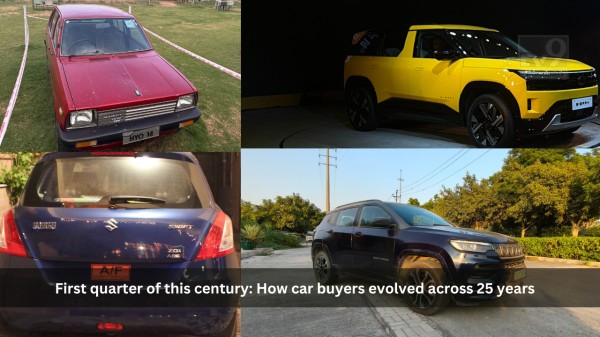
New Delhi: With 2025 coming to an end, we have completed the first quarter of the 20th Century. These 25 years have seen the two-wheelers in India change dramatically. In the early 2000s, two-wheelers in India were basic machines. Most motorcycles and scooters came with kick start, drum brakes and minimal safety equipment. Features were limited, and buyers focused mainly on fuel efficiency and the price of the vehicle. Over the last 25 years, that picture has changed completely; now we have motorcycles with improved safety and various features.
However, not only in motorcycle safety and features, India has seen a major change in terms of riding gear, mainly in helmets. Even so, a rear group of riders are using a complete kit of safety gear while riding. While the majority only need helmets for their head protection or may want to avoid a challan. Despite that, our people are aware of the importance of helmets, and they are buying good helmets with certification rather than a cheap one only to avoid a challan.
Two decades ago, self-start was considered a premium feature. Riders relied on kick levers, especially in winter mornings or when batteries failed. Today, Kick Start has almost disappeared from the market. Even entry-level motorcycles and scooters now come with electric self-start as standard, even though some motorcycles don't have a kick start option, which may cause problems for riders in the event of battery failure or during winter, because you can not always rely on the self-start.
Earlier, braking systems were simple. Drum brakes were common, and safety features were rarely discussed during purchase. The majority of buyers focused mainly on fuel efficiency and the resale value of the bike. That has changed after stricter regulations and rising awareness among riders.
Now, most motorcycles above 125cc come with ABS, either single-channel or dual-channel. Higher-end models also offer traction control, which helps prevent wheel slip, especially on wet roads. Some premium and as well as affordable commuter bikes are now available with cruise control, a feature once seen only in cars.
Scooters and motorcycles are also becoming safer through technology. GPS-based tracking, emergency alerts and connected safety features are now available in several models.
Modern two-wheelers are no longer just bikes with engines; they have changed in many ways. Now the majority come with digital displays, Bluetooth connectivity and smartphone apps. It allows riders to access navigation, call alerts, service reminders, and ride data through mobile apps.
There was a time when powerful motorcycles were rare in India and mostly imported. That has changed in the last decade. Indian riders now have access to mid-capacity and high-capacity bikes locally. Royal Enfield played a key role in this shift with its 650cc twin-cylinder motorcycles. This year, during its motoverse event, the brand has also moved towards higher-capacity offerings, with bikes going up to 750cc.
Helmet usage in India was once driven mainly by law enforcement. Many riders wore helmets only to avoid challans. However, today, more riders understand the importance of good-quality helmets for safety. Even so, the helmet market has also evolved. Buyers now look for better comfort, ventilation and weight. Certification has become an important factor. Common helmet standards include ISI (India), DOT (United States) and ECE (Europe). Among these, ECE-certified helmets are often preferred for higher safety standards.
From early commuter bikes, in the last 25 years, India’s two-wheeler sector has moved to a large variety of motorcycles and scooters, with the rising demand from knowledgeable buyers with higher incomes. Today, the two-wheeler segment boasts different products for different buyers - want a motorcycle or scooter that can go off-road, there are products like Hero Impulse, RE Himalayan, and Xoom 160. RE twins have redefined the segment with their 650CC parallel twin. For sport bike riders on a budget, we have motorcycles like the Yamaha R15 and others.
There was a time in India when Superbikes were not available so easily, so buying them was near impossible; some buyers imported them from another country, which made them very expensive compared to their actual cost. Today, many foreign brands like Kawasaki, Ducati, Harley Davidson, BMW and many others are officially available in our country. While some have manufactured their motorcycle in collaboration with an Indian manufacturer, for example, BMW has made their F 450 GS adventure motorcycle with TVS.
In India, Electric two-wheelers were almost non-existent 10 years ago. However, today they are becoming part of everyday mobility. In electric motorcycles, brands like Revolt and Ultraviolette are offering performance-focused models. In the electric scooter space, companies such as Ather, River and TVS iQube have gained traction with better range, features and reliability.
At the same time, the battery charging ecosystem is improving; for example, Ultraviolette has collaborated with Hindustan Petroleum for their supernova charger. Public chargers, home charging solutions and fast-charging networks are expanding, especially in cities; however, in town, it took some more time to be fully accessible.