Sign In
By signing in or creating an account, you agree with Associated Broadcasting Company's Terms & Conditions and Privacy Policy.
By signing in or creating an account, you agree with Associated Broadcasting Company's Terms & Conditions and Privacy Policy.


New Delhi: India’s introduction of the Right to Disconnect Bill 2025 in the Lok Sabha has sparked an important national conversation on the future of work, even though the Bill is yet to be passed. As a private member bill, its progression into law may take time unless the government chooses to actively prioritise the issue. Nevertheless, its very introduction brings to the surface a long-standing tension between productivity and presence, effort and availability. More importantly, it forces organisations to confront a simple question: are we measuring commitment by outcomes, or by how reachable someone is after hours?
In an exclusive conversation with TV9English, Gaurav Sharma, Chief Human Resource Officer of True Balance, said that this Bill is not about rejecting aspiration or hard work, but about re-examining how work fits into life and how leadership can create that balance.
For years, extended workdays and constant connectivity have been normalized across industries. While technology has improved speed and access, it has also blurred boundaries that were once clear. The expectation to respond at all hours has quietly become part of workplace culture, often without formal acknowledgement.
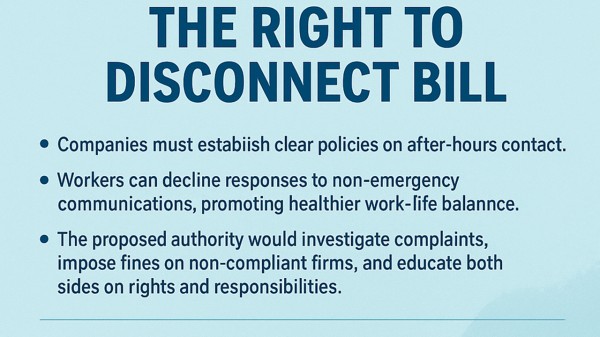
The Right to Disconnect Bill addresses this reality head-on. It creates a legal and cultural signal that rest is not a privilege and personal time is not a negotiable resource. Organizations that already operate with healthy boundaries will adapt with minimal friction. Those built on reactive workflows and unspoken pressure will need meaningful change.
Chronic overwork rarely shows immediate damage, but its long-term impact is well documented. Burnout reduces decision quality, innovation, and retention. It also creates environments where urgency overrides judgment and exhaustion is mistaken for dedication.
By curbing intrusive work practices, the Bill will offer an opportunity to eliminate toxic work hours that drain both people and performance. Healthier schedules are not just employee-friendly policies; they are also employee-friendly policies. They are business imperatives that support consistency, clarity, and long-term productivity.
An important dimension of the Right to Disconnect conversation is employee responsibility. Clear working hours demand sharper execution. When boundaries are defined, expectations must be met within those boundaries.
Mr Gaurav Sharma said, "This shift leaves less room for inefficiency or delayed delivery. Employees will need to manage time, prioritise effectively, and take ownership of outcomes. In that sense, the Bill promotes maturity across the workforce, reinforcing the idea that balance and accountability are complementary, not contradictory."
Legislation can set the framework, but leadership behaviour will determine whether the Bill succeeds in practice. Employees take cues from how leaders operate day to day. A policy loses credibility if senior teams continue to send late-night messages or reward overwork informally.
True alignment requires leaders to model boundary-respecting behaviour. This includes realistic planning, outcome-focused performance evaluation, and visible respect for non-working hours. When leaders demonstrate restraint and discipline, those behaviours cascade naturally through teams.
The Right to Disconnect Bill 2025 should not be viewed merely as a compliance requirement to be managed by human resources teams. Instead, even at this stage, it serves as an invitation to reassess how work is designed, how success is measured, and how trust is built.
"Whether or not the Bill progresses into law in the near term, it presents a timely opportunity for Indian organisations to reflect on sustainable performance models. By aligning ambition with balance and accountability with empathy, companies can move toward workplaces that are resilient, focused, and future-ready. The real value of this Bill lies not in its restrictions, but in the clarity it brings to the conversation around work and leadership," Gaurav Sharma added.