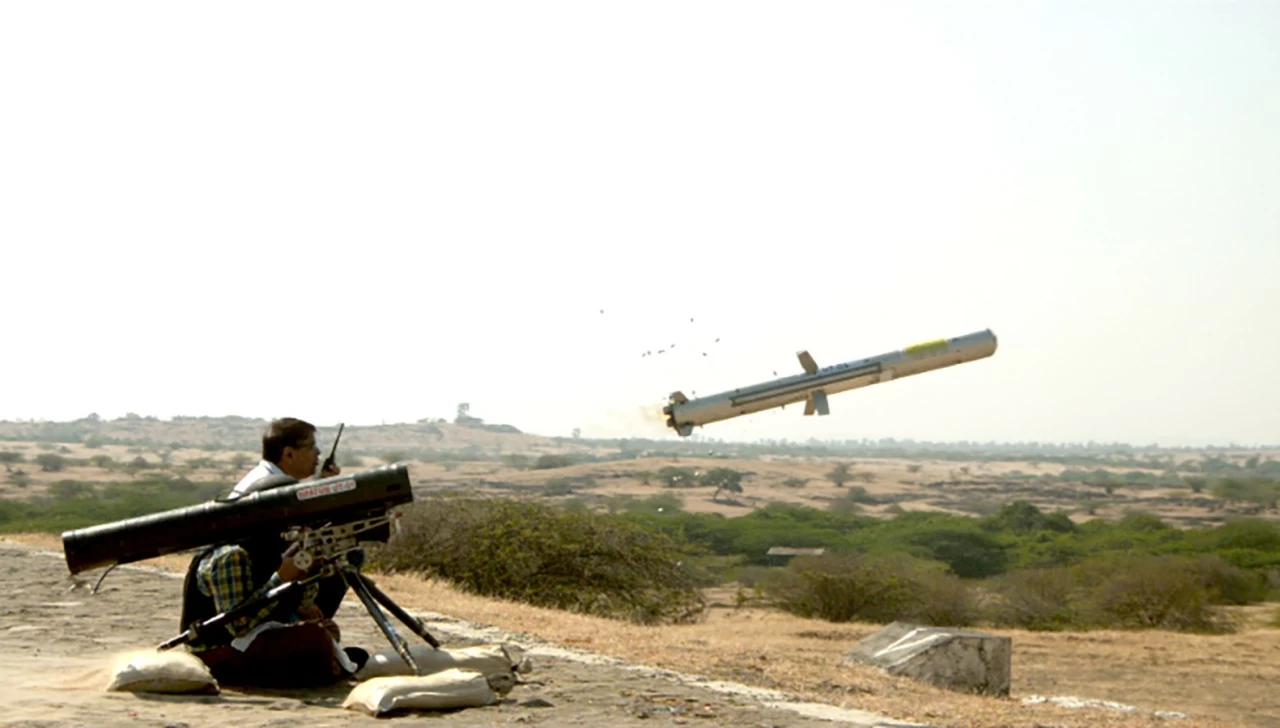
New Delhi: India’s Defence Research & Development Organisation (DRDO) successfully conducted a precision strike test of its Third Generation Man-Portable Anti-Tank Guided Missile (MPATGM). The trial, which took place on January 11, 2026, at the KK Ranges, saw the indigenous weapon system successfully intercept and destroy moving targets with clinical accuracy.
Developed primarily at the Defence Research & Development Laboratory (DRDL) in Hyderabad, the MPATGM is a lightweight, "Fire & Forget" powerhouse. The missile is designed specifically for the Indian Army’s infantry. This weapon allows a soldier to lock onto a target, fire, and immediately take cover or reposition, as the missile guides itself to the objective without further manual intervention.
The system is a collaborative triumph of DRDO’s pan-India network:
Research Centre Imarat (Hyderabad): Developed the sophisticated avionics.
TBRL (Chandigarh) & HEMRL (Pune): Crafted the lethal tandem warhead and propulsion systems.
IRDE (Dehradun): Engineered the high-performance sighting and optical systems.
Lethal specifications: Small size, massive impact
The MPATGM is engineered for portability without compromising on lethality. Weighing just 14.5 kg and measuring 1.3 meters in length with a 120mm diameter, it is light enough for a soldier to carry across rugged terrain.
Key technical features include:
Top attack capability: The missile can strike tanks from above, hitting the thinnest part of the armour.
Dual-mode seeker: Equipped with a miniaturised Imaging Infrared (IIR) Homing Seeker, it can operate with high efficiency during both day and night.
Soft launch system: Using a canister-based tripod and an ejection motor, the missile is "soft launched" before the main engine kicks in, protecting the operator from backblast.
Performance: With a maximum flight time of 17 seconds and a range of 2.5 km, the missile is designed to neutralise modern armoured threats before they can close in.
The "Atmanirbhar" advantage
This latest round of firing trials was aimed at verifying the missile’s performance against the Indian Army's strict General Staff Qualitative Requirements (GSQR). By mastering complex technologies like the all-electric Control Actuation System and advanced IIR seekers domestically, India is significantly reducing its dependence on foreign anti-tank systems.