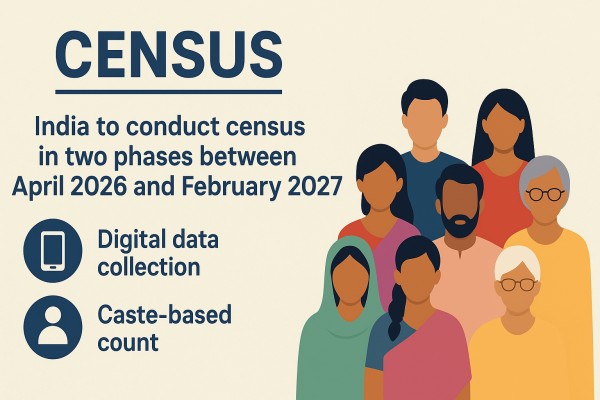
New Delhi: India’s long-awaited national census will be carried out in two carefully sequenced phases between April 2026 and February 2027, the government informed the Lok Sabha on Tuesday. The clarification came in a written reply from Minister of State for Home Affairs Nityanand Rai to a question raised by Congress MP and Leader of the Opposition Rahul Gandhi.
According to the minister, the first phase will take place between April and September 2026 and will focus on house listing and housing surveys. The second phase, which involves population enumeration, will be conducted in February 2027. The reference date for the main enumeration will be midnight on March 1, 2027.
Rs 11,778 crores allocated for 2027 Census
The Union Cabinet has approved a Budget of 11,718 crore rupees for the 2027 Census, marking a major investment in India’s next population count. Information and Broadcasting Minister Ashwini Vaishnaw said the exercise will unfold in two phases and will be the country’s first fully digital Census, with data collected through mobile applications for Android and iOS. It will also include caste enumeration for the first time.
As India prepares for what is considered the world’s largest administrative and statistical operation, around 30 lakh field staff will be deployed nationwide. Officials say the allocation is intended to strengthen digital systems, improve data accuracy and modernise the overall process ahead of the 16th national Census.
Some regions to follow altered schedule
However, some regions will follow an altered schedule due to extreme weather conditions and geographical challenges. The Union Territories of Ladakh and Jammu and Kashmir, along with the snow bound, difficult to access areas of Himachal Pradesh and Uttarakhand, will conduct their population count in September 2026. For these locations, the reference date has been fixed as the midnight of October 1 in 2026.
Rai emphasised that every census exercise is preceded by extensive consultations. Inputs from ministries, departments, institutions and regular census data users are studied before the questionnaire for the upcoming census is finalised. This process, he noted, ensures that the exercise remains contemporary and suited to evolving administrative and demographic needs.
The minister also highlighted the rich institutional legacy of the census, which has been conducted for more than 150 years. Each census cycle is shaped by lessons gathered from previous rounds, allowing the system to steadily adapt to social and technological change.
Caste based census, minister confirms
In a separate written response, Rai confirmed that the 2027 census will include a caste based count. The decision was taken by the Cabinet Committee on Political Affairs on 30 April this year. The move is expected to generate detailed data that could influence welfare planning, policy formulation and political discourse in the years ahead.
Another reply revealed that the next census will be fully digital. Enumerators will be equipped with a mobile application for data collection and residents will have the option to self enumerate online. Officials say the shift to digital tools is intended to improve accuracy, speed up processing and reduce paperwork.