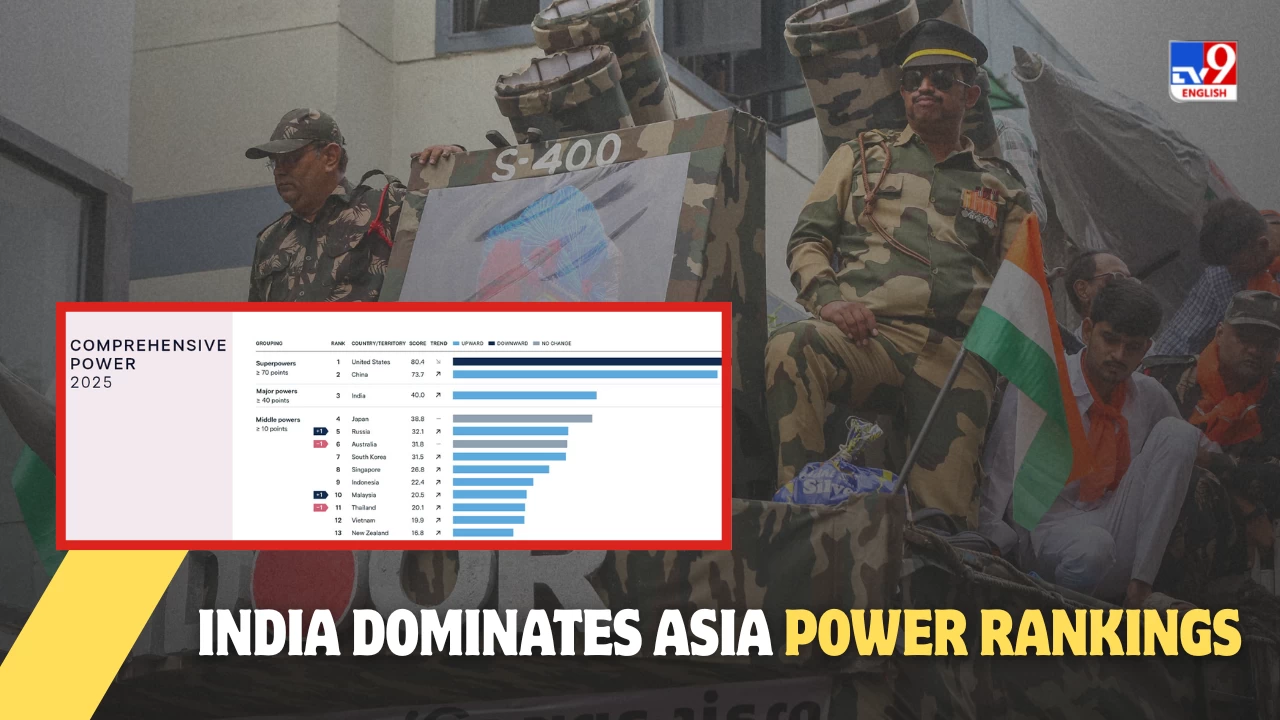
New Delhi: India has been declared a “major power” in the Asia Power Index 2025, with the Lowy Institute attributing its rise to strong economic momentum and improved military capability shaped by its performance in Operation Sindoor. The Australia-based think tank said the operation significantly enhanced expert assessments of India’s strategic weight in the region.
The study observed that India has, for the first time since the Index was introduced in 2018, improved its ranking for economic relationships. Although its trade engagement across Asia remains relatively limited, India has surpassed China to become the second most popular destination for inward foreign investment after the United States, measured by cumulative flows over ten years.
Analysts attributed this shift to global supply-chain diversification and India’s growing appeal as an investment destination.
Diplomatic commands shows slight improvement
Diplomatic influence also showed a slight improvement. The report linked this to more active bilateral outreach and expert assessments suggesting that the quality of India’s diplomatic corps has strengthened. Cultural influence continued to expand, supported by higher people-to-people movement, increased tourism and better air connectivity across the region.
However, the report warned that India’s structural gap with China has widened. China continues to strengthen its military capabilities, remains resilient in the face of US economic pressure, and has benefited from uncertainty surrounding Washington’s Asia policy under the Trump administration. Its diplomatic influence has reached a record high for any country ranked in the Asia Power Index.
Australia suffers slight decline; Russia clinches 5th spot
Australia, meanwhile, saw a modest decline, struggling to keep pace with the economic and military resources of other regional players. Russia, buoyed by support from China and North Korea, climbed back into fifth place in the overall rankings.
The United States recorded its lowest ever score in the 2025 Index. China has now narrowed the power gap with Washington to its smallest since 2020, positioning itself to withstand coercive US economic measures and presenting itself as a more predictable regional partner.
Russia’s influence in Asia continued to rebound. Despite ongoing sanctions and the costs of war, its economic and defence ties with authoritarian partners China and North Korea helped enhance its standing in the region.
Japan’s position remained largely stable. It registered modest gains in military capability but saw declines across other resource measures. Political turnover in Tokyo has reduced its visibility and influence as a foreign policy leader in the Indo Pacific.
Mixed picture for Southeast Asia
Southeast Asia presented a mixed picture. Several countries recorded small gains in comprehensive power in 2025. Malaysia, as ASEAN chair, benefited from increased regional influence, while others such as Thailand remained focused on domestic challenges. Indonesia’s President Prabowo Subianto directed much of his diplomatic attention beyond the region.
The assessment added that Australia faces a long term challenge in sustaining its influence in Asia. Its economic and military resources have weakened relative to regional competitors, leading to a drop below Russia in the 2025 rankings. The report stated that Australia will need to use its capabilities more effectively to retain its strategic weight.
The seventh edition of the Asia Power Index, compiled by Susannah Patton and Jack Sato, evaluates 27 countries and territories across 131 indicators grouped into eight categories. These include Military Capability, Defence Networks, Economic Strength, Diplomatic Reach, Cultural Power, Resilience and Future Resources. The Index covers nations from Pakistan in the west to the United States, Australia and New Zealand in the Pacific, and Russia in the north.