Sign In
By signing in or creating an account, you agree with Associated Broadcasting Company's Terms & Conditions and Privacy Policy.
By signing in or creating an account, you agree with Associated Broadcasting Company's Terms & Conditions and Privacy Policy.
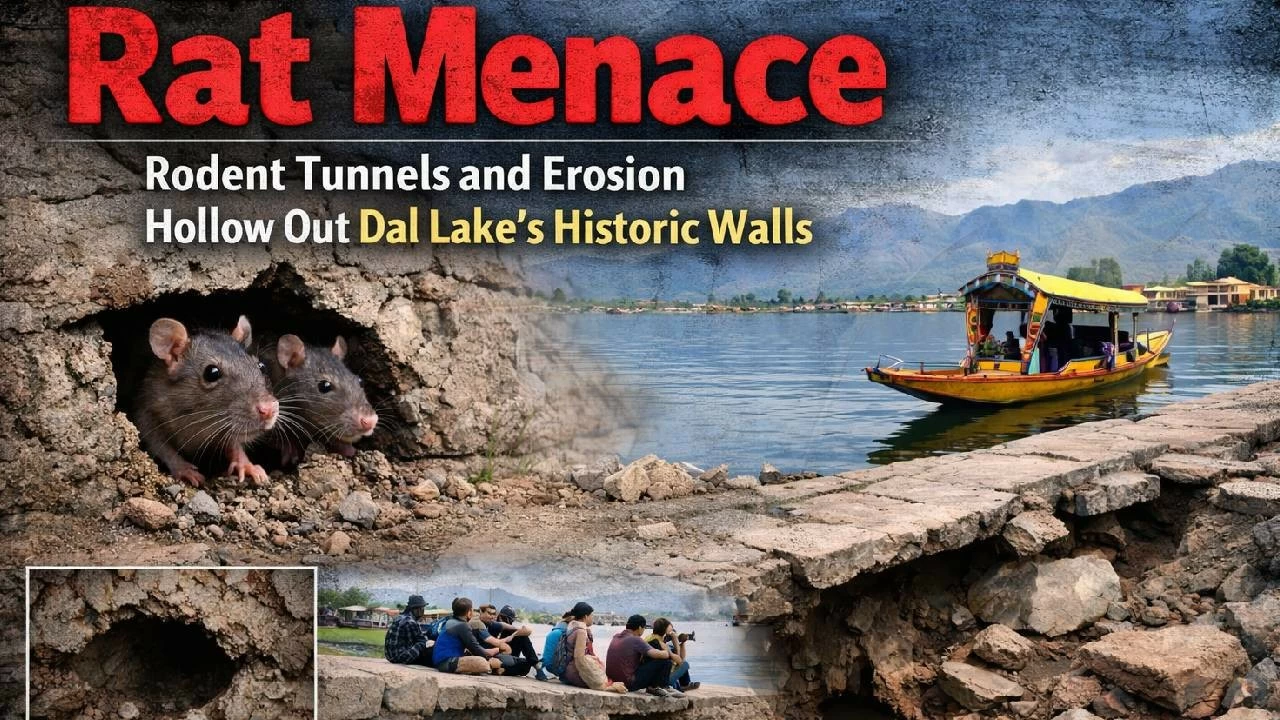


The world-famous Dal Lake in Srinagar, known for its serene waters and iconic shikaras, is facing a silent but dangerous structural crisis. Its historic retaining walls, or bunds, are reportedly turning hollow, raising urgent safety alarms for the thousands of tourists and locals who walk the lake’s edge daily.
Tunnels beneath the surface



Local residents and shikara operators have identified an unlikely culprit behind the weakening structures, ie a surging rat population. Visuals captured by TV9 show rats moving freely in and out of the lakeside walls in broad daylight.
Shikara operators allege that these rodents have dug extensive, deep tunnels beneath the pedestrian footpaths. This burrowing has reportedly compromised the soil foundation, leaving several sections of the walkway fragile and on the verge of cave-ins.
A heritage in decay
Many of these retaining walls date back to the Maharaja era. While some sections have been rebuilt following previous collapses, much of the original masonry remains. Experts and locals emphasise that these aged structures require meticulous annual maintenance to survive the dual pressure of time and environment.
Hidden dangers for tourists
The structural instability poses a significant risk to visitors. On any given day, hundreds of tourists can be seen resting or taking photographs along the lake’s edge, often completely unaware that the ground beneath them has been hollowed out.
The threat is not merely theoretical; the walls have already suffered two major collapses in the past year. In February 2025, a section of the footpath caved in due to erosion, leading to a long-term closure for repairs. Another collapse happened in September 2025 when a portion along Boulevard Road collapsed, where restoration work is still currently underway.
The official stance
While locals point to the rat infestation, officials from the Jammu and Kashmir Lakes Conservation and Management Authority (LCMA) have downplayed the role of rodents. They attribute the large-scale damage primarily to natural erosion processes.
The LCMA stated that they are actively identifying and repairing vulnerable sections. They also highlighted that parts of the Dal Lake bund have already been successfully restored under the Srinagar Smart City Project. Despite these efforts, locals and tourists complained of visible cracks, holes, and cavities along the walls of the Dal Lake.