


Sign In
By signing in or creating an account, you agree with Associated Broadcasting Company's Terms & Conditions and Privacy Policy.
By signing in or creating an account, you agree with Associated Broadcasting Company's Terms & Conditions and Privacy Policy.
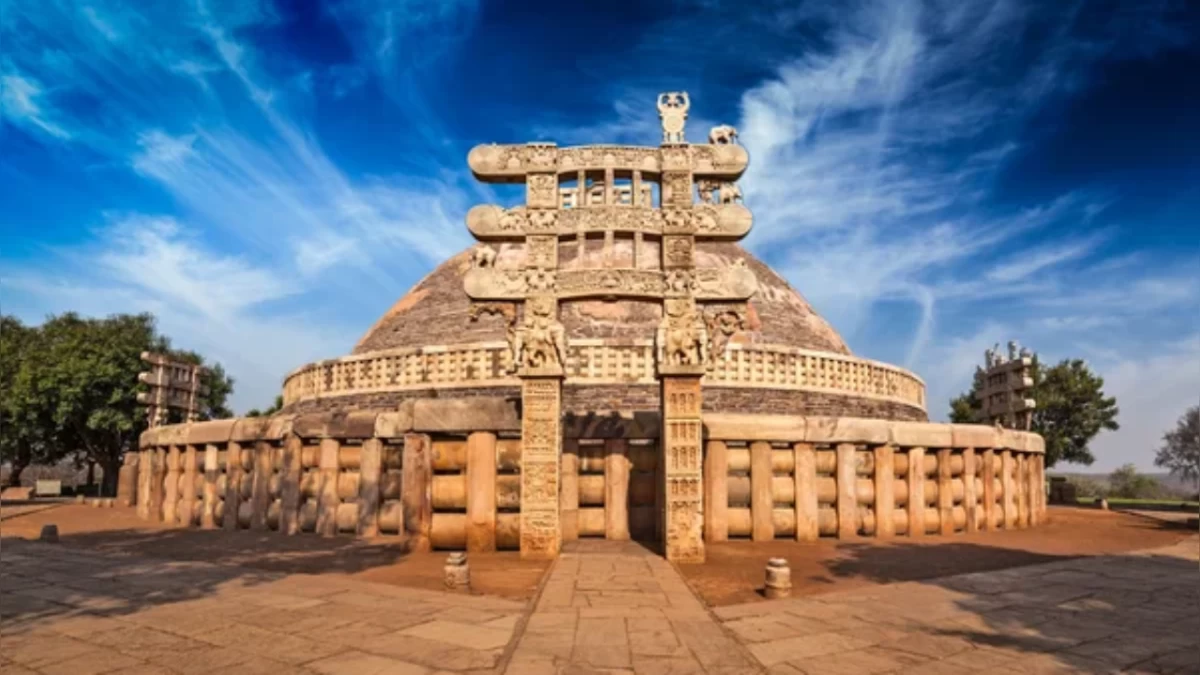


Kolkata: Sanchi is a quaint place in Madhya Pradesh and it is famous mostly for its UNESCO World Heritage Site which shows how Buddhism thrived and spread in India. On a hill overlooking the plain, Sanchi has a group of Buddhist monuments which include palaces, monolithic pillars, monasteries, and temples with most of them dating back to the 2nd and 1st centuries BC. It is the world's oldest Buddhist sanctuary at present and was a major Buddhist centre in India until the 12th century A.D.
Sanchi played a crucial role in the expansion of the influence of Buddhism in India, with the site being developed by Emperor Ashoka himself. The stupas and monuments of Sanchi, along with the inscriptions have helped scholars to decipher the impact of Buddhism on the Indian society, with their cultural and historical importance being so massive that the famous Sanchi Stupa is depicted on the reverse side of the Indian currency note of Rs 200.
Among the monuments in Sanchi, the most famous one is arguably the Great Stupa. It is one of the oldest stone structures in the country and is an important monument to our country's historical architecture. In the 3rd century BC, Mauryan emperor Ashoka originally commissioned it and a simple hemispherical brick structure acted as it nucleus over the relics of the Buddha. The 'chatra', a parasol-like structure which denotes high rank, acts as the crown of the Stupa.
Emperor Ashoka oversaw the stupa's original construction work. Incidentally, his wife Devi was a merchant's daughter hailing from the nearby Vidisha. Sanchi was the birthplace of Devi and also the place where the wedding of Ashoka and Devi took place. In the 1st century BCE, the Stupa got four elaborately carved gateways and a balustrade encircling the entire structure.
For centuries, the Sanchi Stupa and other monuments of the place remained in a state of complete abandonment. The first Western historian to document the existence of Sanchi Stupa was General Henry Taylor, who was a British officer in the Third Maratha War of 1817-1819. In 1822, Sir Herbert Maddock clumsily breached the Stupa, but it was Alexander Cunningham and Frederick Charles Maisey who conducted the first formal survey of the excavations at Sanchi. Till 1881, the site was ravaged by amateur archaeologists and treasure hunters and it stopped that year with the initiation of proper restoration work.
The Sanchi is one of the most important and earliest Buddhist centres and it has helped scholars to understand early India with respect to Buddhism. Preserved by the Archeological Survey of India, the reliefs of Sanchi have also helped us to imagine what ancient Indian cities look like. Also, one can find few artefacts of Sanchi in Western museums like at the Victoria and Albert Museum in London, and at the British Museum. A UNESCO World Heritage Sites since 1989, the monuments of Sanchi include the Great Stupa continue to enthrall people from all over the world with the heritage they represent.
The great Sanchi Stupa was probably vandalized during the 2nd Century BCE as has been presumed based on the Ashokavadana. According to some, it occured during the rise of Pushyamitra Shunga, the Shunga emperor which replaced the Mauryan Empire. As per suggestion, Pushyamitra possibly destoryed the original stupa and it was his son Agnimitra who rebuilt the structure. During the Shunga period, the original stupa made of brick was covered with stone. However, some scholars have argued against this as the Shungas never liked Buddhiusm. The structure was possibly rebuilt due to the private or collective efforts of people not linked to the royal court of the period.
Later, after the Satavahana Empire under Satakarni II conquered eastern Malwa, they constructed the decorated gateways around the stupas. The highly decorated gateways were built from the 1st century BCE, and also, the gateways and the balustrade were also coloured. The reliefs of the Great Stupa narrate Buddha's life along with everyday events to make the teachings more relatable to people. Local people donated money for the stupa's embellishment with no direct royal patronage being involved. Devotees donating money would often choose their favourite scene from Buddha's life and then have their names inscribed on it.

