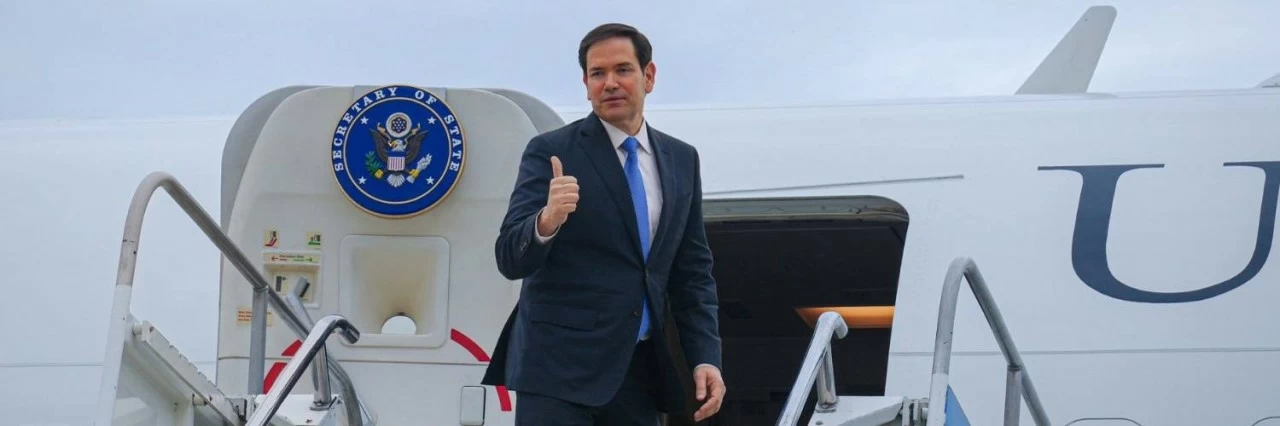
Delhi: US Secretary of State Marco Rubio has highlighted the perpetual vigilance with which the United States monitors the volatile relationship between India and Pakistan, emphasising that ceasefires, though crucial, can unravel with alarming speed. Speaking to NBC News, Rubio emphasised the inherent difficulty in maintaining such agreements, drawing parallels with other global flashpoints, such as Cambodia and Thailand.
Rubio elaborated on the intricate nature of ceasefires, stating, "the only way to have a ceasefire is for both sides to agree to stop firing at one another. And the Russians just haven't agreed to that." He stressed that beyond the initial agreement, the challenge lies in sustaining these halts in conflict, noting that "ceasefires can fall apart very quickly, especially after a three-and-a-half-year war (in Ukraine) like what we're facing now." His ultimate vision extends beyond temporary truces, aiming for comprehensive "peace deal so there's not a war now and there's not a war in the future."
In a separate conversation with Fox Business, Rubio revisited the India-Pakistan dynamic, referencing US President Donald Trump's frequent assertion that he played a pivotal role in resolving their recent tensions. Rubio lauded Trump's focus on "peace and the achievement of peace a priority of his administration," citing India-Pakistan alongside Cambodia-Thailand and Rwanda-DRC as examples where such efforts were visible.
“And I think we are very fortunate and blessed and should be thankful to have a President who has made peace and the achievement of peace a priority of his administration. We’ve seen it in Cambodia and Thailand. We’ve seen it in India-Pakistan. We’ve seen it in Rwanda and the DRC. And we’re going to continue to pursue any opportunities we can find to bring about peace in the world,” Rubio said.
However, these claims of American mediation in the India-Pakistan ceasefire have been met with clear refutations from New Delhi. Since May 10, when former President Trump first announced on social media that India and Pakistan had agreed to a "full and immediate" ceasefire following US-mediated talks, he has reportedly reiterated this assertion nearly 40 times, even linking it to promises of increased trade.
Yet, Prime Minister Narendra Modi, speaking in Parliament, explicitly stated that no foreign leader had asked India to halt "Operation Sindoor" (as per the original text, though this phrasing might be a typographical error or an unusual reference to a military operation). Similarly, External Affairs Minister S. Jaishankar outright dismissed Trump's claims, confirming that there was no third-party involvement in reaching a ceasefire with Pakistan during "Operation Sindoor" and that the agreement had no connection to trade discussions. This divergence highlights a persistent diplomatic narrative where US claims of intervention are squarely contradicted by Indian leadership.