Sign In
By signing in or creating an account, you agree with Associated Broadcasting Company's Terms & Conditions and Privacy Policy.
By signing in or creating an account, you agree with Associated Broadcasting Company's Terms & Conditions and Privacy Policy.
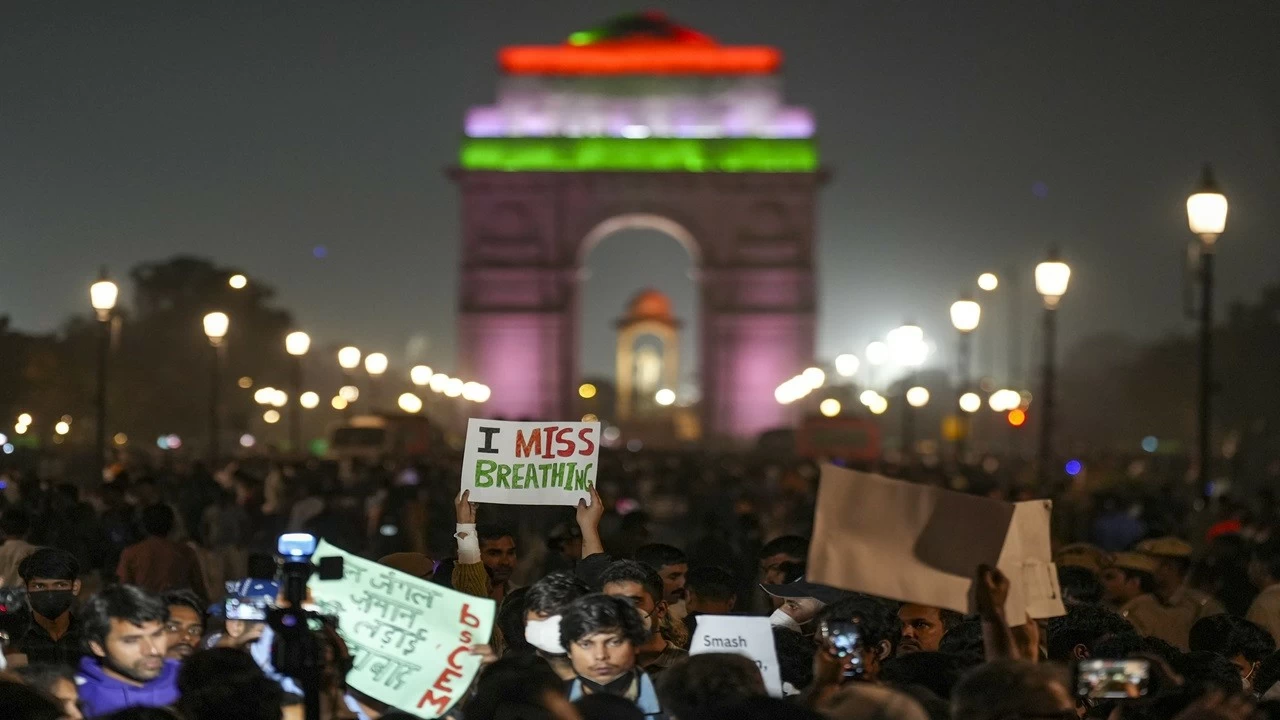

New Delhi: The National Capital has been waking up to smoggy mornings for quite sometime now, and Sunday was no exception. The air quality in Delhi continued to worsen and people were forced to breathe toxic air. In the afternoon, many of them gathered at India Gate to lodge their protest against the air pollution crisis. They demanded immediate government action and stringent steps to combat the "air emergency".
There were also some women who brought their children, carrying nebulisers and medical prescriptions — to drive home how the pollution crisis is choking the city. As the protest mounted, police detained some of the demonstrators. They were taken away and reportedly shoved into a bus. Police claimed that the protesters were repeatedly asked to stage their demonstration at Jantar Mantar, the city’s designated site for public gatherings. When the residents refused to comply, they had to be taken away, the cops pointed out, adding that the detained protesters were later released.
The city’s air quality stayed in the ‘very poor’ category on Sunday morning, with the overall Air Quality Index (AQI) standing at 391, according to the Central Pollution Control Board. But protesters claimed that private monitors showed that the air quality index had crossed 999 at several locations.
The protesters demanded "urgent, accountable and transparent action" from Delhi government to combat the air pollution crisis. They called for an independent air regulator, open access to real-time air data and greater transparency in it, clear health warnings during pollution peak periods, and public accountability in how funds for pollution control are used.
The protesters also said that clean air was a fundamental right of every citizen under Article 21 of the Constitution — Right to Life. They urged the Delhi and central governments to move beyond short-term measures and work towards lasting solutions to protect public health. They wanted to highlight what they called the government’s inaction amid the aggravating situation.
One demonstrator said, "Private monitors show that the air quality index has crossed 999 at several locations. Instead of taking concrete action, authorities are shutting down a peaceful protest. What are people asking for? Their right to breathe. For the last 15 days, we haven’t heard anything — no lockdown, no shutdown. There are only stories about cloud seeding or other distractions. It’s a very unfortunate situation."
"We want to meet our elected officials. We had sought an appointment with the chief minister but were refused. So many parents are here because their children are suffering. Every third child already has damaged lungs; they will live nearly 10 years less than those growing up in cleaner air," environmentalist Bhavreen Khandari was quoted as saying by PTI.
Delhi's air quality has remained in the “very poor” category. The protest shows that public anger is mounting over Delhi’s deteriorating air quality and lack of effective government response. The protest draws attention to a worsening health emergency and the need for sustainable, accountable solutions.
The protest will prompt the government to heed to the "air emergency". It should serve as a wake-up call for authorities to realize the magnitude of Delhi’s pollution crisis. A decisive, long-term action instead of temporary fixes, like artificial rain, is not the solution. Residents have made this point very clear through their protest. The public pressure has been brought to the forefront, and this will force the policy-makers to shed their myopia and devise an action plan for providing residents clean air.