Sign In
By signing in or creating an account, you agree with Associated Broadcasting Company's Terms & Conditions and Privacy Policy.
By signing in or creating an account, you agree with Associated Broadcasting Company's Terms & Conditions and Privacy Policy.
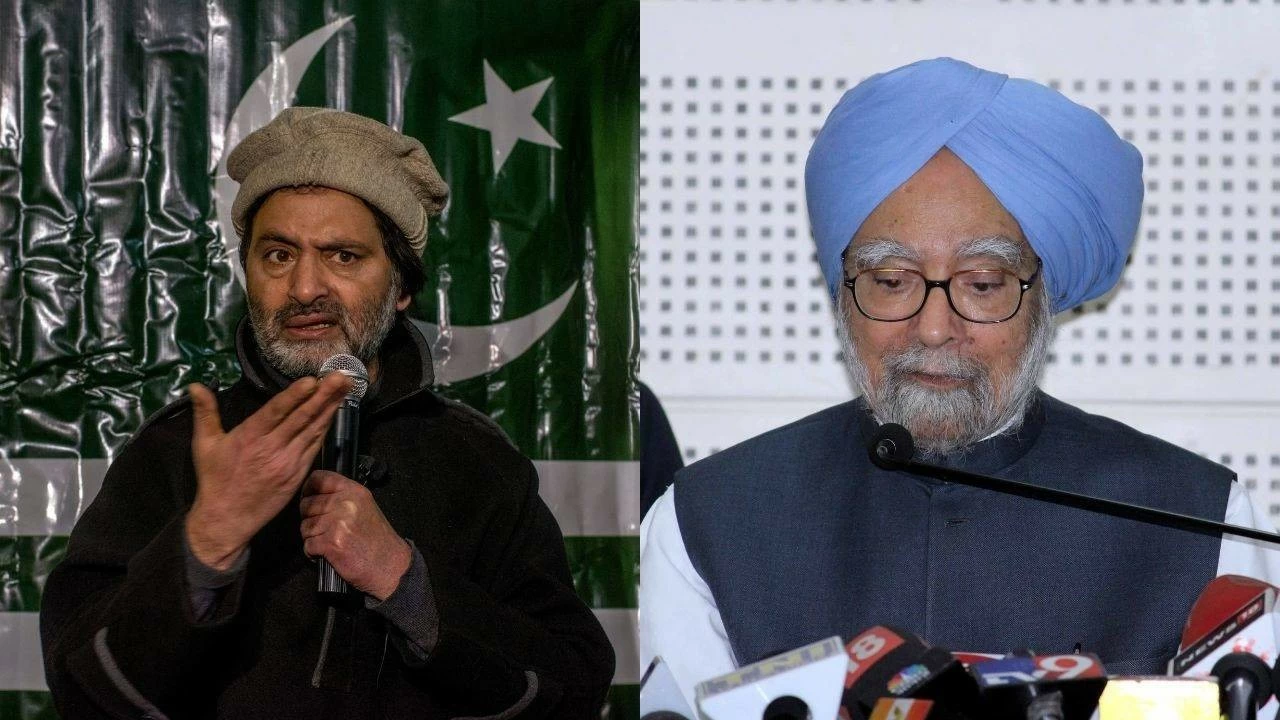

New Delhi: Yasin Malik, the Jammu and Kashmir Liberation Front (JKLF) terrorist serving a life imprisonment in a terror funding case, has claimed that ex-PM Manmohan Singh expressed his gratitude to him after his 2006 meeting in Pakistan with Lashkar-e-Taiba (LeT) founder and 26/11 mastermind Hafiz Saeed.
This was stated in an affidavit filed in the Delhi High Court by him on April 25. Malik made the sensational claim that the 2006 meeting with Saeed was held at the request of senior Indian intelligence officials.
According to Malik's statement, then Special Director of Intelligence Bureau (IB) VK Joshi had a meeting with him in Delhi ahead of his visit to Pakistan following the 2005 earthquake in Kashmir. Joshi allegedly asked Malik to engage not only with Pakistan’s political leaders but also with terrorist leaders, including Saeed, to back Singh’s peace initiatives.
Malik pointed out that during his meeting with Joshi, he was told that he should rope in terrorist leaders. He added that he agreed to meet Saeed and other United Jihad Council leaders at a programme in Pakistan.
In his affidavit, Malik mentioned that Saeed held a gathering of militant outfits, where the former gave an address asking terrorists to move towards peace. Citing Islamic teachings, he said he advocated for reconciliation over violence, stressing that if someone offers you peace, embrace it.
However, the meeting later turned controversial, as it was portrayed as evidence of Malik’s ties to Pakistani terror outfits. In his affidavit, Malik said that this was a "classic betrayal", adding that the meeting was an officially sanctioned effort that was later distorted for political reasons.
"This meeting of mine with Hafiz Saeed and other militant leaders of Pakistan which was initiated and executed only on the request of special director IB VK Joshi, was portrayed in a different context against me," he stated.
After he returned to New Delhi, he debriefed the IB and was asked to brief the PM directly.
Malik said he met PM Singh in the Capital that same evening, with then National Security Advisor MK Narayanan also present. He added that during the meeting, Singh personally thanked him for his endeavour, patience, and dedication.
"When I returned to New Delhi from Pakistan…I met PM Manmohan Singh the same evening…I briefed him on my meetings…he conveyed his gratitude to me for my efforts, time, patience and dedication," according to the affidavit.