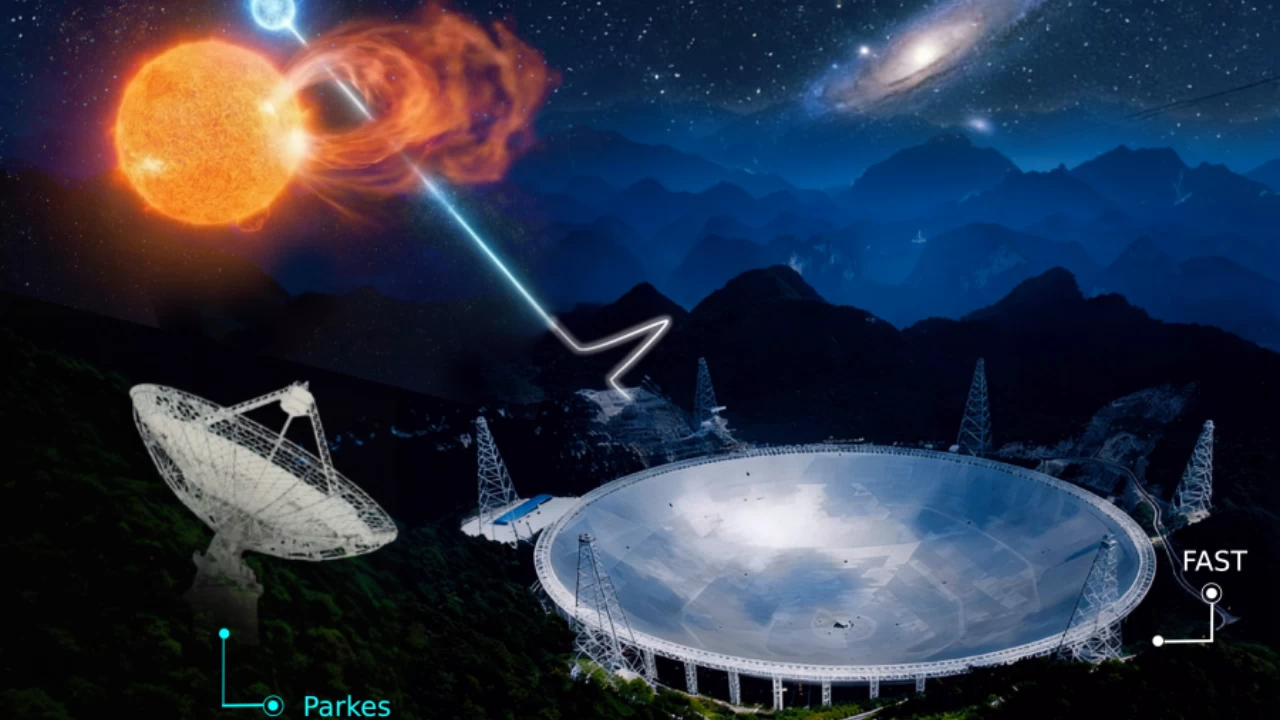
New Delhi: Astronomers have uncovered compelling new evidence that some fast radio bursts (FRBs) originate from binary star systems, overturning the long-held assumption that these powerful cosmic signals come from isolated stars. The discovery was made by an international research team that includes scientists from The University of Hong Kong, using China’s giant radio telescope known as the “Sky Eye”.
By analysing nearly 20 months of data from a repeating FRB located about 2.5 billion light-years away, the researchers identified a clear signature of a companion star orbiting the source. The findings, published in Science, provide the strongest evidence so far that at least some repeating FRBs are produced in binary stellar systems rather than by lone neutron stars.
FAST telescope spots an unusual signal
The breakthrough came from observations made with the Five-hundred-meter Aperture Spherical Telescope (FAST) in Guizhou. The team detected a rare phenomenon known as an “RM flare”, marked by a sudden and extreme change in the polarisation of the radio signal.
Such changes occur when radio waves pass through dense, magnetised plasma. In this case, the researchers believe the plasma was ejected by a nearby companion star, briefly altering the environment around the FRB source as it crossed the line of sight.
Clues point to a magnetar in a binary system
According to Professor Bing Zhang of HKU, the evidence strongly supports a system containing a magnetar, a neutron star with an ultra-strong magnetic field paired with a star similar to the Sun. A coronal mass ejection from the companion star likely caused the RM flare observed by FAST.
The rapid rise and fall of the rotation measure over just two weeks matches what astronomers see from stellar eruptions in our own galaxy, making the binary explanation the most natural fit.
Long-term monitoring reveals hidden behaviour
Most fast radio bursts are seen only once, but a small number repeat. These repeating FRBs allow scientists to monitor them over long periods and catch rare events. FRB 220529A, the source behind this discovery, was quietly observed for months before the dramatic signal change appeared.
The study also aligns with a broader theory that all FRBs may originate from magnetars, with binary companions helping shape when and how often the bursts repeat. Researchers say continued monitoring with FAST and other telescopes could reveal how common such binary systems are and bring scientists closer to solving one of astronomy’s biggest mysteries.