Sign In
By signing in or creating an account, you agree with Associated Broadcasting Company's Terms & Conditions and Privacy Policy.
By signing in or creating an account, you agree with Associated Broadcasting Company's Terms & Conditions and Privacy Policy.
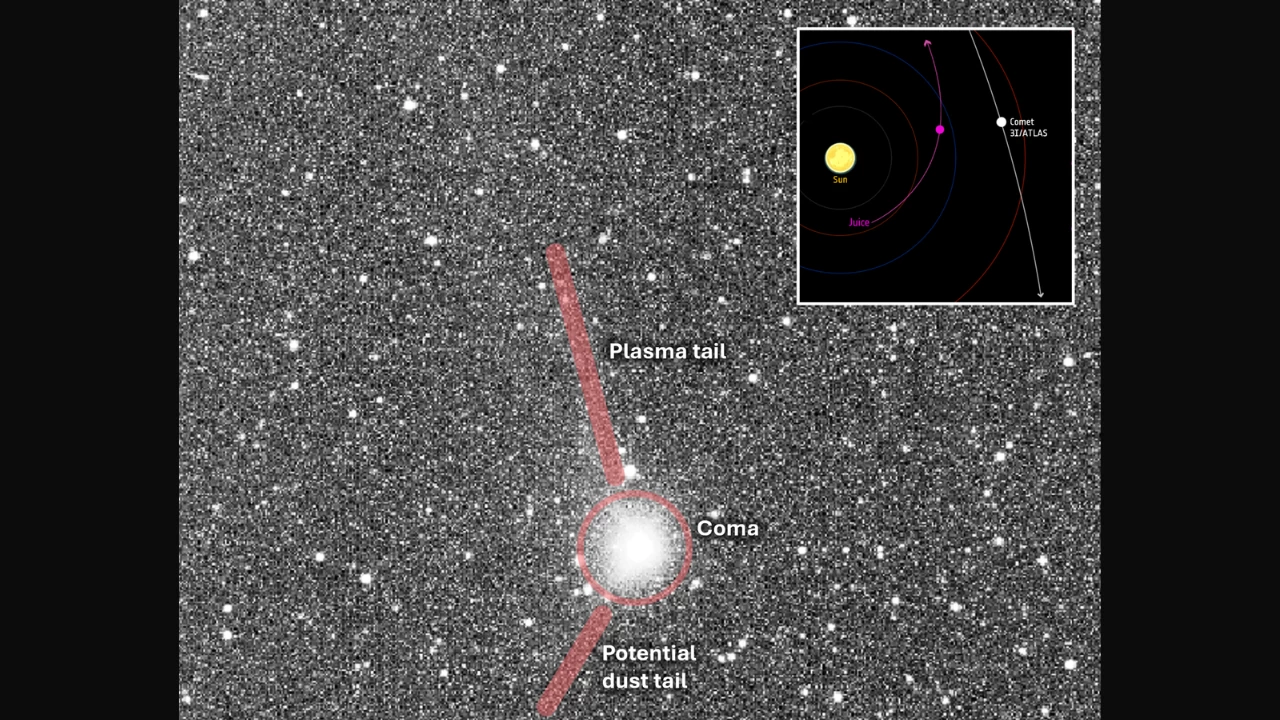


New Delhi: Jupiter Icy Moons Explorer (Juice), an ESA mission, has unexpectedly made a provisional observation of a comet, 3I/ATLAS, located in the interstellar. Juice observed the behaviour and composition of the comet with five science instruments during its observing window of November 2025. Although the detailed information will not arrive on Earth until February 2026, the mission team downloaded a slightly bigger part of one of the many Navigation Camera (NavCam) images, and what they saw surprised them.
The NavCam is not a science-orientated instrument, but the partial frame clearly showed the comet with a bright coma around it and some signs of two separate tails. The image seems to have a plasma tail stretching upwards, and potentially a dust tail has a slight extension to the lower left. The shot was captured on 2 November, two days prior to Juice's closest encounter distance at approximately 66 million kilometres.
Juice was further away from 3I/ATLAS than the Mars orbiters when they observed it in October, but it caught a glimpse of the comet at the time when it was nearest to the Sun. This made the spacecraft reach the comet more actively. A NavCam snapshot indicates that there was high outgassing that the mission team anticipates observing further when the entire instrument data is received.
The five instruments in use, JANUS, MAJIS, UVS, SWI and PEP, were utilised in capturing images, spectrometry readings, composition data and particle measurements. Juice, however, has its main high-gain antenna that is currently acting as a heat shield against the Sun, retarding the transmission of data through the medium-gain antenna. This means that the scientific information will arrive on the earth on 18 and 20 February 2026.
Scientists are hoping that JANUS will produce sharper images and the spectrometers and particle detectors will be able to give more in-depth analysis. They will assist scientists in gaining a clearer insight into the structure and functioning of 3I/ATLAS as it goes around the solar system. ESA will be updating and posting FAQs on its official page, which is at esa.int/3IATLAS.