Sign In
By signing in or creating an account, you agree with Associated Broadcasting Company's Terms & Conditions and Privacy Policy.
By signing in or creating an account, you agree with Associated Broadcasting Company's Terms & Conditions and Privacy Policy.
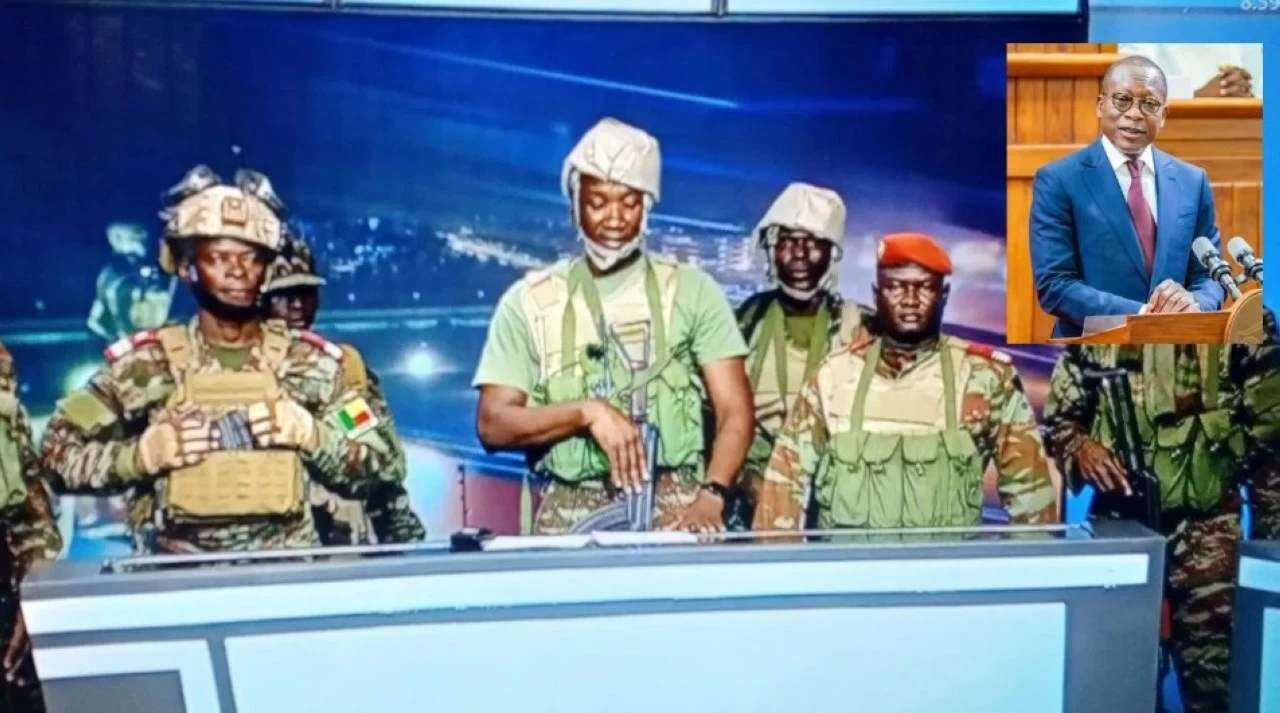


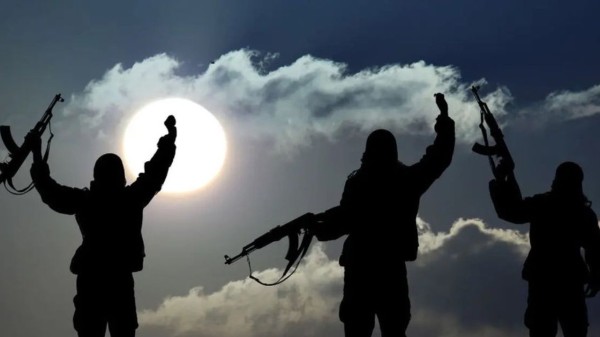
In a stark reminder of West Africa's fragile political landscape, the Republic of Benin has become the latest nation to succumb to military rule. On Sunday, a familiar script unfolded on state television as a group of uniformed soldiers declared the ousting of President Patrice Talon and the dissolution of his government. The military marked a swift and decisive seizure of power in the region.
This unsettling event places Benin squarely within a disturbing trend of military takeovers that has been reshaping the African continent since 2020.
President Talon, who assumed office in 2016 and was slated to conclude his term next April following scheduled presidential elections, now finds his status uncertain. While Wilfried Houngbedji, the official spokesperson for the Benin Government, attempted to quell immediate concerns by stating "everything is fine" to The Associated Press, he offered no further details, leaving observers to speculate on the president's condition.
The renegade military faction, identifying itself as the "Military Committee for Refoundation," appointed Lieutenant Colonel Pascal Tigri as the new head of the military committee in Benin. The coup in Benin echoes a pattern seen across the region, often fueled by a volatile mix of disputed elections, constitutional manoeuvres by incumbent leaders, escalating security crises, and widespread youth discontent.
This latest coup punctuates an already extensive timeline of military interventions that have upended democratic processes across Africa in recent years.
Mali: A double blow (August 2020 & May 2021)
Mali initiated this troubling trend with two successive coups. The first in August 2020 saw soldiers mutiny and apprehend senior military officers near Bamako, following weeks of civilian protests against then-President Ibrahim Keïta. He faced accusations of corruption and a failure to address the growing threat of armed groups. A transitional government was established, with military leader Colonel Assimi Goita as vice president alongside civilian president Bah Ndaw.
However, this power-sharing arrangement proved short-lived. In May 2021, Goita orchestrated a second coup, removing Ndaw and installing himself as president, subsequently delaying elections from 2022 to a distant 2027. Mali, along with Burkina Faso and Niger, now forms a defiant tripartite bloc of military juntas, having severed ties with the Economic Community of West African States (ECOWAS) and firmly rejecting a swift return to democracy.
Chad: Dynastic succession by force (April 2021)
In Central Africa, Chad experienced a different form of power transfer. Following the death of his father, Idriss Deby Itno, in 2021, army general Mahamat Idris Deby swiftly seized power, extending his family's three-decade rule. Three years later, Deby oversaw an election he had promised, declared himself the winner amid opposition claims of widespread rigging. Notably, former Prime Minister Succes Masra, a prominent opposition figure, was sentenced to 20 years in prison earlier this year.
Guinea: The third-term trap (September 2021)
After 11 years in office, President Alpha Condé of Guinea was overthrown by a military group led by Mamady Doumbouya. Conde's controversial 2020 constitutional amendment, which allowed him to seek a third term, was a significant catalyst. Doumbouya is now preparing to contest the December polls, aiming to shed his military attire after a recent referendum controversially allowed junta members to stand in elections and extended the presidential term limit from five to seven years.
Sudan: A partnership to catastrophe (October 2021)
Sudan's military, under General Abdel-Fattah Burhan, staged a coup in October 2021, ousting Omar al-Bashir after his 26-year rule. Burhan then entered a power-sharing arrangement with Muhammad Dangalo, known as "Hedmeti," the leader of the powerful paramilitary Rapid Support Forces. However, their simmering feud erupted into one of the world's most catastrophic conflicts in April 2023, a devastating civil war that continues to ravage the nation, as highlighted by the United Nations.
Burkina Faso: A cycle of instability (January & September 2022)
Following its neighbour Mali's lead, Burkina Faso also endured two successive coups. In January 2022, Lieutenant Colonel Paul-Henri Damiba ousted President Roch Kaboré. However, Damiba's rule was short-lived, as Captain Ibrahim Traoré, head of an army artillery unit, overthrew him in September of the same year.
Niger: The dramatic coup (July 2023)
Gen Abdourahamane Tchiani ousted Mohamed Bazoum, ending a rare democratic transition in Niger. The dramatic coup sparked a crisis in the regional ECOWAS bloc, which threatened to invade Niger if Bazoum was not installed and the country returned to democracy.
Gabon: President Ali Bongo thrown out of power after 14 years (August 2023)
Shortly after President Ali Bongo, who had been in power for 14 years and had run for a third term, was declared the winner of an election in 2023, a group of soldiers appeared on television saying they were seizing power. They cancelled the election and dissolved all state institutions.
Brice Oligui Nguema, a cousin of Bongo, took power and has since ruled Gabon. He was announced the winner of a presidential election in April.
Madagascar: Water crisis and power outage (October 2025)
Expressing their frustration over chronic water shortages and power outages, young people in Madagascar took to the streets to demand former President Andry Rajoelina's resignation. Rajoelina instead dissolved his government and refused to resign, leading to a military takeover of the southern African country.
As Benin grapples with its new military leadership, the continent watches with bated breath, concerned that this pattern of coups is not merely a series of isolated incidents, but rather a dangerous precedent threatening to unravel years of democratic progress and stability across Africa.