Sign In
By signing in or creating an account, you agree with Associated Broadcasting Company's Terms & Conditions and Privacy Policy.
By signing in or creating an account, you agree with Associated Broadcasting Company's Terms & Conditions and Privacy Policy.
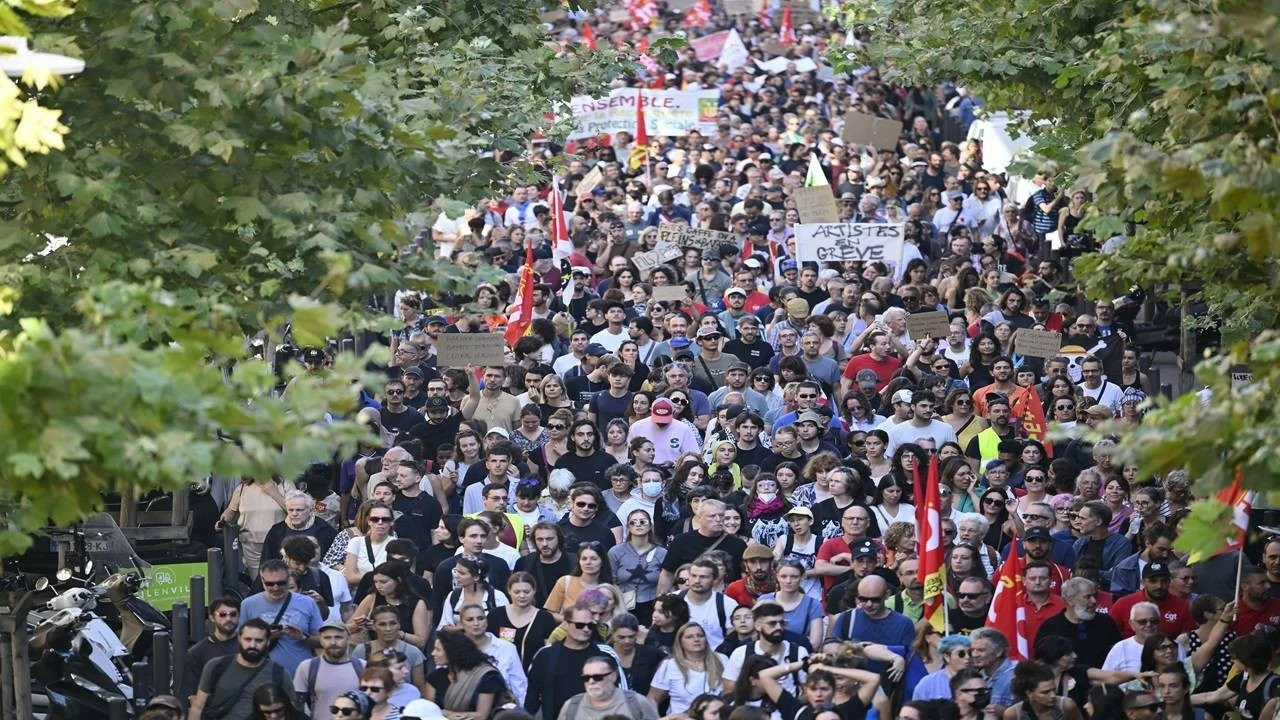


New Delhi: France has been rocked by a wave of protests with thousands of demonstrators hitting the streets, obstructing highways, setting barricades ablaze and clashing with police on Wednesday. They held the banner 'Bloquons tout' (Block Everything).
In Paris, police had to resort to teargas to disperse the crowd. In Lyon, protesters blocked a road and set trash bins on fire. Police prevented around 200 demonstrators from setting up barricades on a main road in the port city of Marseille. In the southwest, a fire caused damage to electrical cables, resulting in halting of train services on one line and disrupting traffic on another.
More than 80,000 security personnel have been deployed across the country. French Interior Minister Bruno Retailleau has issued a stern warning of “zero tolerance” for any acts of violence by the demonstrators.
The protesters are venting their anger against the entire political elite, proposed budget cuts and President Emmanuel Macron. The protests reflect widespread discontent among the people that has spread on social media. The unrest has been simmering. They want to put pressure on President Emmanuel Macron and many want him to resign.
The movement spread online without a clear leadership, while giving voice to a number of grievances against the government. Many people are peeved with the budget cuts recommended by Prime Minister François Bayrou, who was removed from office on Monday (September 8) after lawmakers voted no-confidence motion. Bayrou had suggested huge cuts in public spending by 44 billion euros ($51 billion) to address France’s growing deficit and trillions in debt. The protesters claim that Bayrou’s spending cuts hurt workers and pensioners while shielding the wealthy.
There are also allegations that the political system in France has been favouring large corporations and ultra-wealthy billionaires, while ignoring the rights of ordinary citizens. A number of protesters have demanded overhauling of the constitution, while some want that higher taxes should be imposed on the rich.
The decentralised nature of the 'Block Everything' protests brought back memories of the Yellow Vests, the anti-government movement that swept France in 2018. These protests were also driven by public anger and spread fast through social media. Without a formal leadership, protesters got united by shared frustrations rather than a single agenda.
The history of mass protests in France is quite old. From the 17th French Revolution which overthrew the monarchy to the recent 'Block Everything', the French view protest as a citizen’s duty to speak out when something is wrong, not as a disruption.
In May 1968, the country was gripped by civil unrest with massive student demonstrations, general strikes, and factory occupations. The protesters demanded social, political, and educational reforms. In
In 1995, there were strikes and protests across France as a result of which the government was forced to withdraw controversial pension reforms affecting public sector workers.
In 2006, massive demonstrations were staged against proposed reforms to higher education and labour laws for young workers. Due to the aggressive protests, the government had to make policy changes.
So, these protests, most of the time, have brought about changes in the system. The 40-hour workweek, the withdrawal of pension reforms, and the scrapping of student reforms in 2006 — all these were achieved through mass protests and public resistance.
There's a prevalent culture in France that encourages youths and people to question those in authority and hold them accountable for their acts. Protests are seen as a way to safeguard the rights and bring about fairness, mostly when the public feels that the wealthy or powerful are being favoured. Protests cause problems and often political upheaval, but the French see it necessary for keeping a robust democracy intact.
Amid the 'Block Everything' movement, a protester in Lyon said: "We need change." It is this overriding public sentiment that has unseated governments in France before — and Emmanuel Macron could be the next!