

Sign In
By signing in or creating an account, you agree with Associated Broadcasting Company's Terms & Conditions and Privacy Policy.
By signing in or creating an account, you agree with Associated Broadcasting Company's Terms & Conditions and Privacy Policy.
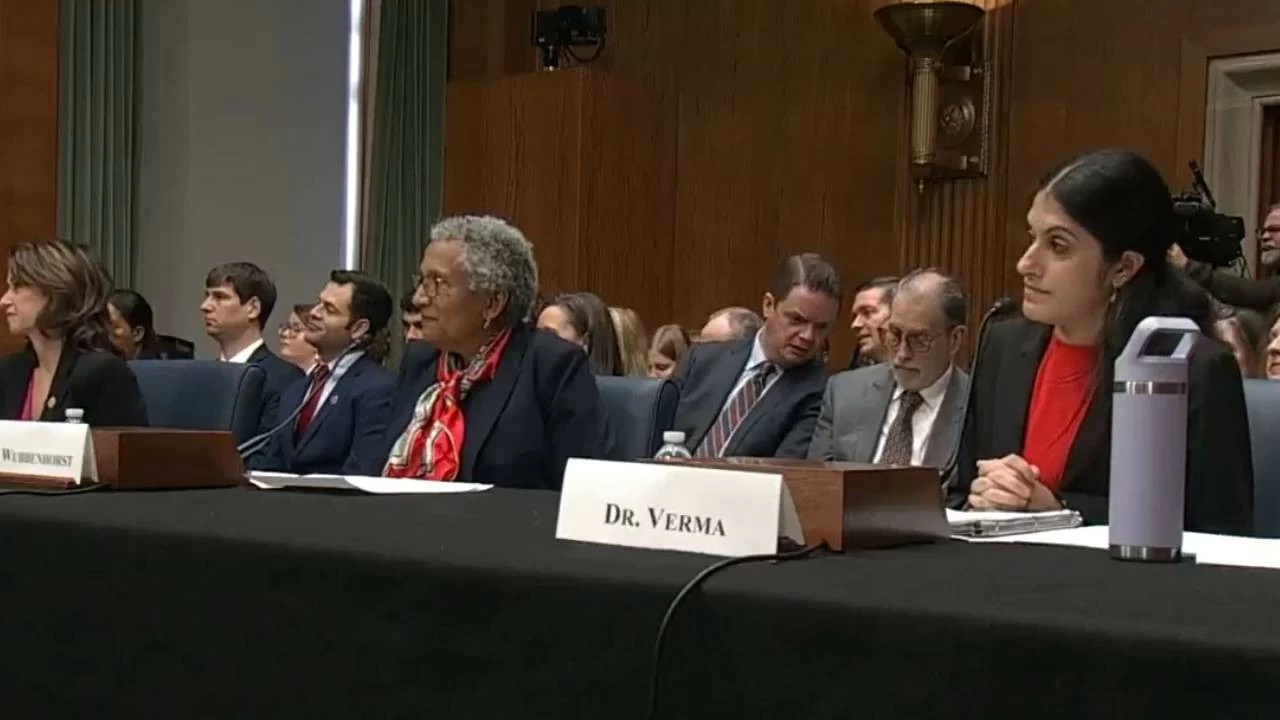


New Delhi: What began as a Senate inquiry into the pharmaceutical safety of abortion pills transformed into a viral cultural flashpoint this Wednesday, as lawmakers and medical experts clashed not just over medicine, but over the very definition of who can conceive.
The eye of the storm, an Indian-origin obstetrician-gynaecologist
Dr Nisha Verma, an Indian-origin obstetrician-gynaecologist and senior advisor for Physicians for Reproductive Health, who identifies with “she/her” pronouns, found herself at the centre of a heated exchange during a Senate Health, Education, Labour, and Pensions (HELP) Committee hearing. While invited as a Democratic witness to discuss reproductive care, Verma became the target of a sharp line of questioning regarding biological reality.
The tension ignited when Senator Ashley Moody (R-Fla.) and later Senator Josh Hawley (R-Mo.) pressed the doctor on a singular point, Can men get pregnant?
A collision of science and politics
Dr Verma repeatedly declined to offer a simple "yes" or "no," opting instead to frame the issue through the lens of inclusive care. “I do take care of patients with different identities. I take care of many women,” Verma told the committee, explaining her hesitation by suggesting the questions were a “political tool” designed to oversimplify a complex social reality. She accused the Republican senators of being “polarised” and attempting to steer a scientific discussion into a partisan trap.
Senator Hawley, however, was not moved by the explanation. “The goal is to establish a biological reality,” he retorted, challenging Verma’s credentials as a woman of science. “I don’t know how we can take you seriously... if you won’t level on this basic issue.” Hawley eventually punctuated the debate by stating for the record, “It’s women who get pregnant, not men.”
The battle over Mifepristone
While the gender debate dominated social media headlines, the hearing’s primary purpose was to examine the regulatory landscape of medication abortion. The discussion took place amidst a simmering feud between pro-life organisations and the political establishment over the safety of Mifepristone.
Mifepristone, which was approved by the FDA in a generic form last October, is the first half of a two-drug regimen (followed by misoprostol) used to terminate early pregnancies. According to the Guttmacher Institute, this "medication abortion" now accounts for nearly two-thirds of all abortions performed in the United States.
The safety divide
The committee heard two starkly different versions of medical reality:
The Pro-Life Argument: Advocacy groups are pushing for more rigorous, independent safety studies, citing concerns over rare but serious complications associated with the drug.
The Pro-Choice Argument: Critics and many medical bodies maintain that mifepristone, which has been used in the U.S. since 2000 and is also used to treat Cushing’s syndrome, is backed by dozens of studies proving its safety and efficacy.