Sign In
By signing in or creating an account, you agree with Associated Broadcasting Company's Terms & Conditions and Privacy Policy.
By signing in or creating an account, you agree with Associated Broadcasting Company's Terms & Conditions and Privacy Policy.
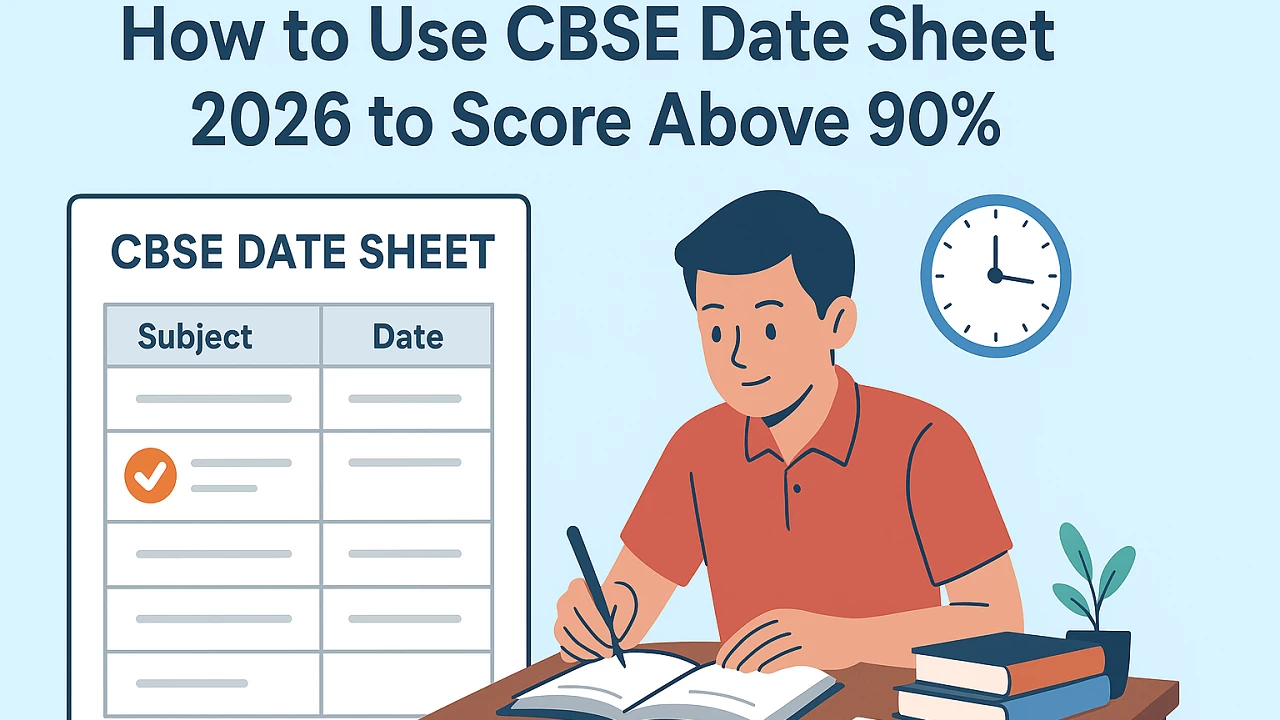


New Delhi: The wait for CBSE date sheet 2026 is almost over. The Central Board of Secondary Education (CBSE) has released the tentative date sheet for board exams 2026. It has released CBSE date sheet 2026 for Class 12 main examination, along with Class 10 Phase 1 and 2 exams. Parents and students can access the CBSE timetable 2026 pdf on the official website at cbse.gov.in.
The Board has announced that the CBSE Class 10 written exams, 1st phase, will be held from February 17 to March 9, 2026. The CBSE 10th 2nd phase exams will be conducted between May 15 and 29, 2026. The Class 12 written exams 2026 will be held in a single phase from February 17 to April 9, 2026.
With CBSE board exams 2026 less than five months away, students should start their exam preparation aggressively. The best way to start preparation is to use a date sheet. A person who starts CBSE exam preparation by planning effectively cannot score less than the 90th percentile in board exams. Here we have shared key tips to score well in board exams using a date sheet.
Identify the gaps between exams
The first and foremost task for students is to identify the gaps between subjects. This will allow students to revise well for board exams, specifically for shorter gaps.
Focus on weak subjects
As the exam dates are available now, it is important for students to know their weak and strong subjects. It is always suggested to master the weak subjects first so that it reduces pressure.
Prepare a study timetable
It is high time for students to prepare their own study timetable to score above 90 per cent in board exams. K Nagaraju, headmaster of the government school in Yelamanchili, Andhra Pradesh, said 2-2-1 rule is best to deal with tough subjects. One should dedicate 2 hours for tough subject, 2 hours of scoring subject and 1 hour for revision.
Dedicate time to solving sample papers
While drafting the study timetable, students need to dedicate time to solving sample question papers and attempting mock tests. This practice will enable you to actually feel the CBSE exam timing.
Always NCERT books...first!
Students should note that most of the questions are direct from the NCERT textbooks. Of course, one refers to the other study material and guides but always keep NCERT as the first choice.
Plan last week effectively
The last week of exam preparation is very important to keep stress under control. Students should prepare their own study notes that can be revised within 2-3 hours.