


Sign In
By signing in or creating an account, you agree with Associated Broadcasting Company's Terms & Conditions and Privacy Policy.
By signing in or creating an account, you agree with Associated Broadcasting Company's Terms & Conditions and Privacy Policy.
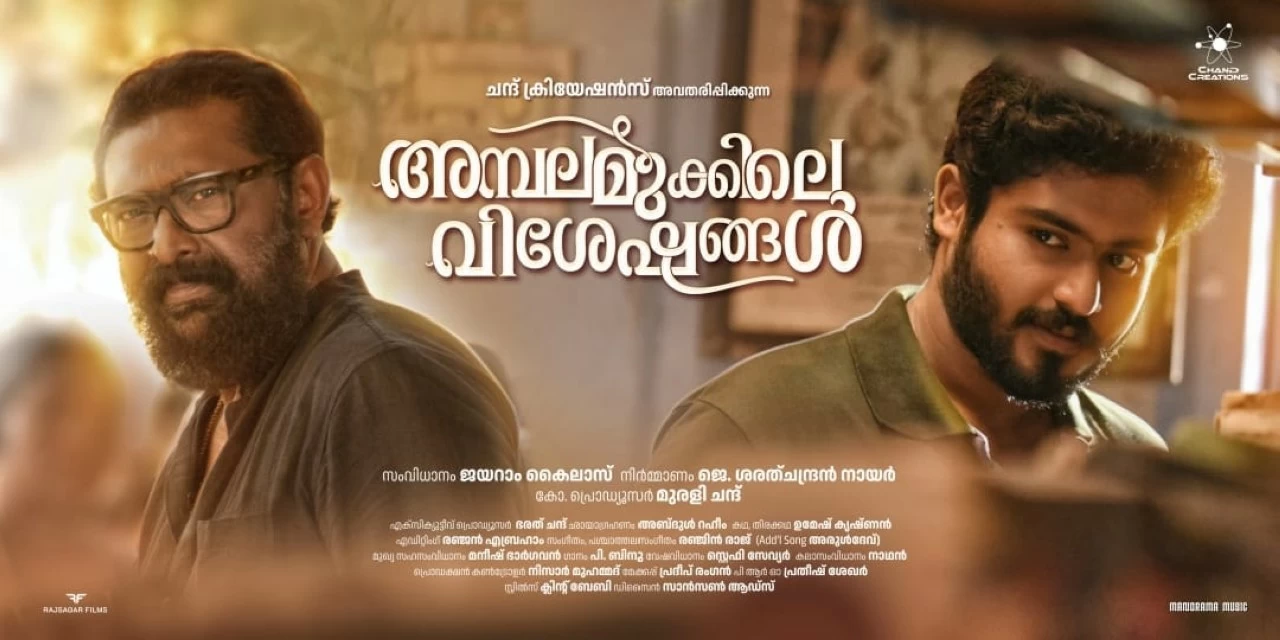


Palakkad: Few days into theatres, ‘Ambalamukkile Visheshangal’, the latest venture by director Jayaram Kailas starring Gokul Suresh continues to create waves among the youth.
In the bustling landscape of Malayalam cinema, where high-concept thrillers, violence and intense dramas often dominate discourse, Ambalamukkile Visheshangal arrives as a gentle, unassuming counterpoint.



Produced by Chand Creations, this film is less about breaking new ground and more about revisiting a familiar, comforting space—the nostalgic, rumor-filled lanes of a typical Kerala village. Its success lies not in shock value, but in its steadfast commitment to being a simple, emotional, and often humorous slice-of-life tale. For audiences seeking a respite from complexity, this film offers a predictable yet pleasant two-hour getaway.
“The movie, even though not in a huge banner, has managed to hot the right chord. There are ample moments in the movie where the thread of the movie is connected very well to the heart of the small villages and some good moments that every cinema goer will cherish”, said Darshan P, a cinema reviewer from Thalassery.
The plot centers on Pappu (Gokul Suresh), a 23-year-old whose sudden disappearance becomes the central nervous system of Ambalamukku village. What unfolds is a classic study in how information vacuums in close-knit communities are inevitably filled with gossip, speculation, and dramatic conjecture. The screenplay, penned by Umesh Krishnan, diligently maps out the social ecosystem of the village, introducing us to a roster of characters who each represent an archetype we instantly recognize: the concerned elder, the melodramatic neighbor, the cunning local politician, and the helpless romantic interest. The central question—"Is Pappu dead?"—serves less as a gripping mystery and more as a narrative device to string together a series of comedic and mildly dramatic encounters.
Where the film finds its footing is in its casting and the authenticity of its performances. Veteran actor Lal brings a grounded, paternal presence to his role, while Dharmajan Bolgatty, as expected, delivers the bulk of the reliable, dialogue-driven humor. Gokul Suresh performs adequately as the everyman protagonist, though the character's arc feels somewhat superficial, limiting his ability to showcase dramatic depth. The true scene-stealers are often in the supporting cast, with actors like Ganapathy and Shaheen Siddique providing moments of genuine warmth and levity. The romantic subplot involving Ishni adds a somewhat-necessary emotional thread, though it follows a well-trodden path without significant surprises.
Technically, the film is competent. Cinematographer Abdul Rahim captures the verdant beauty and cramped, intimate spaces of village life with a soothing palette. The music by Arul Dev and Ranjin Raj is undoubtedly a highlight; the song "Malare Malare" is a melodious standout that effectively underscores the film's emotional core. However, the editing by Renjan Abraham could have been sharper. The film's middle act, in particular, succumbs to a noticeable lag, where sequences feel repetitive and the narrative momentum dips. A tighter edit by 15-20 minutes would have significantly elevated the pacing and audience engagement.
The film's primary weakness is its lack of narrative ambition. For viewers accustomed to the innovative storytelling that has defined the "New Generation" Malayalam wave, Ambalamukkile Visheshangal will feel like a deliberate step back into a safer, more traditional formula. The climax and eventual resolution are telegraphed from a mile away, adhering strictly to convention. This is not a film that seeks to challenge or provoke its audience; it seeks to comfort and mildly entertain.
Meanwhile, crowds continue to hit theatres, especially the family audiences.

