Sign In
By signing in or creating an account, you agree with Associated Broadcasting Company's Terms & Conditions and Privacy Policy.
By signing in or creating an account, you agree with Associated Broadcasting Company's Terms & Conditions and Privacy Policy.
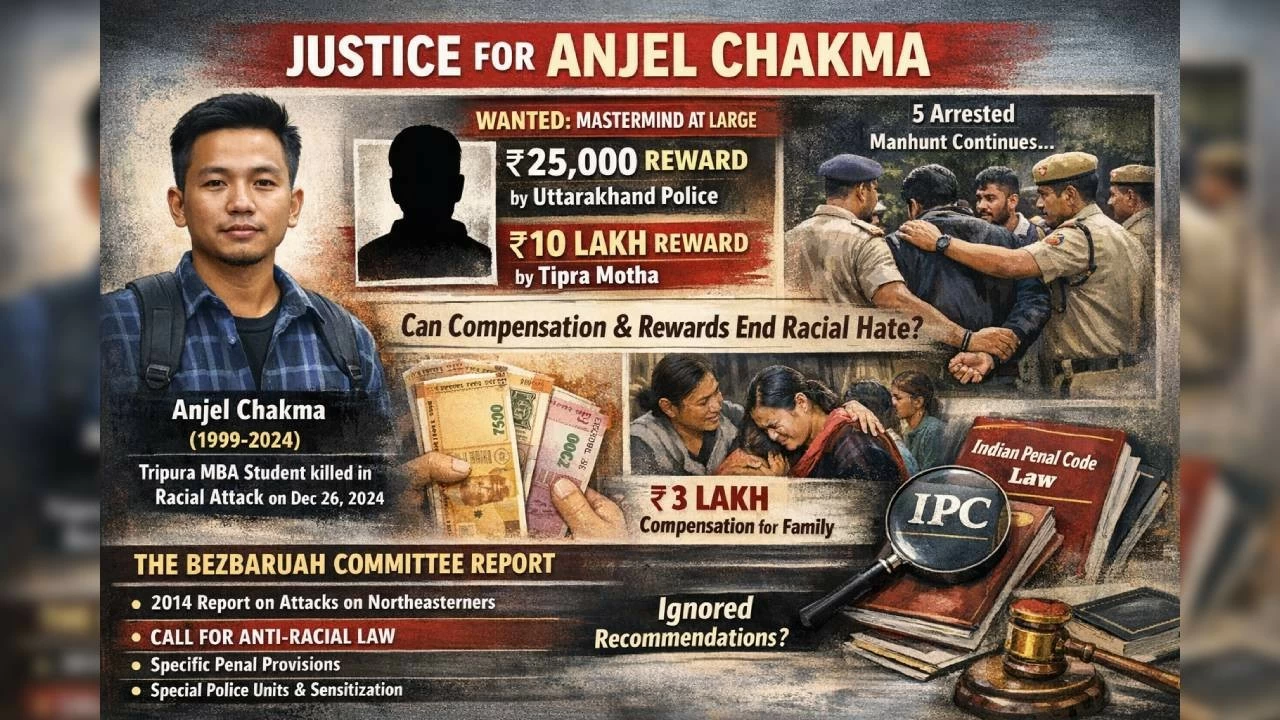


New Delhi: The tragic death of Anjel Chakma, a 24-year-old MBA student from Tripura, has ignited a fierce national debate over racial discrimination and the adequacy of India’s legal safeguards for citizens from the Northeast. While the political spectrum offers condolences, the primary focus has shifted to a high-stakes manhunt for the mastermind behind the attack.
Anjel Chakma, a resident of Nandannagar in West Tripura, was pursuing his MBA in Dehradun. On December 9, 2024, his life took a horrific turn when he confronted a group of six attackers over a racial slur directed at him. The confrontation turned violent, and Anjel was brutally attacked. After battling for his life for over two weeks, he succumbed to his injuries on December 26.
Bounties and arrests in the Tripura student attack
The Uttarakhand Police have successfully apprehended five out of the six accused. However, the mastermind of the killing remains at large. In a desperate bid to bring the fugitive to justice, the Uttarakhand Police have declared a cash reward of Rs 25,000 for the person who provides details about the whereabouts of the main attacker.
Pradyot Kishore Manikya Debbarma, the Tipra Motha supremo, has announced a reward of Rs 10 lakh for information leading to the arrest of the main accused.
Financial aid and the cycle of hate
The Tripura Tribal Areas Autonomous District Council (TTAADC) has announced Rs 3 lakh in compensation for Anjel’s family. Despite these gestures, rights groups and activists are asking a haunting question: Will compensation and rewards ever break the cycle of racial abuse?
BNS vs reality
While the new Bharatiya Nyaya Sanhita (BNS), 2023, does not explicitly use the term "racial slur," it provides several mechanisms to prosecute hate-based crimes.
Section 196: Targets those promoting enmity or disharmony based on race (Punishment: up to 3 years; 5 years if in a place of worship).
Section 197: Addresses imputations prejudicial to national integration, specifically words that imply a class of persons cannot uphold the Constitution (Punishment: up to 3–5 years).
Section 352: Deals with intentional insults meant to provoke a breach of peace.
The missing link: The Bezbaruah Committee report
The tragedy has brought the 2014 Bezbaruah Committee report back into the spotlight. Established after a series of attacks on Northeasterners in metro cities, the committee explicitly recommended adding specific penal provisions to the IPC (now BNS) to handle racial abuse. Experts argue that current laws remain too generic, leaving a legal vacuum where "racial hate" is categorised under broader "enmity" clauses rather than being identified as a specific, heinous crime.
The Bezbaruah Committee was tasked with examining the causes of such attacks, reviewing existing legal safeguards and recommending specific measures, including legal changes, to prevent racial discrimination
In its report submitted to then Home Minister Rajnath Singh, the Bezbaruah Committee strongly recommended that India introduce specific penal provisions to deal with racial abuse, discrimination and hate crimes, noting that existing IPC sections were inadequate and generic.
Other Recommendations by the Bezbaruah Committee
Apart from legal amendments, the panel suggested establishing special police units in cities with large Northeast populations. It also recommended a mandatory sensitisation programme for police and public servants, and appointing Northeast nodal officers in states. The committee stressed on launching awareness campaigns against racial discrimination.