


Sign In
By signing in or creating an account, you agree with Associated Broadcasting Company's Terms & Conditions and Privacy Policy.
By signing in or creating an account, you agree with Associated Broadcasting Company's Terms & Conditions and Privacy Policy.
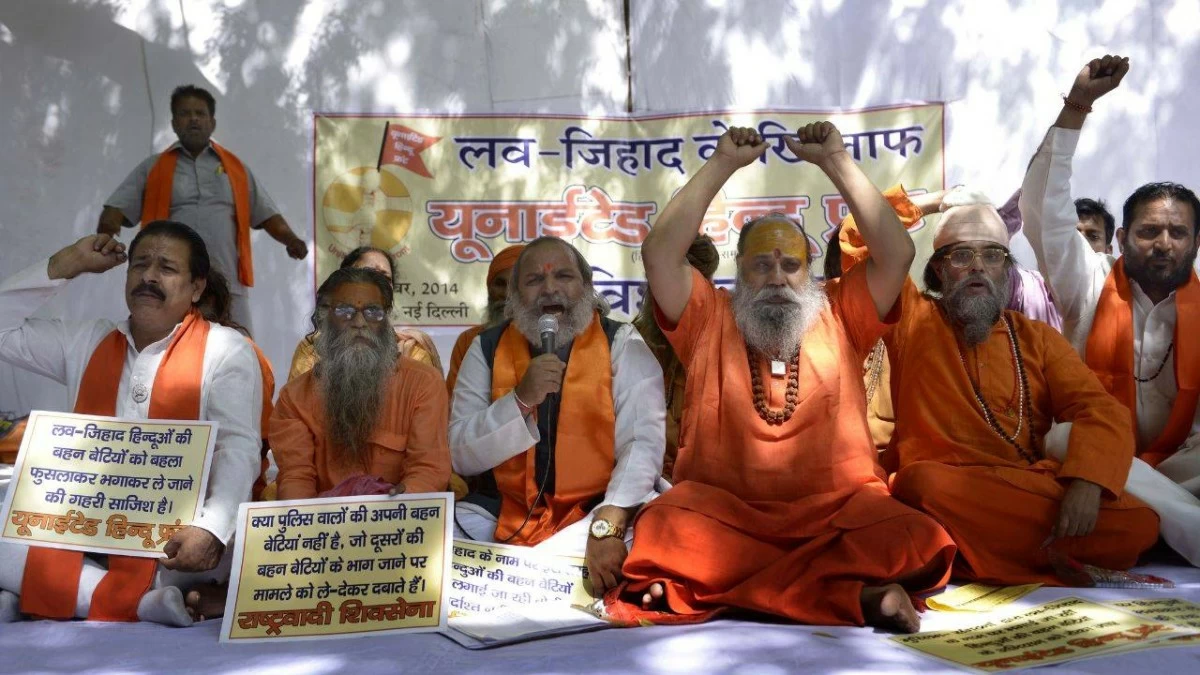


New Delhi: 'Love Jihad' is a term used by certain groups in India to describe an alleged campaign where Muslim men purportedly lure Hindu women into romantic relationships with the intent to convert them to Islam. The concept has been a subject of intense debate, with critics calling it a conspiracy theory lacking substantial evidence. Despite the controversies, many Indian states, including Uttar Pradesh, have enacted laws addressing concerns related to forced religious conversions, often in the context of interfaith marriages.
In November 2020, the Uttar Pradesh government promulgated the Prohibition of Unlawful Religious Conversion Ordinance, 2020, commonly referred to as the 'Love Jihad' law. The ordinance was later enacted as the Uttar Pradesh Prohibition of Unlawful Conversion of Religion Act, 2021. The primary objective of this legislation is to prevent religious conversions achieved through misrepresentation, force, undue influence, coercion, allurement or fraudulent means, particularly in cases where conversion is a precondition for marriage.



Advance Declaration: People intending to convert to another religion and the religious convertors facilitating such conversions are required to submit a declaration to the District Magistrate at least 60 days in advance.
Punitive Measures: The Act stipulates imprisonment ranging from one to ten years and fines for those found guilty of unlawful conversions. The severity of the punishment escalates if the individual converted is a minor, a woman or belongs to Scheduled Castes or Scheduled Tribes.
Marriage nullification: Any marriage conducted solely for the purpose of unlawful conversion or vice versa can be declared null and void.
In July 2024, the Uttar Pradesh State Assembly passed the Uttar Pradesh Unlawful Conversion of Religion (Amendment) Bill, 2024. The amendment introduced more stringent provisions, including life imprisonment for severe cases of unlawful conversion involving minors, women or people from Scheduled Castes or Scheduled Tribes.
Since the enactment of the original ordinance in 2020, Uttar Pradesh has witnessed several cases registered under this law. As of November 2021, there were reports of 108 First Information Reports (FIRs) involving 350 individuals, with 189 arrests and 72 convictions related to unlawful religious conversions. In September 2022, a notable case resulted in the first conviction under this law, where a person was sentenced to five years in prison for unlawfully converting a minor girl under the pretext of marriage.
The Act has faced criticism from various quarters, including legal experts, human rights activists and opposition parties. Critics argue that the law infringes upon individual freedoms guaranteed by the Indian Constitution, particularly the right to freedom of religion and the right to choose one's partner. Concerns have also been raised about the potential misuse of the law to harass interfaith couples and marginalised communities. In December 2020, a group of 104 former bureaucrats penned an open letter to Chief Minister Yogi Adityanath, urging the repeal of the law and alleging that Uttar Pradesh had become the epicentre of politics of hate, division, and bigotry.
The stringent provisions of the Act have reportedly led to a chilling effect on interfaith marriages in Uttar Pradesh. Couples from different religious backgrounds have expressed apprehension about legal repercussions and societal backlash. There have been instances where interfaith couples sought protection from courts, fearing harassment under the anti-conversion law.
The enactment and enforcement of the 'Love Jihad' law in Uttar Pradesh have major political and social implications. The ruling Bharatiya Janata Party (BJP) has positioned the law as a necessary measure to protect vulnerable individuals from coercive conversions and to uphold public order. However, opposition parties and civil society organisations view the law as a tool to further a majoritarian agenda and to marginalise minority communities.
Uttar Pradesh is not alone in enacting laws aimed at curbing unlawful religious conversions. States like Madhya Pradesh, Gujarat and Karnataka have introduced similar legislations, often referred to as anti-conversion laws. These laws share common features, such as requiring prior notice or permission for religious conversions and prescribing stringent penalties for violations. However, the implementation and impact of these laws vary across states, influenced by regional socio-political dynamics.

