
Sign In
By signing in or creating an account, you agree with Associated Broadcasting Company's Terms & Conditions and Privacy Policy.
By signing in or creating an account, you agree with Associated Broadcasting Company's Terms & Conditions and Privacy Policy.
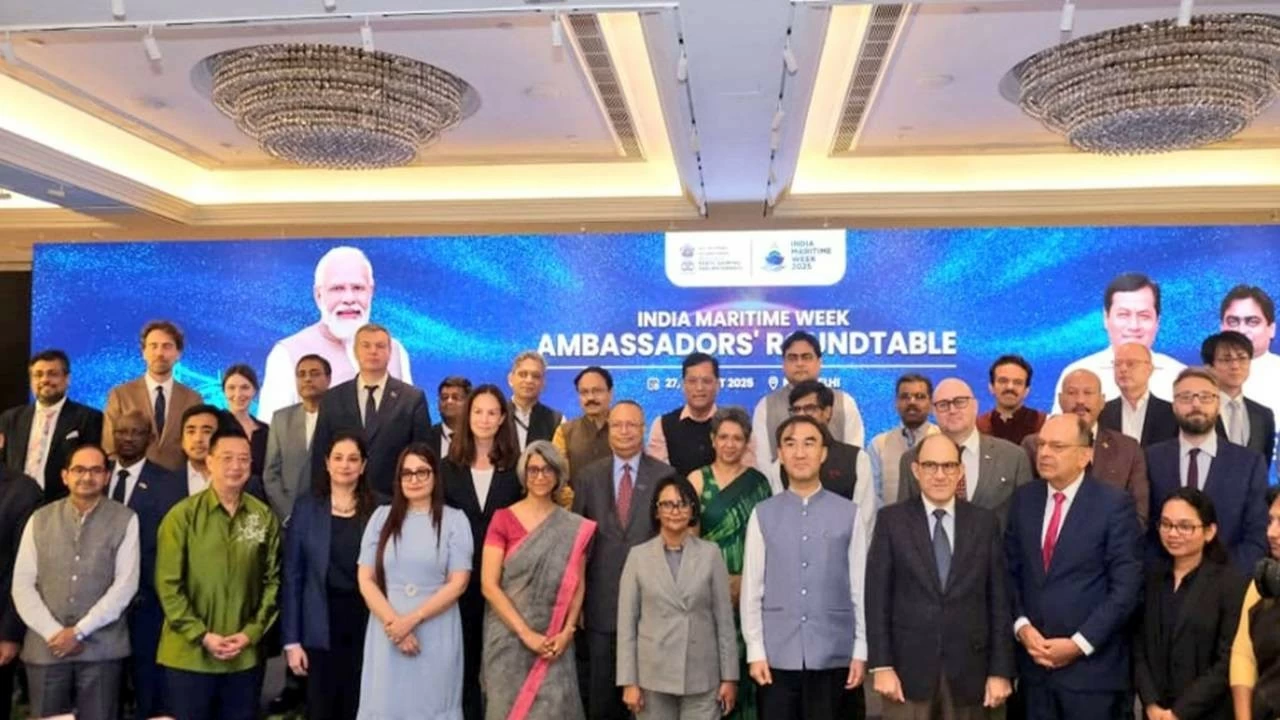


New Delhi: Envoys from 28 countries along with senior government officials, industry leaders and representatives of multilateral bodies were hosted by the Ministry of Ports, Shipping and Waterways (MoPSW) for the Ambassadors’ Roundtable Meet in New Delhi on Wednesday. Discussions were held on collaborations and partnerships. The key meeting comes ahead of the India Maritime Week (IMW) 2025, to be observed from October 27–31 in Mumbai.
Over the last few years, India has been positioning itself as a global hub for maritime trade and logistics, by capitalising on its strategic location. The world has also recognised India’s growing role in global maritime trade, sustainable shipping and the blue economy.
At the meeting, the government unveiled a $1 trillion maritime investment roadmap, drawing support from envoys. Global powers have started viewing India as a hotspot for investment and innovation.
Union Minister for Ports, Shipping and Waterways Sarbananda Sonowal pointed out India’s maritime journey is entering a new chapter. "With transformative initiatives such as Maritime India Vision 2030 and Maritime Amrit Kaal Vision 2047, our ports, shipping and logistics ecosystem is becoming more resilient, sustainable and future-ready,” he said.
Minister of State for Ports, Shipping and Waterways Shantanu Thakur underlined the reforms in port modernisation, inland waterways expansion, and green and digital shipping, and urged greater role of the private sector.
All these developments have opened wide avenues for international collaboration. And no wonder, the rush for partnerships is growing. The $1 trillion maritime investment roadmap offers a lot of scope for joint ventures in port and cargo terminal development, multi-modal logistics hubs, maritime services, shipbuilding, recycling and repair, and in green hydrogen infrastructure and sustainable shipping solutions.
PM Modi has often said: "Ports are not just gateways of prosperity, but gateways of India’s future." India has been modernising its maritime sector to transform it into a key driver of nation-building, technological advancement, and sustainable development. AI-powered logistics, digitised port operations, and automation are boosting the efficiency of India’s ports and improving their global competitiveness.
With growing global recognition of India’s potential, there is a huge increase in maritime investments and global partnerships. And no wonder, as Thakur said, "Global players are joining hands with Indian counterparts in shipbuilding, port modernisation, smart logistics, and green shipping."
At the Wednesday gathering, R. Laxmanan, Joint Secretary, MoPSW, showcased opportunities in mega projects such as Vadhavan Port, Galathea Bay Transshipment Port and Tuna Tekra Terminal, alongside investments in green hydrogen hubs, LNG bunkering, shipbuilding, ship recycling, and maritime industrial parks. These are projects that will shape global partnerships in the coming days. These initiatives are crucial and drive India's sustainable economic growth. The collaborations with international partners will hold the key to unlocking financing, and growth for these projects.
India is committed to tapping the potential of the blue economy and promoting sustainable growth. Five new legislations — the Bills of Lading Act, Carriage of Goods by Sea Act, Merchant Shipping Act, Coastal Shipping Act and the Indian Ports Act — are steps in the right direction as they replace colonial-era laws and align India’s framework with global best practices.