Sign In
By signing in or creating an account, you agree with Associated Broadcasting Company's Terms & Conditions and Privacy Policy.
By signing in or creating an account, you agree with Associated Broadcasting Company's Terms & Conditions and Privacy Policy.


New Delhi: India is a place of diversity – the variety of cultures, festivals, traditions, communities, languages, and people that we find here is insane! And, of course, we can't overlook the most important section – food. Indian cuisine is a treasure for foodies with delicious, scrumptious dishes in every corner of the country. Each region in India has something tasty and different to offer. From North Indians' favourite Rajma Chawal to South India's staple Idli Sambhar to Pitha of the Eastern side and Dhokla of Western India, each dish is rich in flavours that send everyone on a culinary adventure.
What is as exciting as the curries are the breads. All of us can savour the flavourful curries because of the breads, be it rotis, pooris, or parathas. Among the endless variety of bread in India, paratha and parotta are two very popular and staple foods in the Indian household. Often mistaken, people think paratha and parotta are the same. One might think that it is just the accent of different regions that makes them separate. But are paratha and parotta the same? Or are they two distinct breads? If you're interested in finding out the answers to these questions, keep reading as we answer them for you.
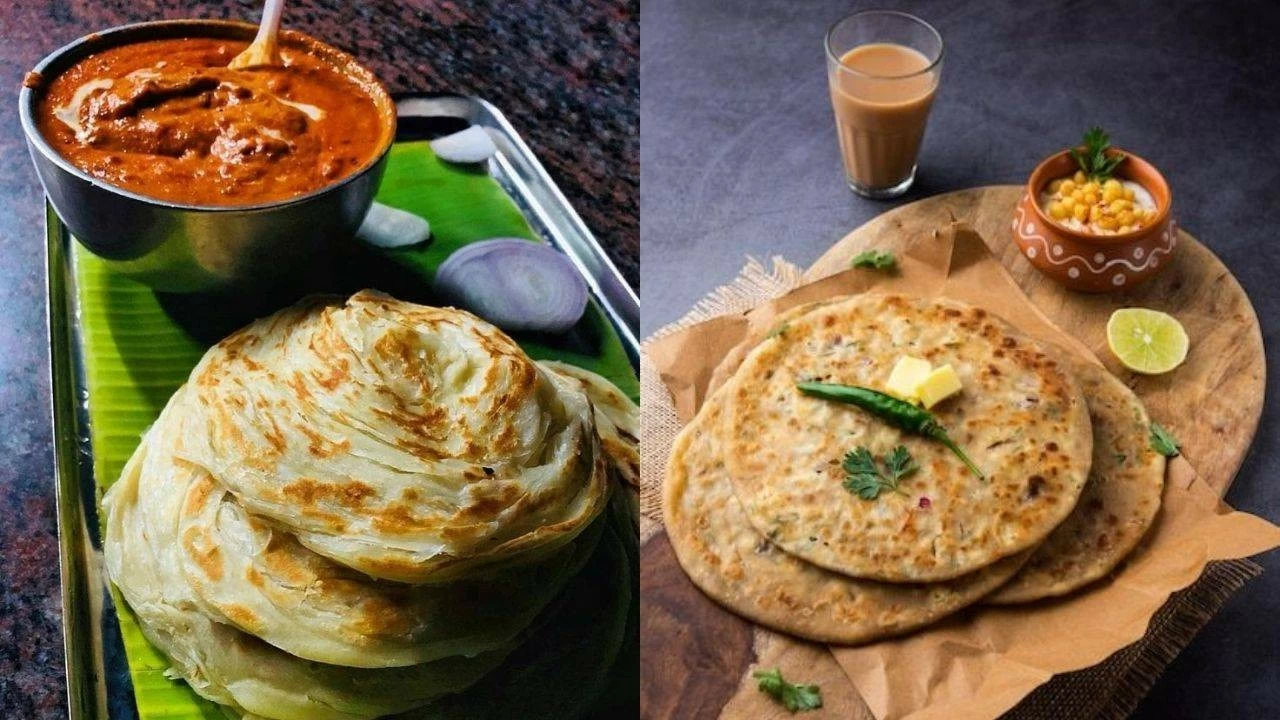
Paratha is one of the famous flatbreads in North India. Generally, parathas are eaten for breakfast, but it is also served as lunch and dinner. Parathas are made with atta (whole wheat flour) and have flavourful fillings inside. Although there are simple, plain parathas available too, there are a variety of fillings for stuffed parathas that are made of potato, paneer, onion, cauliflower, daal, and others.
On the other hand, Parotta is a famous dish from South India. Unlike paratha, parotta is made with maida (all-purpose flour). The use of maida instead of atta, along with milk and sugar, is what gives the parotta its flaky and crispy texture. It does not have any fillings and is served with rich curries.
1. Ingredients
The difference in the main ingredients used to make parathas and parottas is what makes them different. Parathas are made with wheat flour (atta), while parottas are made using all-purpose flour (maida). Additionally, while kneading the dough for parathas, water and salt are used, and for parotta, people generally use milk and sugar for the dough.
2. Preparation procedure
The preparation style of parathas and parottas is different as well. For parathas, you need to just roll out the dough and put in the stuffing. However, for parottas, first you need to roll out the dough ball into a long rope and then coil it again into a ball for rolling it out. This results in multiple layers in parottas and the flaky texture.
3. Texture
The texture of parathas and parottas also varies to a great extent. Parathas have a soft and fluffy texture. Parotta, on the other hand, is crispy and flaky. However, due to personal preference, some people make the parathas crispier by roasting them for a couple of minutes longer on the tawa, while others make the parottas soft and delicate.
4. Serving style
Since paratha has already stuffing inside, it is served with a bowl of curd and achaar, topped with butter. Whereas parotta is paired with delicious vegetarian and non-vegetarian curries. While this is the traditional style of serving, people are experimenting with paratha with sabzi and dal.
So, parathas and parottas are not the same and are very distinct, hailing from two different parts of India. Both the flatbreads are unique in their own way and have flavours that one can’t resist. So, if you’ve mistaken parotta for paratha, it is time to taste both of the flatbreads.