Sign In
By signing in or creating an account, you agree with Associated Broadcasting Company's Terms & Conditions and Privacy Policy.
By signing in or creating an account, you agree with Associated Broadcasting Company's Terms & Conditions and Privacy Policy.
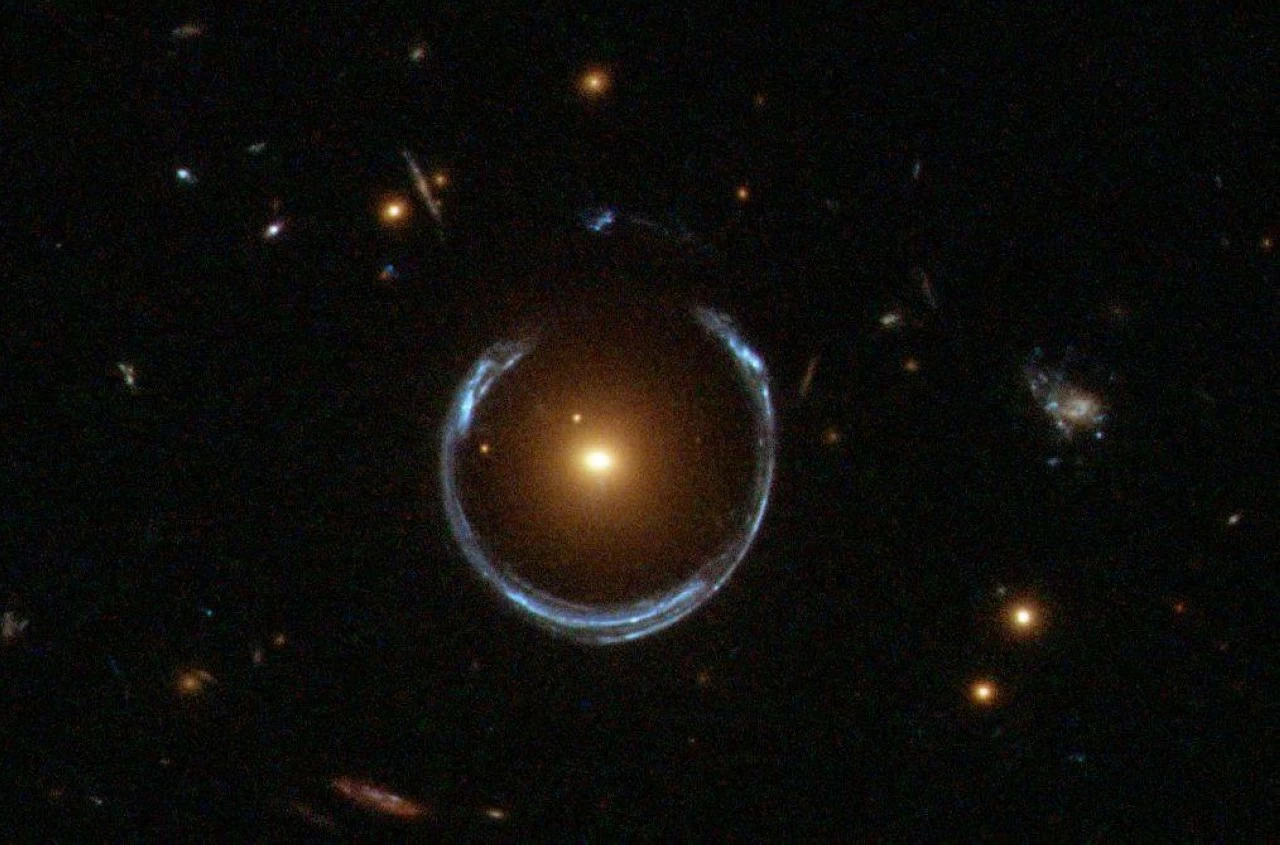


Astronomers may have discovered the most massive black hole known, within the Cosmic Horseshoe galaxy, at a distance of five billion lightyears from the Earth. The tremendous gravity of the galaxy distorts the light from background objects, with a background galaxy stretched out into an arc, forming the prominent Einstein Ring. The Cosmic Horseshoe galaxy is among the most massive galaxies known. The ultramassive black hole contains 10,000 times the mass of the supermassive black hole at the heart of the Milky Way galaxy, designated as Sagittarius A*, or 36 billion times the mass of the Sun.
Supermassive black holes are believed to exist in the centres of most large galaxies, with the largest hosting ultramassive black holes. A paper describing the findings has been published in the Monthly Notices of the Royal Astronomical Society. One of the authors of the paper, Thomas Collett says, "This is amongst the top 10 most massive black holes ever discovered, and quite possibly the most massive. Most of the other black hole mass measurements are indirect and have quite large uncertainties, so we really don't know for sure which is biggest. However, we’ve got much more certainty about the mass of this black hole."
The ultramassive black hole has a tremendous influence on the galaxy surrounding it. Stars in the central regions of the galaxy are zipping around the ultramassive black hole at speeds approaching 400 km per second. While stellar mass black holes are formed by the violent deaths of giant stars, scientists do not fully understand how supermassive and ultramassive black holes are formed. If these black holes are formed by a series of mergers between smaller black holes, there should be many intermediate mass black holes in the sky, but these have proven to be notoriously difficult to find, with only a handful of known candidates. The conventional theory is that the ultramassive black holes were formed by the mergers of multiple galaxies, along with their supermassive black holes.