Sign In
By signing in or creating an account, you agree with Associated Broadcasting Company's Terms & Conditions and Privacy Policy.
By signing in or creating an account, you agree with Associated Broadcasting Company's Terms & Conditions and Privacy Policy.


Black holes, specifically stellar mass black holes containing up to 150 times the mass of the Sun are formed by the violent deaths of massive stars. Supermassive black holes occupy the cores of large galaxies, and can contain upwards of 100,000 solar masses. Straddling the mass gap are elusive intermediate-mass black holes (IMBHs), rare objects of which only a handful of candidates are known. These IMBHs are neither large nor small, and are difficult to spot because they do not consume as much gas and dust as the supermassive black holes. However, these IMBHs can occasionally snack on wayward stars, with the energy from the tidal disruption event revealing their presence.
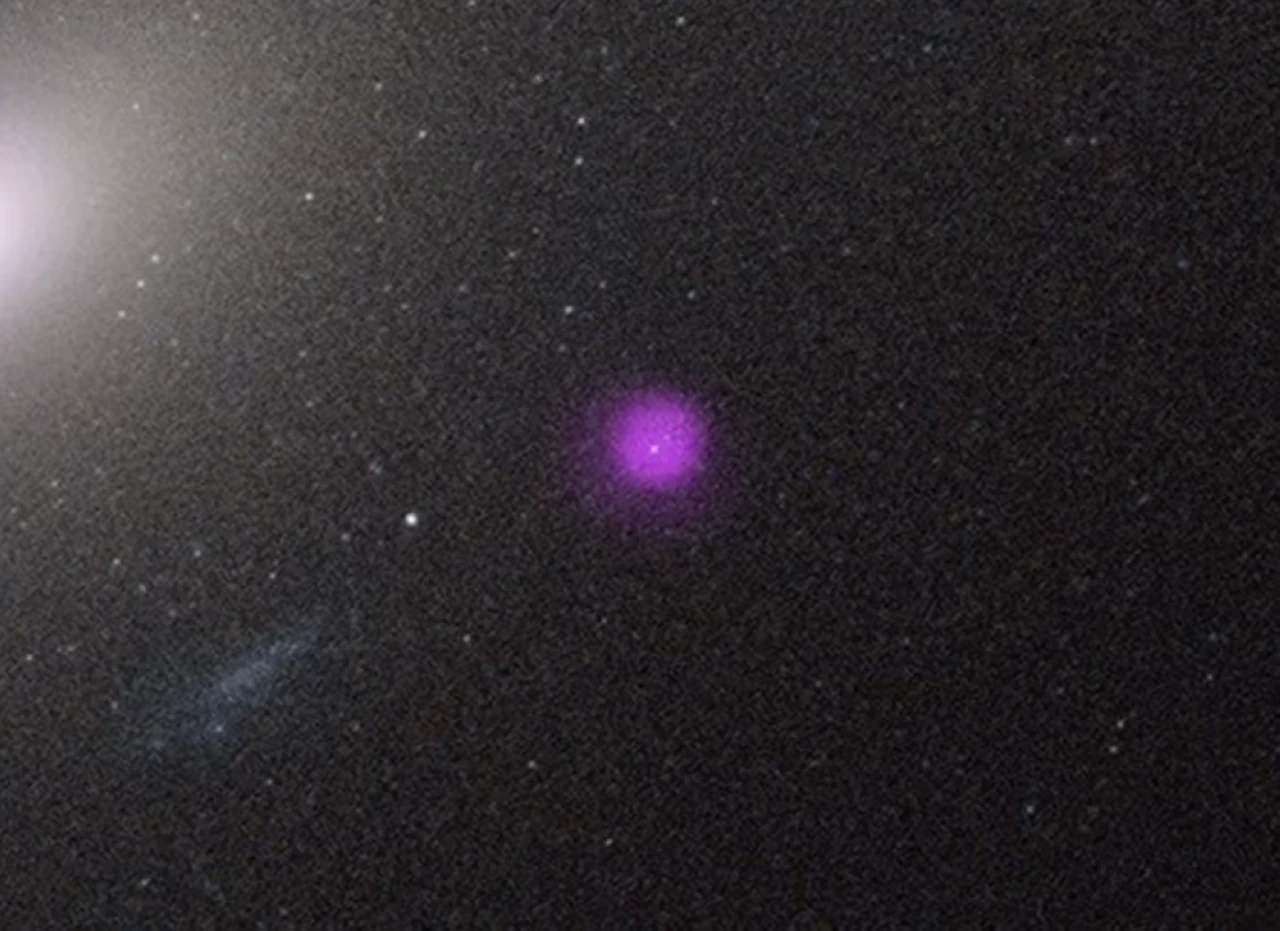
Astronomers have now spotted a potential IMBH located in the fringes of the galaxy designated as NGC 6099, located at a distance of about 450 million lightyears from the Earth, in the constellation of Hercules. The black hole is located at a distance of about 40,000 lightyears from the core of the galaxy. The unusual source of X-rays was first detected in 2009, with follow-up observations confirming the tidal disruption event. The Hubble space telescope was able to resolve a small cluster of stars surrounding the IMBH. The density of globular clusters increase towards the centres, where IMBHs are suspected to lurk, in theory. The discovery therefore aligns with theoretical predictions on IMBHs.
A paper describing the findings has been published in The Astrophysical Journal. Lead author of the paper, Yi-Chi Chang says, "X-ray sources with such extreme luminosity are rare outside galaxy nuclei and can serve as a key probe for identifying elusive IMBHs. They represent a crucial missing link in black hole evolution between stellar mass and supermassive black holes." The astronomers are continuing to study the IMBH because it can provide valuable insights into the formation and evolution of supermassive black holes. There is also presumably a supermassive black hole occupying the core of the galaxy, which appears to be quiescent, and not actively feeding on any material.