Sign In
By signing in or creating an account, you agree with Associated Broadcasting Company's Terms & Conditions and Privacy Policy.
By signing in or creating an account, you agree with Associated Broadcasting Company's Terms & Conditions and Privacy Policy.


NASA launched the Cassini spacecraft to Saturn on 15 October, 1997 on board a Titan IVB/Centaur rocket from Cape canaveral in Florida, USA. The probe was embarking on a 13 year journey to orbit the Jewel of the Solar system and probe its moons in unprecedented detail. On the 4.9 billion kilometre journey, Cassini hurtled past the asteroid 2685 Masusky, providing a rare glimpse at a Main Belt asteroid, and an unassuming space rock.
Cassini was not built for studying asteroids, and was packed with 12 instruments, including cameras, spectrometers and magnetometers, designed to probe the thick atmosphere of Satrun, its ring systems and the ice moons such as Titan and Enceladus. The probe was powered by three Radioisotope Thermoelectric Generators (RTGs), that generated energy from the heat of decaying plutonium. The probe took a complex route through the Solar System, with two flybys of Venus, one flyby of Earth, and another of Jupiter before reaching Saturn on 1 July 2004. The observations of Masursky was an opportunity to test the payloads before reaching saturn.
The asteroid Masursky was discovered on 2 May 1981 by Edward Bowell at Lowell Observatory. The asteroid was named after Harold Masursky, a planetary geologist who was instrumental in NASA’s Viking and Voyager missions. The asteroid was a faint speck, its size and nature were poorly characterised and constrained by Earth-based telescopes. Based on the brightness of the asteroid, it was estimated to be between 10 and 30 kilometers wide, orbiting the Sun every 3,.73 years at a distance ranging between 2.06 and 3.03 Astronomical Units, which is the distance between the Sun and the Earth.

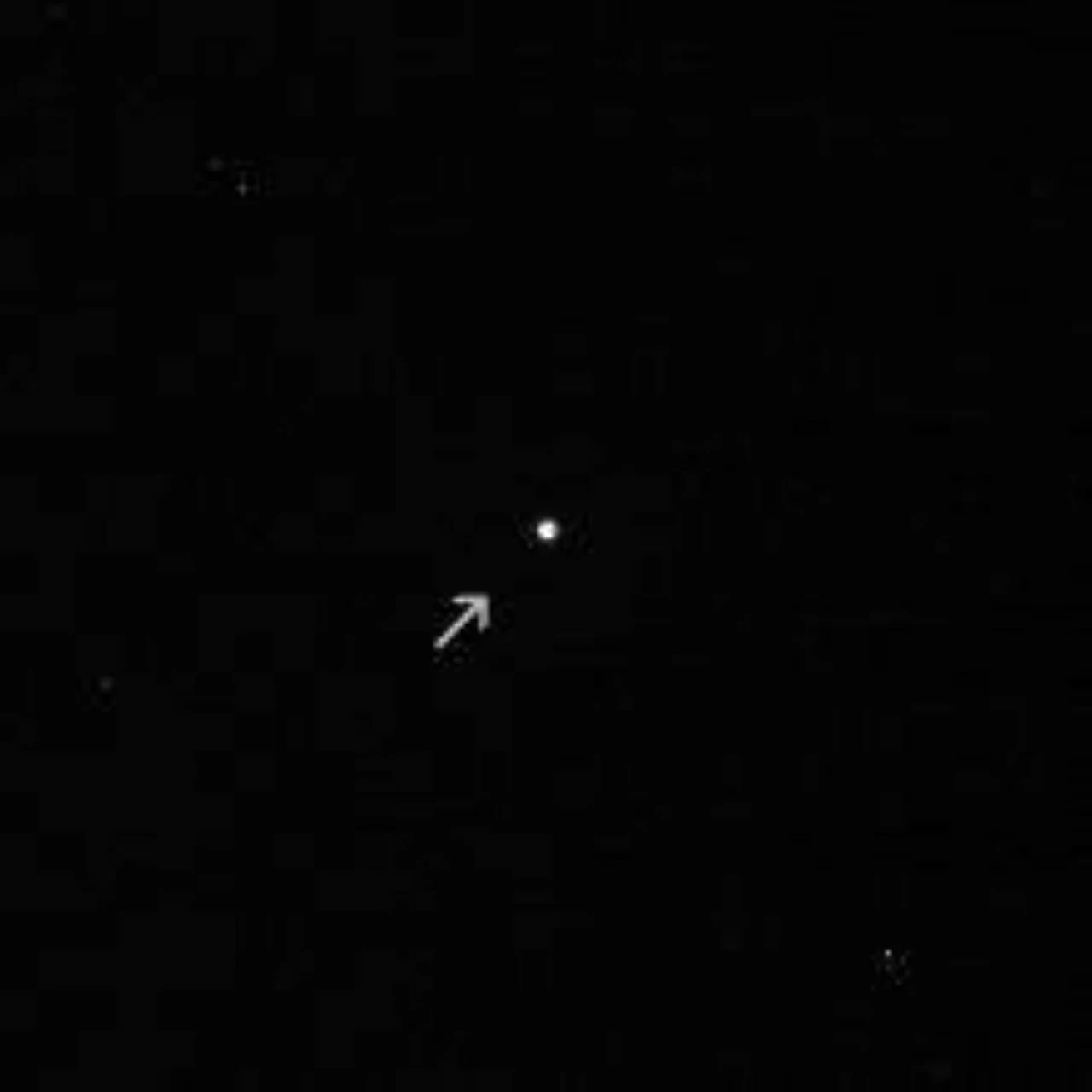
Cassini's capture of Masursky on 22 January 2000. (Image Credit: NASA/JPL/Cassini Imaging Team).
On 23 january, 2000, the imaging subsystem on Cassini consisting of two cameras with 1,024x1,024 pixel CCDs locked onto Masursky. Images were captured seven and five and a half hours before the closest approach, revealing a blob only about seven pixels wide. The images were too fuzzy to resolve surface features, craters or moonlets, but was sharp enough for science. The observations were sufficient to resolve the size of Masursky, between 15 and 20 kilometres across. The instruments on board confirmed that the stony asteroid was flecked by iron. The spectrometry also detected minerals such as olivine and pyroxene, aligning with the profile of the Flora family. Cassini was not able to resolve the eight to ten hour spin of the asteroid, which was later refined by ground observations using more sophisticated instruments.
The data was relayed back to the Earth through NASA’s Deep Space Network. Scientists believed that Masursky was a fragment of a collision from the chaotic infancy of the Solar System. The science was not revolutionary, as the Galileo probe to Jupiter had captured much sharper views of asteroids Gaspra and Ida in 1991 and 1993. However, Masursky served as a benchmark, allowing ground teams to calibrate and validate the systems on board Cassini under real-world conditions. These were critical for the flybys of Titan and Enceladus, and the other moons of Saturn.
Despite containing millions of asteroids, the Main Belt poses a low collision risk to probes. The dust analyser barely detected anything substantial, confirming that the asteroid belt was navigable for future missions, just as Galileo had done a decade earlier. Masursky belonged to a group of asteroids that are considered the prime suspects for the meteorite supply on Earth, or the meteors that survived the trip through the atmosphere of the planet. The data from Cassini on Masursky provided additional evidence to bolster that connection.

Illustration of Cassini at Saturn. (Image Credit: NASA).
The encounter with Masursky is little more than a footnote in the 20 year saga of Cassini, that conducted incredible science, including discovering water spouts on Enceladus, before ending its mission as a shooting star in the skies of Saturn in 2017. However, the brief, half-hour encounter during the 20-year mission helped inform missions such as Psyche to 16 Psyche, and the Lucy mission to the Trojan asteroids captured by Jupiter.
NASA deliberately destroyed the Cassini spacecraft out of an abundance of caution. The space agency was losing the ability to control the spacecraft with depleting fuel. The RTGs were still generating power, but the thrusters could not work for longer. There was a remote chance that the spacecraft would drift into the ice moons of Titan or Enceladus. Although Cassini was sterilized, there was a small chance that the probe would introduce alien microbes, or genetic material from the Earth to the biospheres of these ice worlds. The decision to deliberately destroy Cassini was a responsible action.