Sign In
By signing in or creating an account, you agree with Associated Broadcasting Company's Terms & Conditions and Privacy Policy.
By signing in or creating an account, you agree with Associated Broadcasting Company's Terms & Conditions and Privacy Policy.
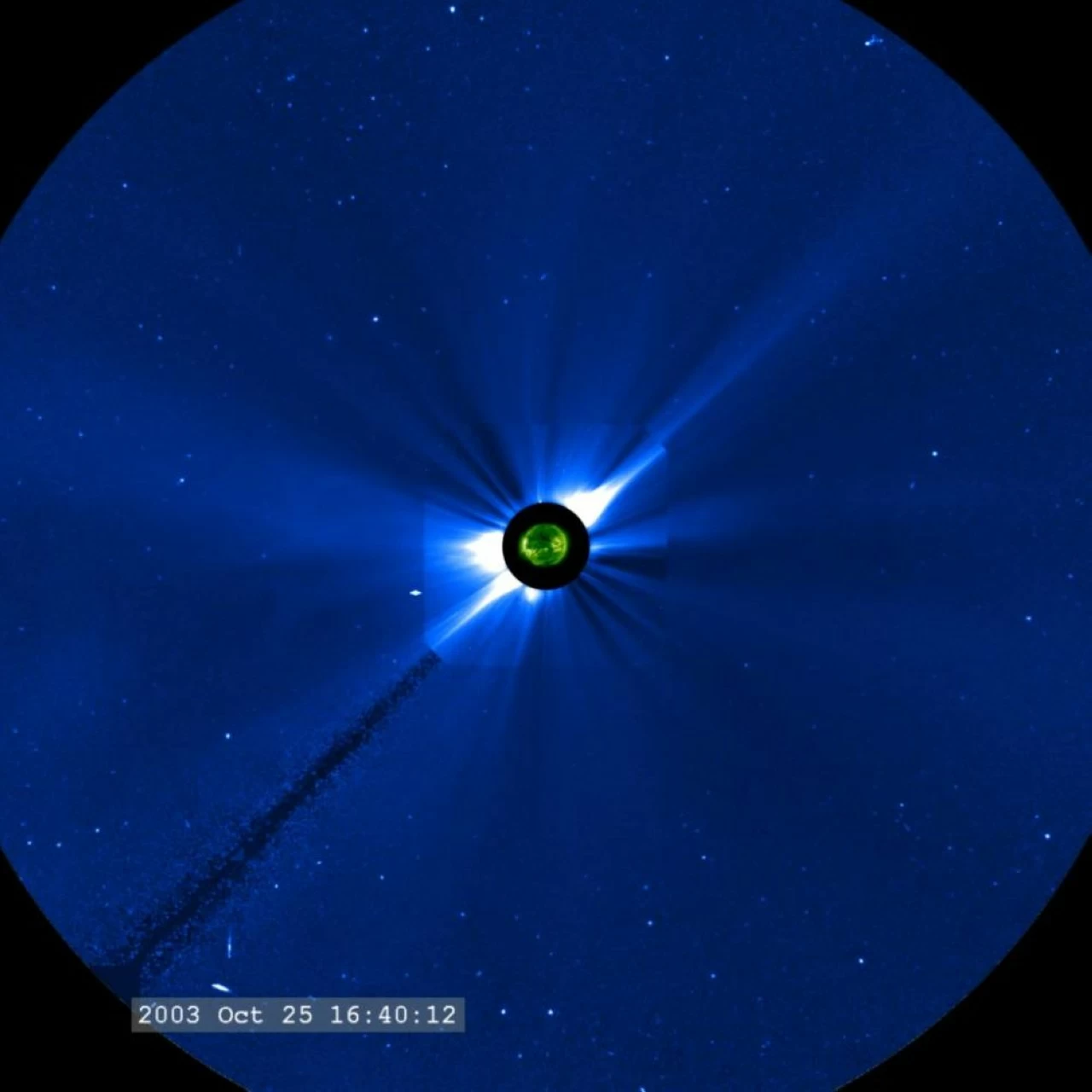


The Sun follows a well-understood 11-year Solar Cycle that has been continuously tracked since 1755. The ongoing Solar Cycle 25 began in 2019, and is currently at its peak. Solar Cycle 23 began in May 1996, and peaked around 2000, characterised by the maximum number of active regions or sunspot clusters on the visible surface of the Sun. Three years after the peak, something unexpected happened, with large, complex clusters emerging with little warning. A series of solar eruptions followed, including solar flares and coronal mass ejections, that battered the Earth and other planets in the Solar System with Solar Storms.
Seventeen major solar flares were observed over the course of October 2003, culminating in an extreme event on 4 November. The X-class flare saturated the detectors at X28, and is estimated to be an X45 flare, comparable in scale to the Carrington Event, that is considered to be the most energetic solar storm in modern history. Observations made by the Colaba Solar Observatory in 1859 following the Carrington Event, were similar to observations conducted by the Tihany magnetic observatory in Hungary following an X-class solar flare on 28 October 2003.
Astronauts on board the International Space Station had to take refuge in the shield portions to reduce the impact of exposure to extreme radiation. A Japanese scientific satellite as well as a payload on board the Mars Odyssey orbiter conked off because of the solar outbursts. The geomagnetic storm affected about half of all satellites orbiting the Earth, disrupting broadcast services. The deep-space missions had to be put in safe mode. Two months after the storm, the cloud of charged plasma washed over the Voyager 2 spacecraft, well beyond the orbit of Pluto.
Geomagnetic storms cause geomagnetically induced currents along any long conductors on the ground, including copper cables and oil pipelines. These currents were strong enough to damage electrical transformers across Europe and South Africa, and even caused a blackout in Sweden. Airlines had to reroute flights to limit the exposure of the passengers and crew to elevated levels of radiation. Almost all industries on the surface of the Earth that are sensitive to solar outbursts experienced some degree of disruption from the extreme geomagnetic storming. The general public around the world were made aware of the concept of Space Weather because of this event.
The radiation from the flare reached the Earth in eight minutes and 20 seconds, causing radio blackouts on the sunlit side of the Earth. The coronal mass ejection with the soup of charged particles reached the Earth a day later, traveling at incredible velocities. The opening up of Chinese and Russian airspace for commercial flights was allowing short trips between North America and Asia, but these were disrupted by the solar storms that affect the polar regions more. The Antarctic science teams were cutoff from communications for five days. Satellite navigation services were disrupted, interrupting surveying, deep-sea drilling and mining operations.
On the plus side, the October 2003 solar storms resulted in the most spectacular displays of polar lights in living memory. The auroras were visible in latitudes that they do not generally appear in, including Texas, Florida, Australia and Central Europe. These extreme geomagnetic storms were observed between 28 and 30 October, 2003. There was an X17 solar flare on 28 October, followed by an X10 solar flare on 29 October. The most powerful eruption was the X45 solar flare on 4 November, that was fortunately not directed towards the Earth.
The Solar Storm was another powerful demonstration of just how vulnerable the technologies that humans rely on so heavily are to extreme space weather events. Energy distribution, communication, and navigation services can all be disrupted by extreme solar activity. Since then, systems have become more reliable and robust as we begin to understand more about how the Sun can influence the technological infrastructure on Earth. The event spurred research into prediction models to improve forecasts, highlighted the importance of continuous monitoring, and alerting relevant industries with timely updates.
These solar storms are a normal occurrence, with solar outbursts increasing in frequency during the peaks of the Solar Cycles. Modern technologies are well-fortified against solar storms, but there are signs of much larger storms preserved in ice cores and tree rings. These are Solar Superstorms between 10 and 100 times stronger and more intense than the Carrington Event, or the Great Halloween Storms of 2003. There are six such extreme superstorms recorded over the last 15,000 years, and are known as Miyake events.