Sign In
By signing in or creating an account, you agree with Associated Broadcasting Company's Terms & Conditions and Privacy Policy.
By signing in or creating an account, you agree with Associated Broadcasting Company's Terms & Conditions and Privacy Policy.
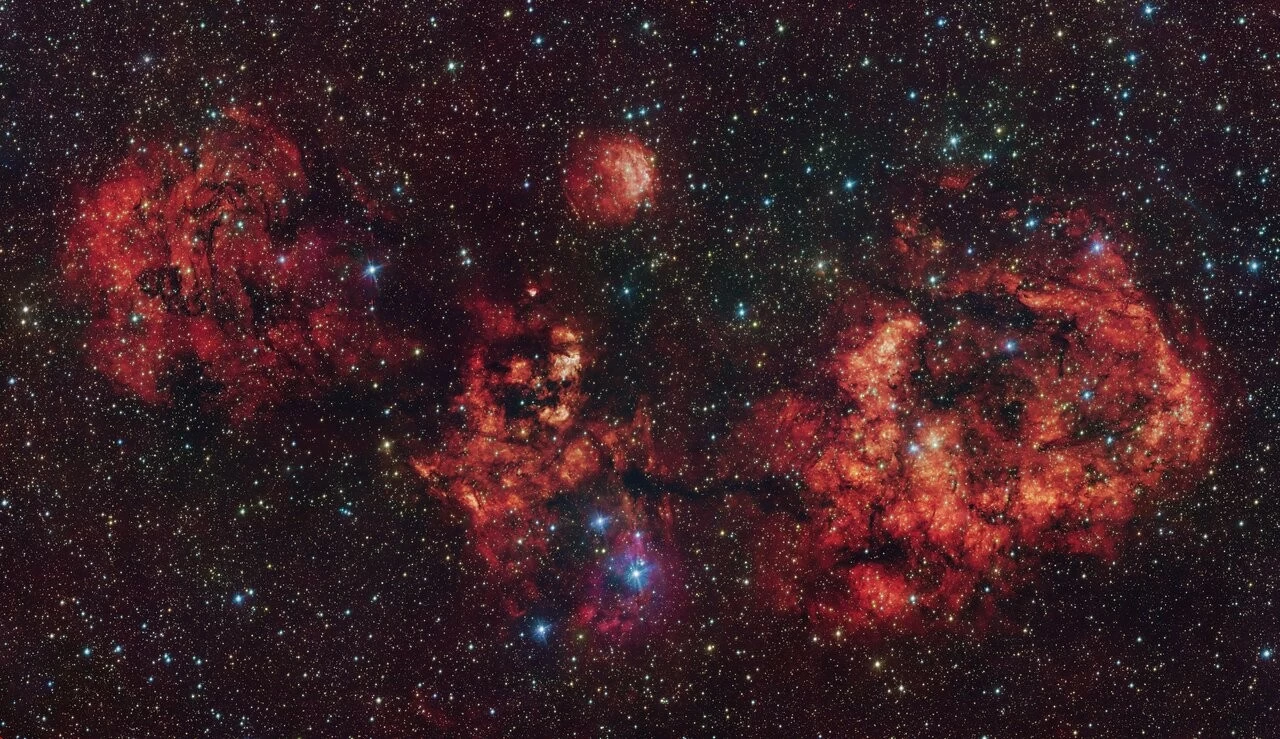


The VST telescope in Paranal, Chile operated by the European Southern Observatory has captured an image of a pair of nebulae designated as RCW 94/95 at a distance of 10,000 lightyears away in the southern constellations of Circinus and Norma. The nebula, a vast cloud of gas and dust is a stellar nursery that is producing new stars at a furious rate. These energetic young stars are shrouded by the surrounding clouds of gas and dust, but the injection of energy makes the material glow red by exciting hydrogen atoms. The dark filaments are colder and denser accumulations of gas and dust than the surrounding environment, with grains of dust blocking starlight.
The right wing of the bat is designated as RCW 94, while the main body is RCW 95, with the rest of the nebular clouds lacking an official designation. The instrument is located in a high-altitude region in the Atacama desert of Northern Chile, using the 268 megapixel OmegaCAM. The observations were conducted as part of multiple surveys, with the data available to the scientific community. The young stars within the stellar nursery are shaping and carving the surrounding material, blowing away the gas and dust with intense stellar winds in some regions, and forming dense clumps of star-forming material in others, from which new stars are born.
Stellar nurseries are vast, frigid molecular clouds made up primarily of hydrogen, with a small amount of dust and other gases. These star-forming regions can span dozens to hundreds of light years across, where the densest knots increase in density and temperature under the influence of gravity, drawing in matter from the surrounding regions. When the conditions are sufficient to sustain the fusion of hydrogen into helium, a star is born. Polar jets erupt from the young protostars which shape the surrounding nebula, influencing the formation of new stars. One of the most well-known and well-studied stellar nurseries close to the Earth is the Orion Nebula.