Sign In
By signing in or creating an account, you agree with Associated Broadcasting Company's Terms & Conditions and Privacy Policy.
By signing in or creating an account, you agree with Associated Broadcasting Company's Terms & Conditions and Privacy Policy.
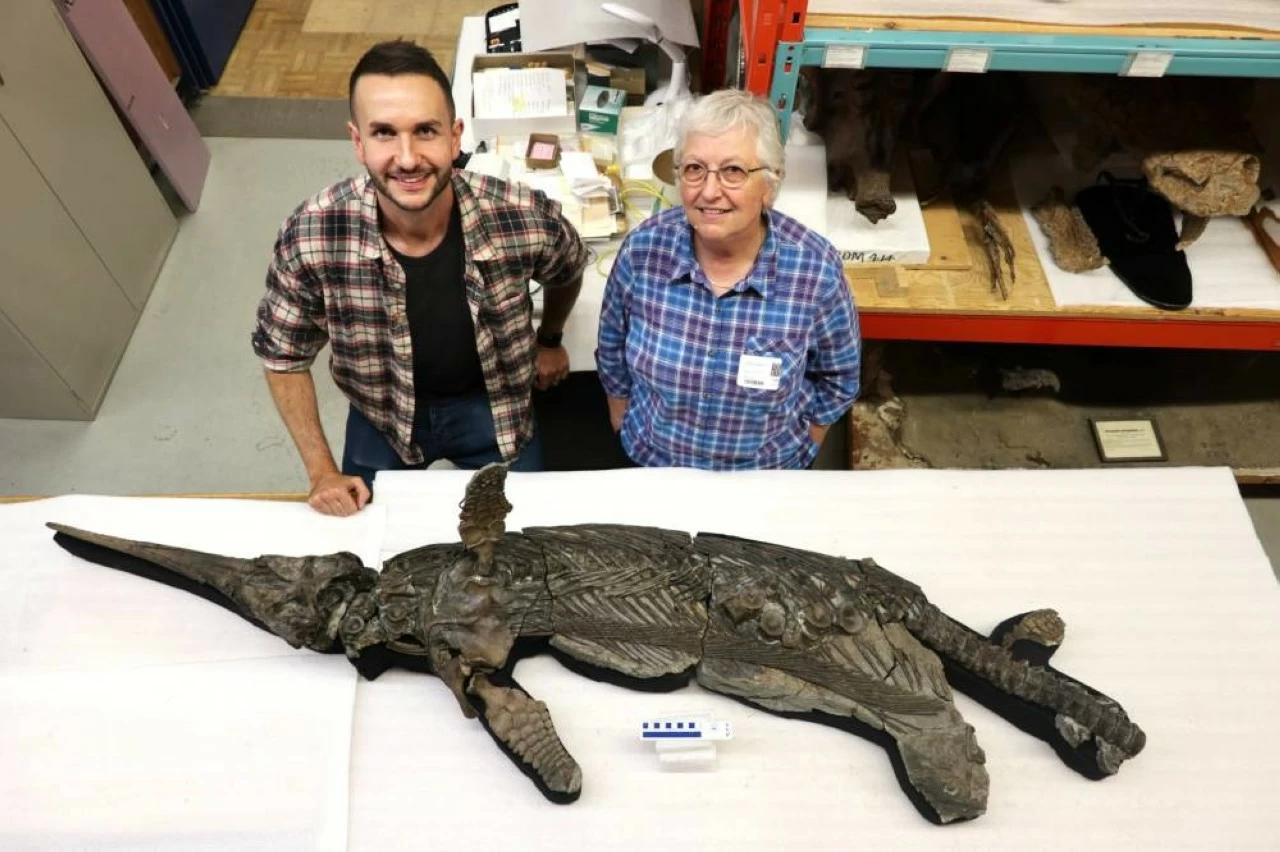


A nearly complete fossil of a dolphin-sized ichthyosaur called Xiphodracon goldencapensis has been discovered in the Jurassic Coast of the UK. The 'Sword Dragon of Dorset' is the only known specimen of its kind and helps fill an important gap in the fossil record of ichthyosaurs, marine reptiles that once ruled ancient oceans. While ichthyosaurs lived at the same time as dinosaurs, they are not dinosaurs. This is the first described genus of an Early Jurassic ichthyosaur found in the region in over 100 years, although thousands of ichthyosaur fossils have been discovered in the Jurassic Coast of UK.
The specimen was discovered close to Golden Cap in Dorset, in 2001, and is almost perfectly preserved in three dimensions. The animal would have been about three metres long, and would have fed on fish and squid. The remains are so exquisitely preserved, that there are traces of the last meal within the stomach. The scientists who studied the fossil have identified features that have never previously been seen in any ichthyosaur, including a strange and unique bone around the nostril called a lacrimal. The species was given its name because of the elongated, sword-like snout, as well as the location of its discovery. Xipho is the Greek word for snout, with the second part of the name being a reference to sea dragons, which is commonly used to refer to ichthyosaurs.
A paper describing the findings has been published in Papers in Palaeontology. Coauthor of the paper Erin Maxwell says, "This skeleton provides critical information for understanding ichthyosaur evolution, but also contributes to our understanding of what life must have been like in the Jurassic seas of Britain. The limb bones and teeth are malformed in such a way that points to serious injury or disease while the animal was still alive, and the skull appears to have been bitten by a large predator - likely another much larger species of ichthyosaur- giving us a cause of death for this individual. Life in the Mesozoic oceans was a dangerous prospect."