Sign In
By signing in or creating an account, you agree with Associated Broadcasting Company's Terms & Conditions and Privacy Policy.
By signing in or creating an account, you agree with Associated Broadcasting Company's Terms & Conditions and Privacy Policy.
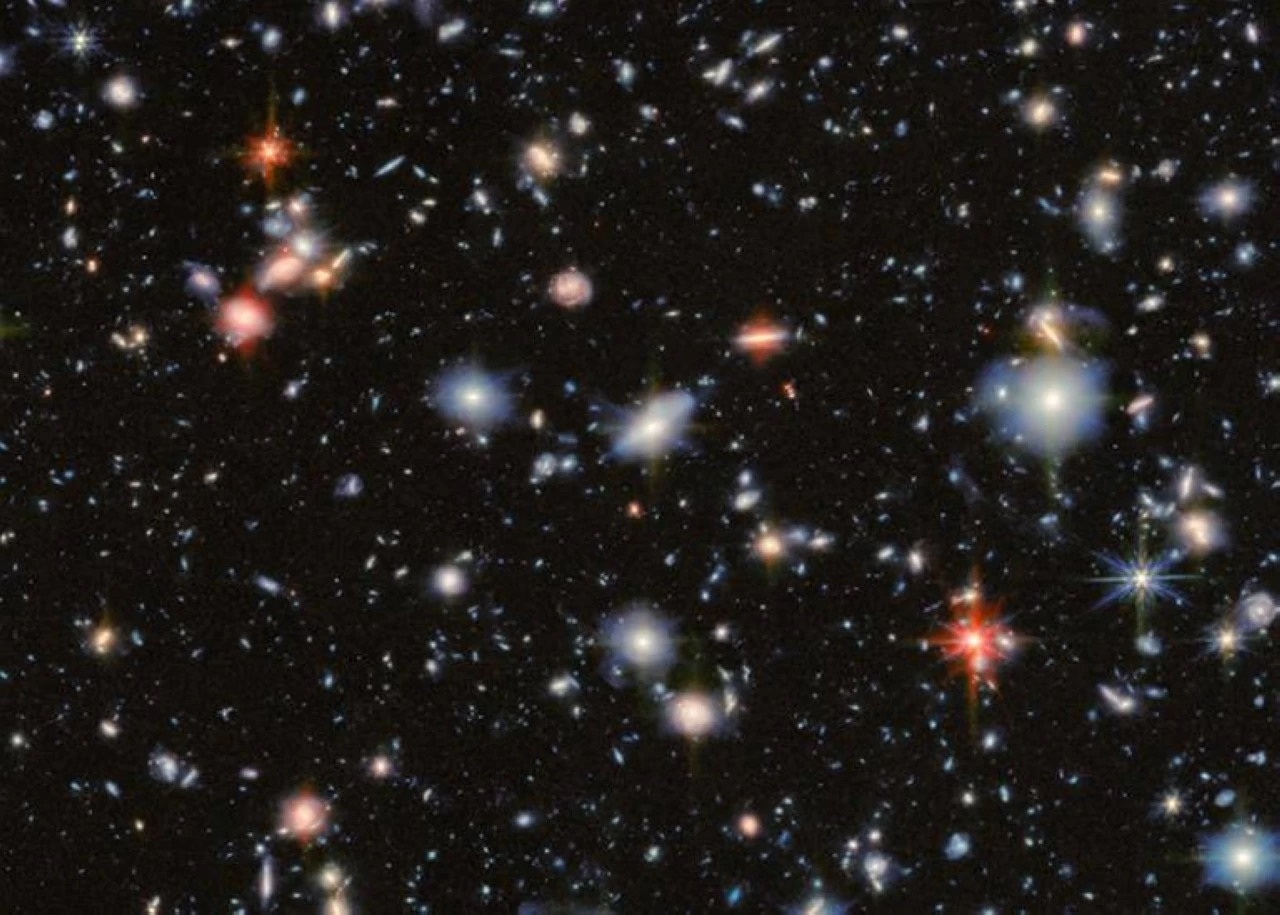


Between September 2003 and January 2004, astronomers pointed the Hubble space telescope to an apparently empty portion of the sky. 800 exposures, over 400 orbits, equaling 11.3 days of observations, revealed the empty patch was brimming with distant, faint galaxies. This Hubble Ultra Deep Field is one of the most frequently observed portions of the sky, with a number of ground and space-based telescope observing the same patch. The James Webb Space Telescope has spotted the most distant galaxies known yet, dubbed 'Little Red Dots'.
As the universe expands, the light from the earliest galaxies get increasingly redshifted. In the future, these galaxies will grow increasingly dimmer, and disappear from view. These early galaxies are full of surprises, emitting energetic ultraviolent light from newly formed massive stars. However, by the time they reach the Earth, this ultraviolet light becomes infrared light. Some of the galaxies contain black holes, which are surprising as scientists do not have an explanation of how such black holes can form so soon after the Big Bang.
The earliest galaxies are challenging our assumptions of how objects in the cosmos form and evolve. The conventional understanding is that the supermassive black holes occupying the cores of galaxies were formed through a series of mergers between smaller black holes. The earliest galaxies that already contain supermassive black holes suggest a different formation mechanism, perhaps the direct collapse of black holes from entire stellar nurseries that can produce millions of stars. Researchers have made observations of the Hubble Ultra Deep Field by Hubble, ALMA, VLT and Webb available to the scientific community. A paper describing the findings has been published in Astronomy and Astrophysics.