Sign In
By signing in or creating an account, you agree with Associated Broadcasting Company's Terms & Conditions and Privacy Policy.
By signing in or creating an account, you agree with Associated Broadcasting Company's Terms & Conditions and Privacy Policy.
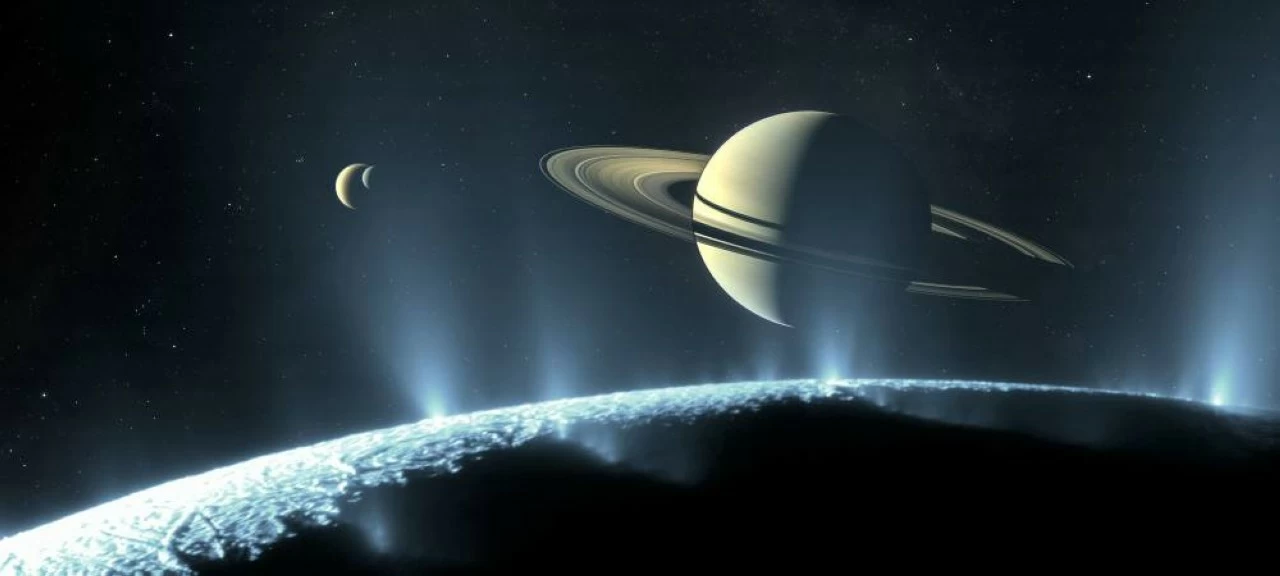


Saturn, the Jewel of the Solar System has a moon system that is among the most complex and fascinating objects hosted by the Sun. These moons range from tiny, irregular bodies to worlds that could well be planets in their own right. The Saturnian system provides an unparalleled laboratory for understanding the process of planet assembly. These moons host rich chemistry, and potentially even life forms. The moons of Saturn are believed to have formed in two ways, co-accretion along with Saturn, and by the capture of passing objects from the asteroid belt and the Kuiper belt, explaining the extreme diversity. Some ice moons are geologically active, while others are inert deserts of rock and ice.
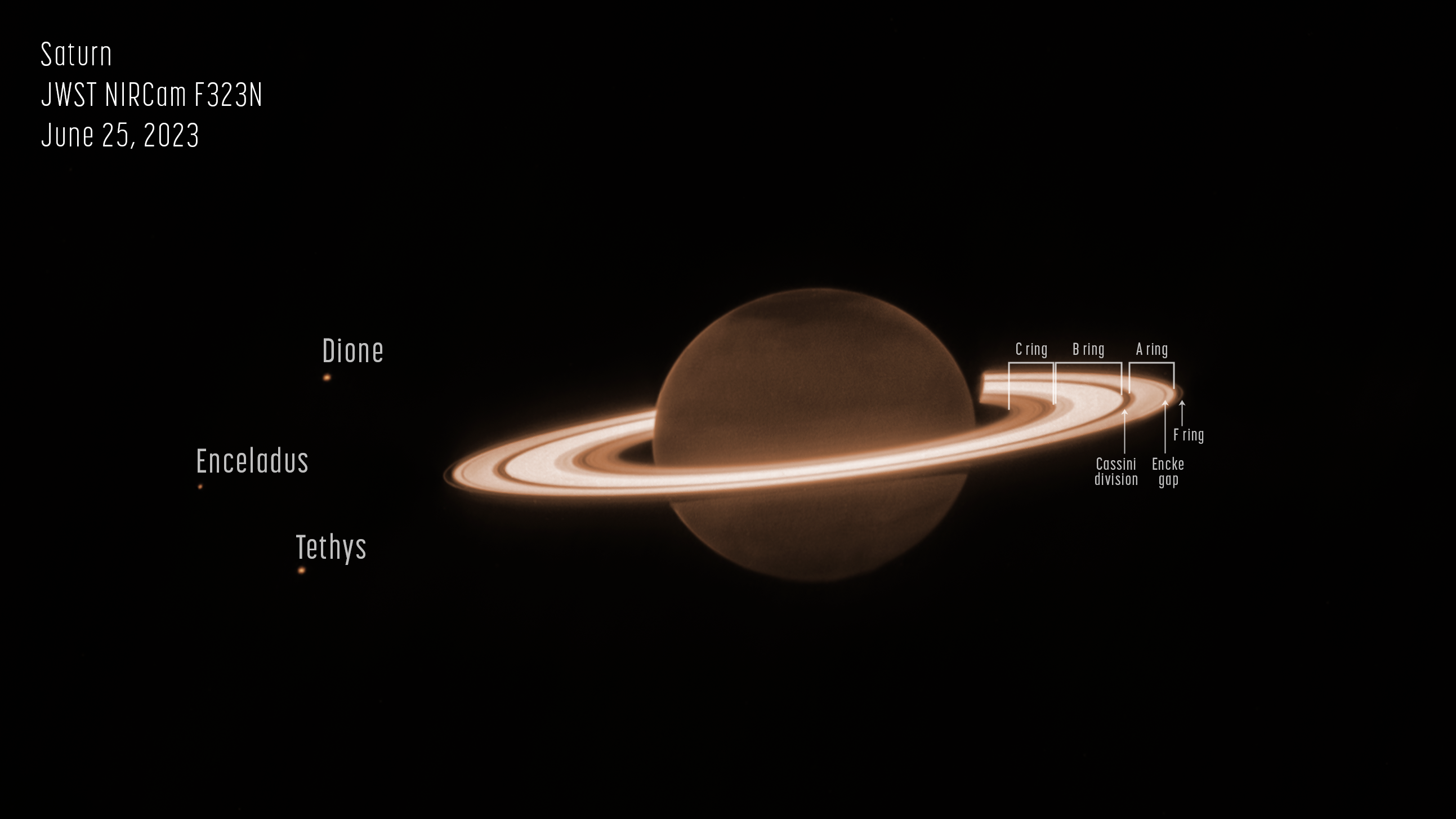
Saturn and some of its moons captured by Webb. (Image Credit: NASA, ESA, CSA, Matthew Tiscareno (SETI Institute), Matthew Hedman (University of Idaho), Maryame El Moutamid (Cornell University), Mark Showalter (SETI Institute), Leigh Fletcher (University of Leicester), Heidi Hammel (AURA); Image Processing: Joseph DePasquale (STScI)).
The smallest moonlets measure only a few hundred metres across and are embedded within the complex ring systems of Saturn. Titan is the largest moon in orbit around Saturn, and is bigger than mercury, with a diameter of 5,151 kilometres. Titan and Enceladus are spherical in shape under the influence of gravity. Other moons such as Hyperion and Phoebe have irregular shapes and chaotic orbits, hinting at a violent past where they were captured after being bombarded.
Titan is the largest moon of Saturn and is very similar to a primordial Earth, with its thick nitrogen-rich atmosphere, surface lakes of liquid hydrocarbons, and geological features shaped by flowing liquids. The temperatures on the surface hover around -179°C. Radar observations from Cassini have mapped channels, lakes dunes and even cryovolcanoes, that spews out ammonia rich water from the subsurface. Beneath the ice shell is a subsurface ocean, made up of water mixed with ammonia. The ammonia prevents the water from freezing. Titan can host an exotic life form on the surface that uses liquid hydrocarbons as a solvent, and more familiar carbon-based lifeforms in the subsurface ocean, making it a prime candidate in the search for extraterrestrial life. A complex chemical cascade takes place in the atmosphere under the influence of sunlight, leading to the generation of reddish organic solids called tholins that create an obscuring haze in the atmosphere and settle on the surface.
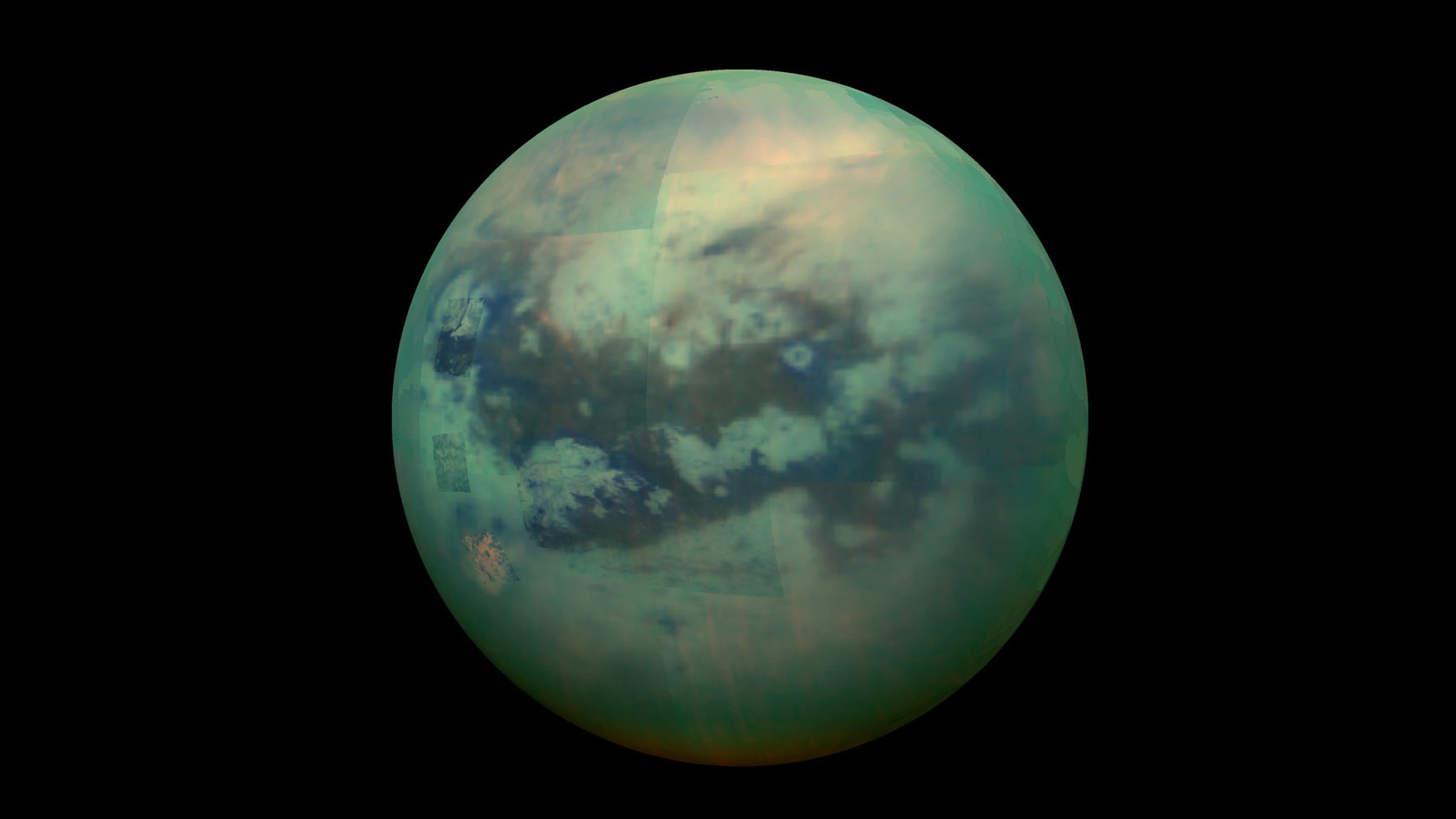
Titan may harbour two forms of life. (Image Credit: NASA).
Enceladus measures only 504 kilometres across, but has a differentiated interior, and also hosts a global subsurface ocean. Cassini spotted geysers erupting from a tortured region near the south pole called the Tiger Stripes, that are fractures spraying water vapour, ice particles, salts and complex organic molecules into space. Observations indicate that the global saltwater ocean beneath the surface is in contact with the rocky core. The seafloor hosts hydrothermal activity providing an energy source for methanogenic lifeforms that can live in the absence of sunlight.
Iapetus is also an ice moon with an equatorial ridge that rises to a height of 20 kilometres. The moon resembles a walnut and is two-toned with the leading hemisphere covered in a dark, reddish material, which is likely to be dust rich in organics originating from the outer moon Phoebe. The trailing hemisphere is composed of clean ice and is much brighter. Iapetus is a two-toned moon.
Then there is Mimas, the Death Star moon. Mimas measures 396 kilometres in diameter, with about one third of the moon covered by the giant Herschel Crater, which makes it resemble the planet-destroying superweapon from the Star Wars franchise. Mimas has a battered surface and lacks geological activity, but observations have indicated a possibility that this moon too hosts a subsurface ocean.

Some of the smaller moons of Saturn. (Image Credit: NASA).
Tethys, Dione and Rhea are all mid-sized moons with heavily cratered surfaces. The Ithaca Chasma, a canyon system, stretches over 2,000 kilometres across the surface of Tethys. Dione and Rhea preserve signs of geological activity in the past, including relics of cryovolcanism and ice tectonics. These moons may also host thinner and less active subsurface oceans. Cassini has detected tenuous atmospheres made up mostly of oxygen around both Dione and Rhea, produced by harsh ultraviolet light from the Sun breaking down the ice on the surface.
A number of small moons such as Pan, Atlas, Daphnis and Prometheus are embedded in the ring system. These moons range from 8 to 30 kilometres across, and have bizarre pancake-like shapes because of the accumulation of particles from the ring. Through gravitational interactions, these moons sculpt the edges and gaps of the ring system. Janus, Epimetheus, Pandora and Prometheus all orbit Saturn outside the ring system. All of these moons appear to be captured objects because of their chaotic orbits. These moons interact gravitationally with one another and the ring system.