Sign In
By signing in or creating an account, you agree with Associated Broadcasting Company's Terms & Conditions and Privacy Policy.
By signing in or creating an account, you agree with Associated Broadcasting Company's Terms & Conditions and Privacy Policy.
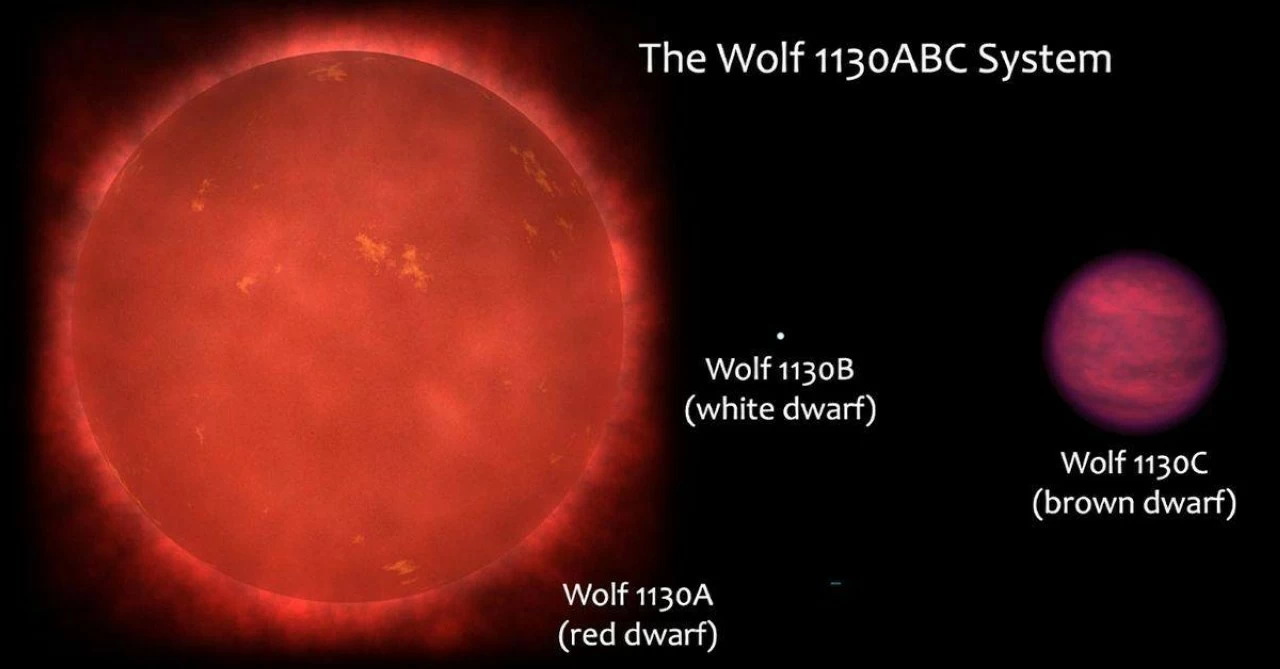


The discovery of phosphine gas in the atmosphere of a brown dwarf designated as Wolf 1130C raises more questions. The brown dwarf is part of a triple system consisting of a red dwarf star in a tight orbit around a white dwarf, the remnant core of a dead star and a tertiary brown dwarf. The triple system is located at a distance of 54 lightyears from the Sun in the constellation of Cygnus. Phosphorus is one of the key elements necessary for life as we know it on Earth, and forms phosphine when combined with hydrogen. Phosphine is a toxic and explosive gas, that has been found in the atmospheres of gas giants such as Saturn and Jupiter, but not on any other brown dwarf so far.
Phosphine gas is considered a biosignature for anaerobic life, as there are few natural sources of this gas on terrestrial worlds. The phosphine gas on the brown dwarf was spotted by the James Webb Space Telescope, which also happens to be the only astronomical instrument capable of investigating the chemical compositions of distant worlds. The mystery is not that phosphine gas was discovered on a brown dwarf, but rather why it has not been spotted in other brown dwarfs and the atmospheres of giant exoplanets. The gas forms naturally in the hydrogen rich atmospheres of gas giants such as Saturn and Jupiter.
Brown dwarfs are exotic objects sometimes called failed stars that bridge the mass gap between the largest planets and the smallest stars. Based on theory alone, astronomers expected phosphine gas to be abundant in the atmospheres of giant exoplanets and brown dwarfs, with the observations by Webb challenging these theoretical predictions, till the detection of phosphine gas in Wolf 1130C. The phosphine gas on the brown dwarf was present in the predicted theoretical abundances of 100 parts per billion. Astronomers suspect that the low abundance of metals in the atmosphere of Wolf 1130C is modifying its underlying chemistry, allowing hydrogen to form molecules with phosophorus as against oxygen. The researchers intend to investigate more metal-poor brown dwarfs for the presence of phosphine.