Sign In
By signing in or creating an account, you agree with Associated Broadcasting Company's Terms & Conditions and Privacy Policy.
By signing in or creating an account, you agree with Associated Broadcasting Company's Terms & Conditions and Privacy Policy.
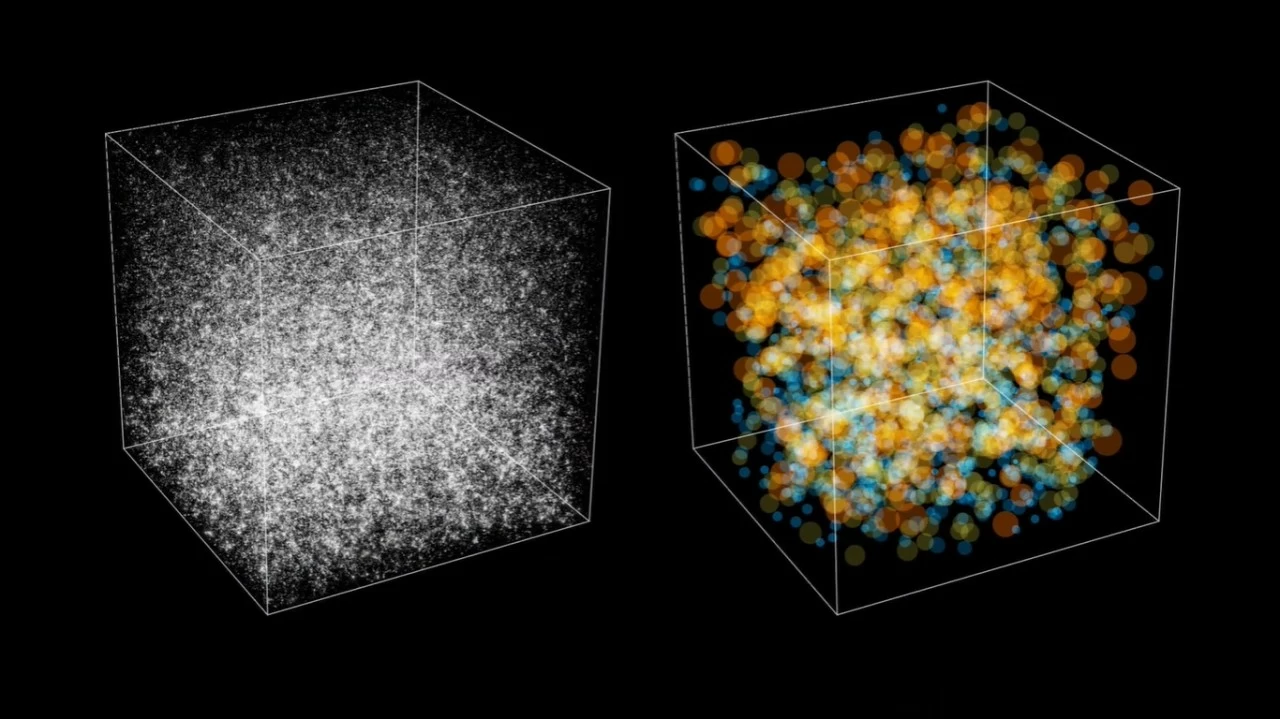


Scientists estimate that there are as many as two trillion galaxies in the observable universe. These galaxies are not scattered randomly, but are distributed across the surfaces of giant cosmic bubbles, that are several hundred million lightyears across. These bubbles are voids, and there are few galaxies found within these voids. The Milky Way may be in one of these voids. NASA's planned Nancy Grace Roman Telescope will be able to measure and map these cosmic voids in unprecedented detail, allowing scientists to get a better handle on the history of the expansion of the universe. Roman is sensitive enough to observe faint and distant galaxies, that promises to revolutionise the study of cosmic voids.
The universe is made up of regular or baryonic matter, dark matter and dark energy. The gravitational influence of baryonic and dark matter slows down the expansion of the universe, while dark energy accelerates it. The nature of both dark matter and dark energy is not understood, and better understanding the distribution of galaxies and voids across the universe can help scientists shed light on dark matter and dark energy. The research into these voids will allow scientists to put constraints on the nature of dark energy. Scientists have investigated a potential survey where Roman will look away from the plane of the galaxy. The observations have the potential of revealing thousands of cosmic voids, some as small as 20 million lightyears across.
Astronomers will use two types of data from Roman to map the voids in 3D. The positions of the galaxies in the sky, and their cosmological redshift determined using spectroscopic data. The redshift is the degree to which light from the galaxy as shifted towards the redder wavelengths because of the expansion of the universe. Based on theoretical models, most of the voids are expected to be roughly spherical in shape. NASA completed construction and full assembly of the Roman space telescope in November 2025, and is now conducting the final tests before the instrument is shopped to the launch site. NASA plans to launch Roman no sooner than May 2027 on board a Falcon Heavy Rocket, but the launch can take place as early as September 2026, as the project is ahead of schedule and under budget.