Sign In
By signing in or creating an account, you agree with Associated Broadcasting Company's Terms & Conditions and Privacy Policy.
By signing in or creating an account, you agree with Associated Broadcasting Company's Terms & Conditions and Privacy Policy.


The Earth and all the worlds in the Solar System are bathed in a steady stream of energetic particles emanating from the Sun known as the Solar Wind. Made up of electrons, protons and ions, the solar wind is driven by the high temperatures of the solar corona or outer atmosphere. The energetic particles can easily escape the gravity of the Sun, carrying a portion of the Sun’s magnetic field in a bubble outwards into space, forming the heliosphere, which extends to 100 AU from the Sun. The solar wind interacts with planetary magnetic fields and affects the space environment around planets. This solar wind is the baseline for space weather.
During the Solar Maximums, the peaks of the well-understood 11-year Solar Cycles, the number of sunspots increases. Clusters of sunspots or active regions are regions of tangled magnetic fields, that can suddenly erupt in the form of solar flares, sudden and dramatic bursts of magnetic energy. The solar flares are measured in the intensity of their X-rays, but the associated radiation is across the electromagnetic spectrum, from radio waves to gamma rays. Solar flares are caused by magnetic field lines around sunspots becoming twisted and stressed, causing them to snap and reconnect, releasing the stored energy. Solar flares can cause brief disruptions in radio communications on the sunlit side of the Earth, expose astronauts and passengers in high altitude jets to increased doses of radiation, and directly damage satellites.
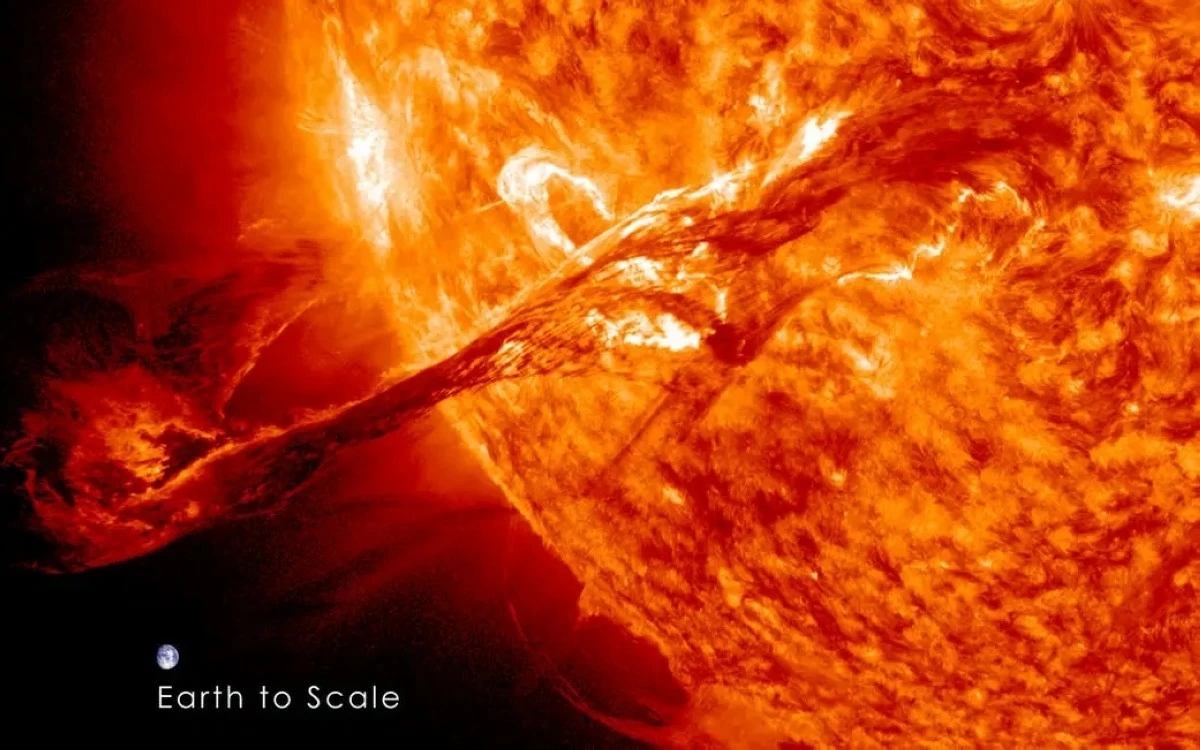
The radiation from Solar Flares reaches the Earth in about eight minutes and 20 seconds, but the energetic particles take longer. Coronal mass ejections can be associated with solar flares, where plasma from the outer atmosphere of the Sun is propelled outwards into space, at several million kilometres per hour. These coronal mass ejections can trigger geomagnetic storms on encountering the Earth, causing power blackouts, disrupting communications, degrading navigation signals, drag satellites to lower altitudes, induce spectacular displays of polar lights and confuse migrating birds.
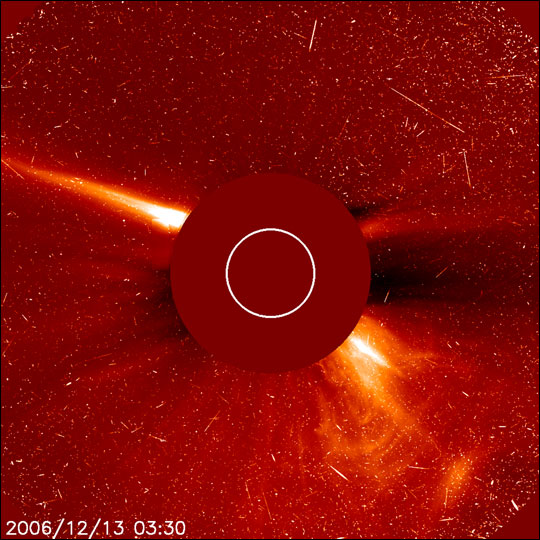
A coronal mass ejection. (Image Credit: NASA).
Coronal mass ejections, once unleashed from the Sun travel at different speeds outwards into space. They can collide, interact, merge and overtake each other in interplanetary space. The slower CMEs tend to speed up in interplanetary space, while the faster than average CMEs slow down. Modelling the three-dimensional movement of the plasma through interplanetary space is a notoriously challenging job. Determining if the coronal mass ejections will strike the Earth, and when is also difficult, which is why the space weather forecasters are even less accurate than Earth weather forecasters.
Solar flares can at times generate arcades, that are loops of plasma that extend from the photosphere or the surface of the Sun into the corona. They are held in place by the magnetic fields of the Sun but can be suddenly released, contributing to coronal mass ejections and influencing space weather. Similarly, filaments of relatively denser and cooler plasma can also be suspended in the solar atmosphere and launched outwards when they become unstable. These filament eruptions can also influence space weather and cause geomagnetic storms.
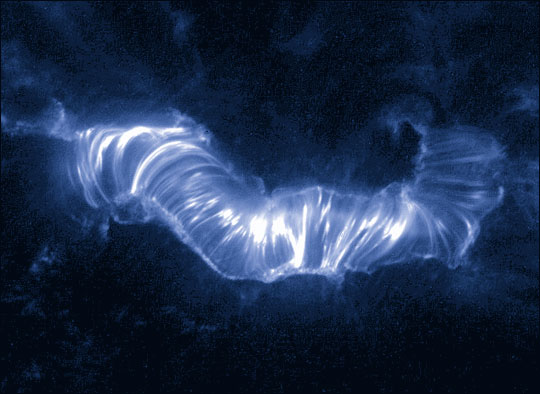
A solar arcade of magnetic loops. (Image Credit: NASA).
Coronal holes are regions of the solar corona where the magnetic field is open, instead of looping back to the surface. These are visible as vast dark regions on the Sun, much larger than sunspots. The energetic particles from the Sun continuously stream outwards from coronal holes. This stream is stronger than the solar wind, but not as chaotic or energetic as coronal mass ejections. These coronal holes are more common during the solar minimum. Coronal holes can produce high speed streams (HSS), that can cause geomagnetic storms when passing over the Earth.
The solar flares, filament eruptions, high speed streams from coronal holes, and coronal mass ejections all impact the Earth in different ways and at different times. The initial burst of radiation from solar flares strikes the Earth in eight minutes and 20 seconds. With current technology, it is only possible to forecast a probability for an intense flare, and not possible to provide early warning alerts. Solar Particle Events are bursts of high energy particles, mostly protons that are accelerated by both solar flares and CMEs. These particles can travel at nearly the speed of light, and can damage the sensitive electronics in spacecraft. There are also electron storms, that are much rarer.
Coronal mass ejections and high speed streams induce geomagnetic storms on encountering the geomagnetic field of the Earth. These storms can last for days, or even weeks. Geomagnetic storms can disrupt most of the technologies that the modern human civilization relies on. These are the regular gamut of solar storms that the Earth can be expected to face. However, there have been six recorded solar superstorms over the past 15,000 years. The last of these occurred over a millennium ago, and are known as Miyake Events. The technologies on Earth are not fortified against such extreme solar superstorms.