Sign In
By signing in or creating an account, you agree with Associated Broadcasting Company's Terms & Conditions and Privacy Policy.
By signing in or creating an account, you agree with Associated Broadcasting Company's Terms & Conditions and Privacy Policy.
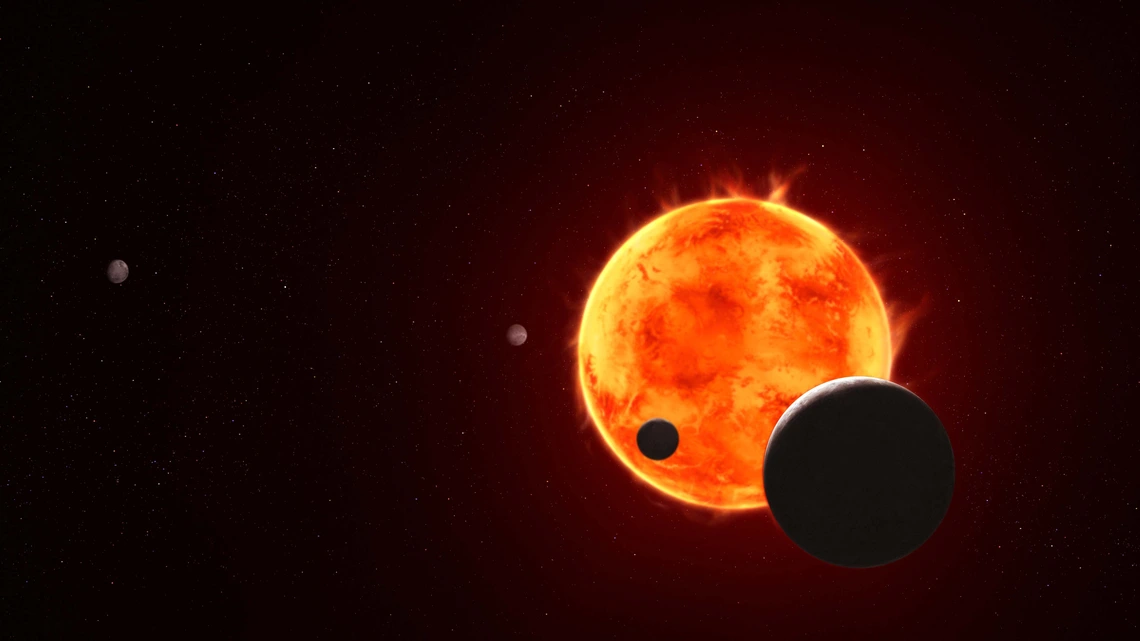

The James Webb Space Telescope has investigated the exoplanet Trappist-1 e during a series of four transits, as the rocky exoplanet passed in front of its host star from the vantage point of the Earth. The technique looks for light from the host star filtered through the atmosphere of the transiting exoplanet, if it has one, which is then examined to figure out the chemical inventory of the atmosphere. As a rocky planet in the habitable zone around an ultracool red dwarf star, the understanding was that if Trappist-1 e has an atmosphere at all, it is habitable.
The results have been published in a series of papers in The Astrophysical Journal Letters. The first paper rules out a thick, hydrogen-dominated atmosphere with clouds. The second paper argues that it is possible for the data to be consistent with a nitrogen-rich atmosphere, along with traces of carbon dioxide and methane. Now the host star, Trappist-1 is much cooler and smaller than the Sun, with the temperature low enough for the star itself to contain gas molecules in its atmosphere. It is unclear if the methane signal originated from the star or the exoplanet. A third paper dives into the complexity of the method, and calls for caution when it comes to interpreting the findings.
The James Webb Space Telescope has moved the field of exoplanet science from an era of discovery to one of characterisation. Because of the exquisite sensitivity of the deep space observatory, it is possible to investigate the atmospheres of exoplanets, as against merely discovering them. There are two methods to investigate exoplanet atmospheres, the transit method and the secondary eclipse method, where the exoplanet being studied passes behind the host star. The Webb Space Telescope was not designed to investigate worlds as small as Trappist-1 e. The researchers plan to conduct follow-up observations using the dual transit method, where the system will be observed during the transit of two planets, Trappist-1 e and Trappist-1 b passing in front of the host star at the same time. The inner world is known to lack an atmosphere.