Sign In
By signing in or creating an account, you agree with Associated Broadcasting Company's Terms & Conditions and Privacy Policy.
By signing in or creating an account, you agree with Associated Broadcasting Company's Terms & Conditions and Privacy Policy.
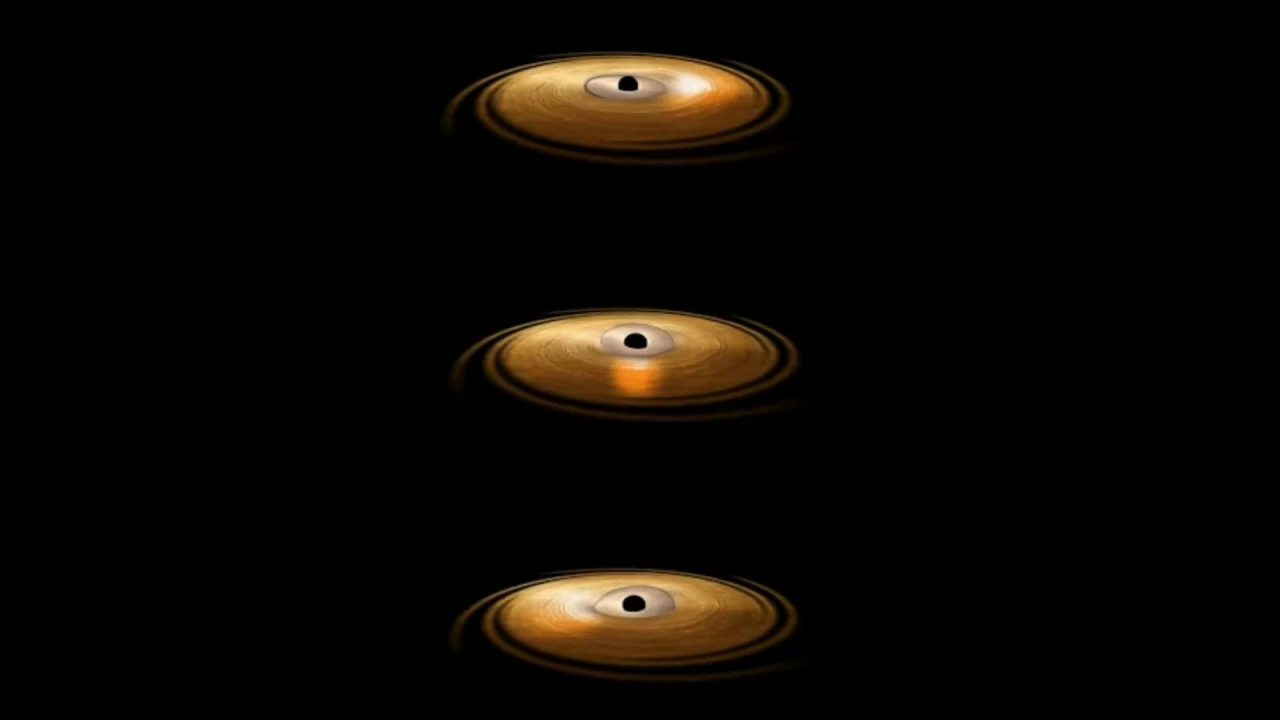


Astronomers have observed wobbles in the inner accretion disk of a black hole for the first time. The process is known as frame-dragging or the Lense-Thirring precession and describes how black holes drag nearby objects such as stars, inducing instabilities in their orbits. The research is based on examination of a tidal disruption event designated as AT2020afhd where a star was torn apart after wandering too close to a black hole. The star was spaghettified, and stretched out into a swirling disk around the black hole.
Some of the infalling material was channeled by the tangled magnetic fields produced by the accretion disk itself into relativistic polar jets, with the material from the shredded star moving at nearly the speed of light. By tracking rhythmic changes in both the X-rays and radio signals from the source, the team of astronomers observed that both the disk and the jet were wobbling in unison with a periodicity of 20 days. The observations confirm a prediction of General Relativity, first proposed by Albert Einstein in 1913 and mathematically described by Lense and Thirring in 1918.
A paper describing the research has been published in Science Advances. One of the study authors Cosimo Inserra says, "Our study shows the most compelling evidence yet of Lense-Thirring precession – a black hole dragging space time along with it in much the same way that a spinning top might drag the water around it in a whirlpool. Unlike previous TDEs studied, which have steady radio signals, the signal for AT2020afhd showed short-term changes, which we were unable to attribute to the energy release from the black hole and its surrounding components. This further confirmed the dragging effect in our minds and offers scientists a new method for probing black holes."