Sign In
By signing in or creating an account, you agree with Associated Broadcasting Company's Terms & Conditions and Privacy Policy.
By signing in or creating an account, you agree with Associated Broadcasting Company's Terms & Conditions and Privacy Policy.
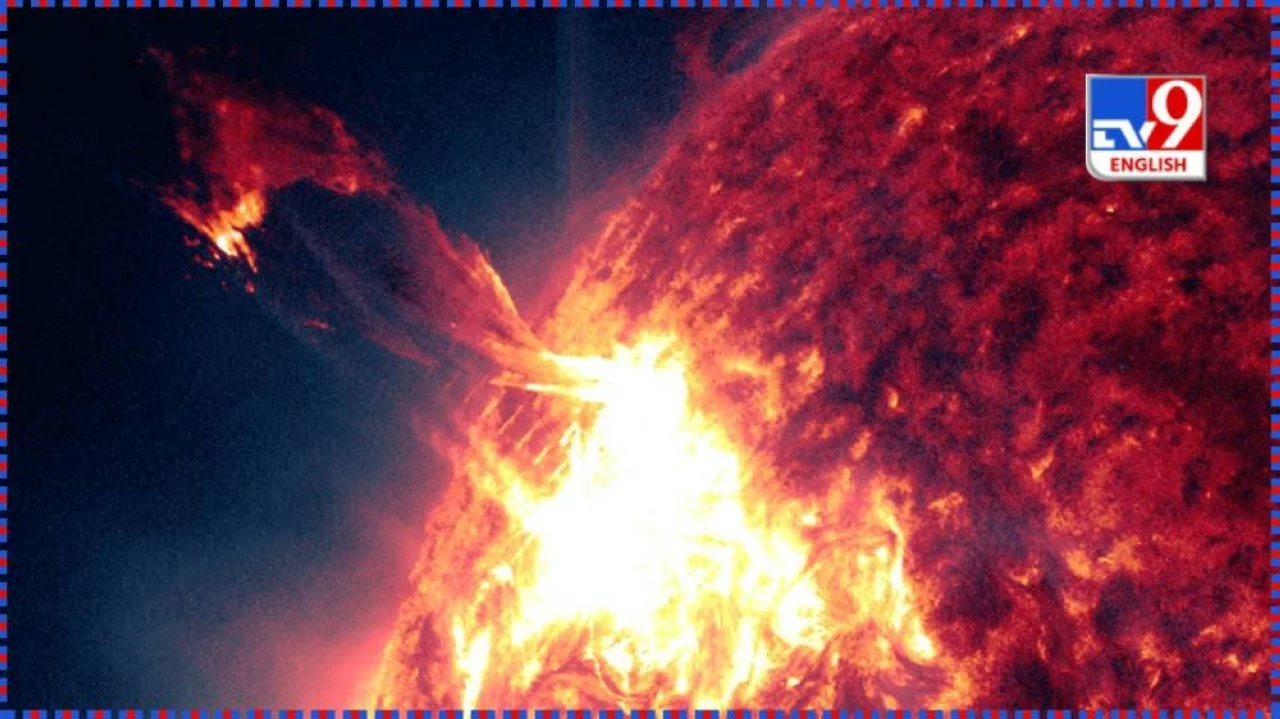


An X1.8 flare was spotted erupting from the Sun, peaking at 17:30 hours IST on 4 November, 2025. The flare is associated with the SIDC Sunspot Group 687 or the NOAA Active Region 4274. The Solar Influences Data Analysis Centre (SIDC) is operated by the Royal Observatory of Belgium while the National Oceanic and Atmospheric Administration (NOAA) is US based and operates the Space Weather Prediction Centre (SWPC), which issued an alert for a strong radio blackout on the sunlit side of the Earth. Navigation signals were also degraded for about an hour. There is a fast CME associated with the flare, but it is not directed towards the Earth, but the modelling is ongoing.
According to the SWPC, "The associated partial halo CME has been modelled with a velocity between 700-800 km/s. Based on its position in the NE, the bulk of the ejecta is likely to pass behind Earth but model analysis will confirm when it becomes available. The Region continues to exhibit sheer across its intermediate region producing a complicated magnetic field. It has been the primary producer of most of the flare activity throughout the period." The active region grew on the far side of the Sun and has now rotated into view. It's size and complexity indicates that it will continue to fire solar flares over the next week.
According to the analysis by the UK Met Office, "There has been continued growth of the sunspot, particularly in its trailing region and evidence of a complex magnetic configuration in the northwest portion of the main lead spot." According to the Australian Space Weather Forecasting Centre, "A northeast-directed CME was observed, visible in LASCO C2 coronagraph imagery from 04/1736UT. This CME is considered to be associated with the aforementioned X1.8 flare from AR4274. Modelling indicates this CME does not contain a significant Earth-directed component." According to the SWPC, "Probabilities have increased to 65 per cent for R1-R2 (Minor-Moderate) and 15 per cent for R3 (Strong) due to the continued activity and complex structure of Region 4274." Hopefully, there is some severe space weather ahead.