Sign In
By signing in or creating an account, you agree with Associated Broadcasting Company's Terms & Conditions and Privacy Policy.
By signing in or creating an account, you agree with Associated Broadcasting Company's Terms & Conditions and Privacy Policy.



Xenotransplantation is the process of transplanting organs, tissues or cells from one species to another. Most of the ongoing research is focused on transplanting pig organs to humans. Pigs are suitable donors because their organs are similar in size to human organs, and they reproduce quickly, allowing large numbers to be raised. The primary barrier is the human immune system, which recognises the pig tissues as foreign, and attacks them. This results in hyperacute rejection within minutes to hours, triggered by antibodies against pig carbohydrates. Without modifications, xenografts rapidly fail.
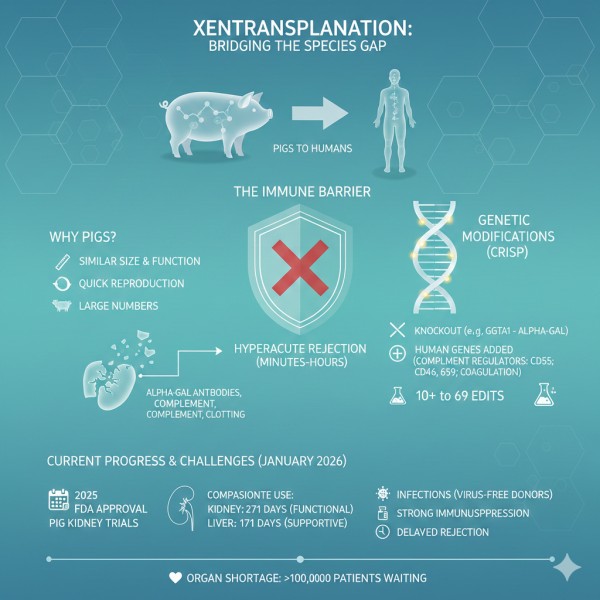
To overcome rejections, scientists are using gene editing tools such as CRISPR to alter pig DNA. The crucial changes including knocking out certain genes, especially ones associated with producing carbohydrates, to reduce binding by human antibodies. Human genes are added to express proteins, to control coagulation and inflammation. Pigs with 10 or more edits, sometimes up to 69, have been created by companies such as eGenesis and United Therapeutics. These modifications greatly reduce hyperacute rejection, and extend graft survival in preclinical tests on non-human primates, and some early human cases.
In 2025, the US FDA approved initial clinical trials for pig kidney xenotransplantations following compassionate use cases where gene-edited pig kidneys functioned in living patients for months, with one case reaching 271 days before removal due to declining function. A pig liver xenotransplant supported a patient for 171 days. These results demonstrate that xenografts can perform key functions such as filtration or metabolism. However, there are challenges, including delayed rejection, infections from pig viruses (that can be prevented by gene edits), and the need for strong immunosuppression, that can make the host vulnerable to diseases. The ongoing trials are aimed at improving long-term outcomes and address the organ shortage affecting over 10 million people worldwide.