Amazon unveils Nova 2 AI models and frontier agents to automate software work
Amazon has introduced four new Nova 2 models along with Nova Forge and new frontier agents like Kiro, AWS Security Agent and AWS DevOps Agent. These tools aim to automate coding, security checks and operations while improving accuracy and multimodal reasoning. Companies including Reddit, Hertz and Commonwealth Bank are already testing the new services.
AWS expanded its Nova portfolio with four new models and a service to build custom versions.
New Delhi: Amazon is doubling down on its own AI stack with a big expansion of its Nova models and a new wave of AI agents that the company calls “frontier agents.”
The update covers almost everything an engineering team touches in a day, from writing code and scanning security issues to automating browser clicks for boring web work.
Nova 2 Lite and Pro target everyday and heavy AI workloads
At the core of the update is the Nova 2 model family. Amazon says tens of thousands of companies already use Nova for content, task automation and AI agents.
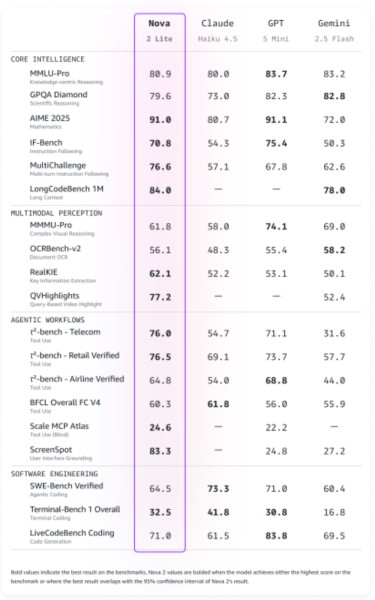
Nova 2 Lite is pitched as a fast and lower cost reasoning model that takes text, images and video as input and responds with text. Amazon describes it as useful for customer service chatbots, document workflows and business automation. According to the blogpost, Nova 2 Lite is “equal or better on 13 out of 15 benchmarks compared to Claude Haiku 4.5, equal or better on 11 out of 17 benchmarks compared to GPT-5 Mini, and equal or better on 14 out of 18 benchmarks compared to Gemini Flash 2.5.”
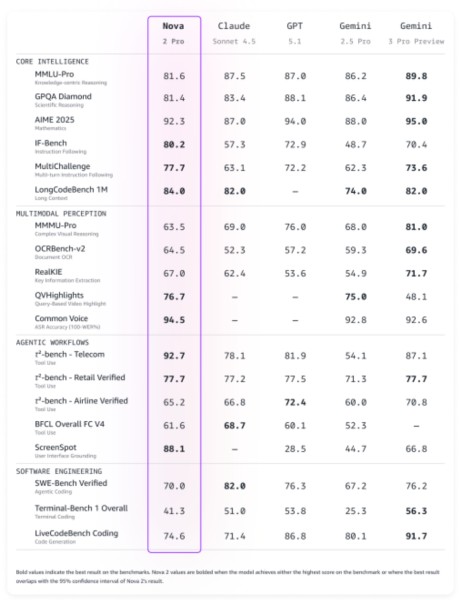
Nova 2 Pro sits at the top end. It handles text, images, video and speech, and is aimed at tricky work like agentic coding, long range planning and complex problem solving. Amazon says Nova 2 Pro is “equal or better on 10 out of 16 benchmarks compared to Claude Sonnet 4.5, equal or better on 8 out of 16 benchmarks compared to GPT-5.1, equal or better on 15 out of 19 benchmarks compared to Gemini 2.5 Pro, and equal or better on 8 out of 18 benchmarks compared to Gemini 3 Pro Preview.” Both Lite and Pro have built in web grounding and code execution, so they can pull fresh information and run snippets of code rather than rely only on training data.
Sonic and Omni push voice and multimodal use cases
On the media side, Nova 2 Sonic and Nova 2 Omni push deeper into voice and multimodal AI.
Nova 2 Sonic is a speech to speech model that handles both understanding and generating voice in real time. Amazon highlights expanded multilingual support, expressive voices and a context window of one million tokens. It can flip between voice and text and is wired to work with Amazon Connect and providers like Vonage, Twilio and AudioCodes. The company positions it for customer service and assistants that live on phone lines.
Nova 2 Omni is the most ambitious piece. It is described as “a unified multimodal reasoning and generation model that can process text, images, video, and speech inputs while generating both text and images.” It can work across very long inputs, from hours of audio to hundred page documents, and is meant to avoid stitching many smaller models together. Marketing teams, for example, could feed it product catalogs, testimonials and video material and ask for full campaign assets in one workflow.
Nova Forge lets companies build their own “Novellas”
Alongside the models, Amazon announced Nova Forge, a service that lets organisations train their own variants of Nova that it calls “Novellas.” The idea is to mix a company’s proprietary data with Amazon’s frontier models at several points in the training pipeline.
The blog explains that Nova Forge gives access to “pre-trained, mid-trained, and post-trained Nova model checkpoints so customers can mix their proprietary data with Amazon Nova-curated datasets at every stage of model training.” It also describes three extra features. Customers can train models in custom “gyms,” synthetic environments that simulate real use cases, create smaller and faster models through distillation, and use a responsible AI toolkit.
Reddit is one of the early users. “Working with Nova Forge is allowing us to improve content moderation on Reddit with a more unified system that's already delivering impressive results,” said Chris Slowe, CTO, Reddit. He added that replacing multiple specialised workflows with one “marks a shift in how we implement and scale AI across Reddit.”
Nova Act and frontier agents aim to act like team members
For teams that live inside web apps all day, Amazon has introduced Nova Act. It is an AWS service for building AI agents that take actions in a browser using a custom Nova 2 Lite model. According to the company, Nova Act “delivers 90% reliability on early customer workflows and outperforms competing models on relevant benchmarks.” Early users include Sola Systems, 1Password, Hertz and Amazon’s own Leo team for QA workloads.
On top of that, AWS is moving into what it calls “frontier agents” with three named products. Kiro autonomous agent focuses on software development, AWS Security Agent focuses on security, and AWS DevOps Agent focuses on operations.
Kiro is built on the earlier Kiro coding tool and is meant to move from small suggestions to long running coding tasks. AWS CEO Matt Garman told the audience at re:Invent, “You simply assign a complex task from the backlog and it independently figures out how to get that work done.” He also said, “It actually learns how you like to work, and it continues to deepen its understanding of your code and your products and the standards that your team follows over time.” Amazon says Kiro keeps “persistent context across sessions” so it can work for hours or days with few interruptions.
AWS Security Agent is aimed at design reviews, pull request checks and penetration testing. SmugMug staff software engineer Andres Ruiz said, “AWS Security Agent helped catch a business logic bug that no existing tools would have caught, exposing information improperly,” and called its ability to read API responses and find unexpected data “a leap forward in automated security testing.”
AWS DevOps Agent tries to act like an on call engineer. It taps into tools like CloudWatch, Datadog, New Relic and Splunk, learns how resources connect and looks for root causes during incidents. Jason Sandery, head of cloud services at Commonwealth Bank of Australia, said, “AWS DevOps Agent thinks and acts like a seasoned DevOps engineer, helping our engineers build a banking infrastructure that’s faster, more resilient, and designed to deliver better experiences for our customers.”
For developers, security teams and ops engineers, this stack of Nova models, Nova Forge and frontier agents shows how strongly Amazon wants AI to sit inside everyday workflows, not just in demo videos. How far teams in India and elsewhere are ready to trust these systems over long runs is the next question.