New Delhi: White House deputy chief of staff Stephen Miller on Monday raised a political storm when he said that Greenland should be part of the United States. "The president has been clear for months now that the United States should be the nation that has Greenland as part of our overall security apparatus," Miller said during an interview with CNN Monday afternoon.
Miller’s comments came after the Danish leader, together with Greenland's prime minister and other European leaders, firmly rejected Trump's renewed call for the island to come under US control. Renewed fears for US accession of Greenland have arisen after the military operation done by it in
Venezuela.
The battle for Greenland
US President Donald Trump has consistently been insistent on his demand of acquiring
Greenland due to its ‘strategic importance’ to the US. Trump has argued the US needs to control Greenland to ensure the security of NATO territory in the face of rising threats from China and Russia in the Arctic.
"It's so strategic right now," Trump told reporters on Sunday. "Greenland is covered with Russian and Chinese ships all over the place," he further added. Since the start of his second Presidential term, Trump has made similar comments on Greenland, openly stating his intention of ‘buying’ or ‘acquiring’ the country. Many see Trump’s intentions of acquisition related not just to US national security but also to the country’s significant mineral deposits.
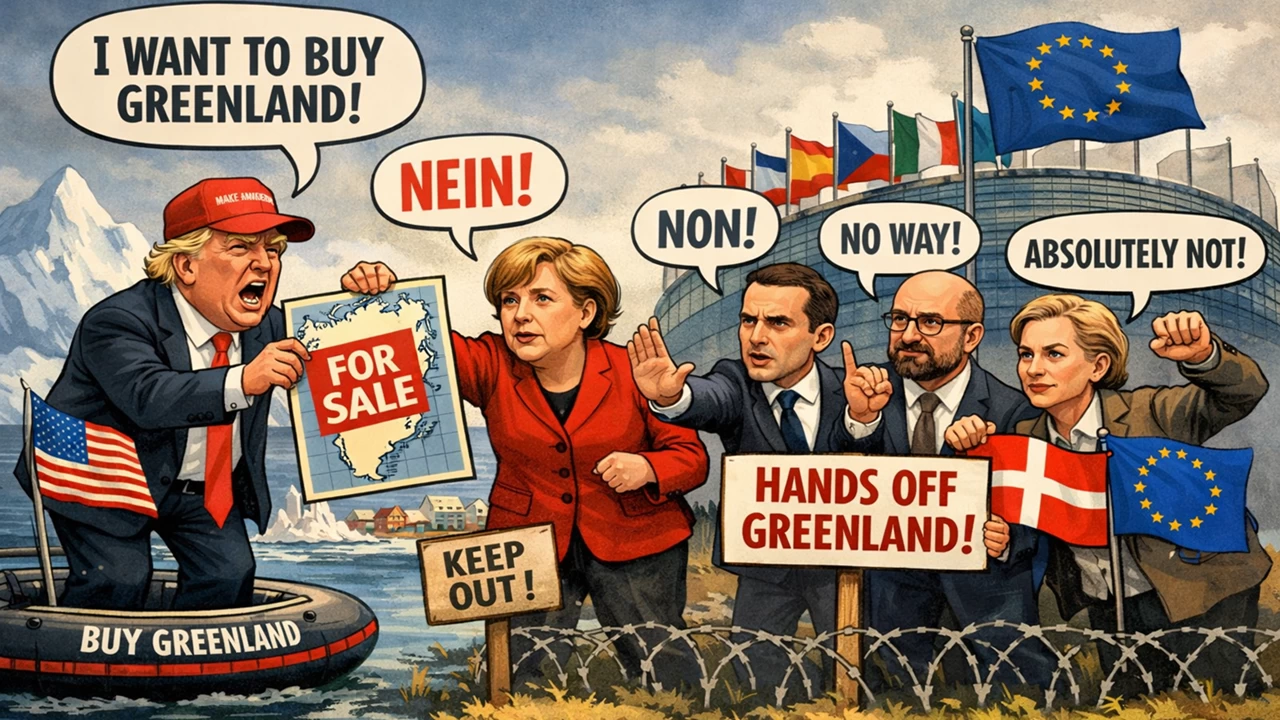
Trump’s comments though have not been welcomed in either Denmark or Greenland, both of which have stated that a country's borders and sovereignty are determined by international law. Several European leaders also pushed back on Tuesday against Donald Trump's comments. The leaders issued a statement reaffirming the strategic, mineral-rich Arctic island "belongs to its people."
The West resists, looks to react
The leaders of France, Germany, Italy, Poland, Spain and the United Kingdom joined Danish Prime Minister Mette Frederiksen in defending
Greenland's sovereignty after Trump's Greenland comments. They reiterated their commitment to ensure self-governing territory of the kingdom of Denmark and thus keep it part of the NATO military alliance.
"Greenland belongs to its people," their statement read. "It is for Denmark and Greenland, and them only, to decide on matters concerning Denmark and Greenland." The NATO statement further reads, “Security in the Arctic must therefore be achieved collectively, in conjunction with NATO allies including the United States, by upholding the principles of the UN Charter, including sovereignty, territorial integrity and the inviolability of borders.”
Canadian Prime Minister Mark Carney also took to X sharing his views on the issue, saying, “Canada and Denmark are Allies and partners in our shared responsibility for the security and resilience of the Arctic. As I reaffirmed to PM Frederiksen today, Canada will always support the sovereignty and territorial integrity of Denmark, including Greenland. Together, we’ll keep working to secure peace in Ukraine and across Europe.”
With such opposition, Trump’s plans of expansion do not look like aligning with many of his allies, particularly those in Europe and even with neighbours like Canada. The US President is thus looking at managing a tricky situation where he might have to balance his own imperialistic aspirations while placating the anxieties of his European allies at the same time. The pushback from Europe on the issue of Greenland though is clear and they can well look at exploring other options if Trump continues with his stated intentions in regards to acquiring Greenland.
Europe may thus look to come up with a collective response against Trump’’s expansionist and assertive geopolitical approach. It is most likely to center on reinforcing NATO’s institutional resilience while simultaneously reducing strategic dependence on the United States. Accelerating defense integration initiatives within the EU and increasing national military spendings may be another way in which Europe would be forced to deal with Trump’s increasingly imperialistic streak.
The moment though is extremely critical for the relationship between the US and Europe, which have traditionally been seen as being aligned on multiple important foreign policy issues. It is Trump’s recent cascading rhetoric of aggression that has emplaced a renewed anxiety in Europe and American neighbours like Canada as to the level of trust and engagement with the US is currently feasible. While what action Trump might initiate in Greenland may soon be known, what is clear is a recalibration from Europe on American commitment to a collective cause and security is imminent.